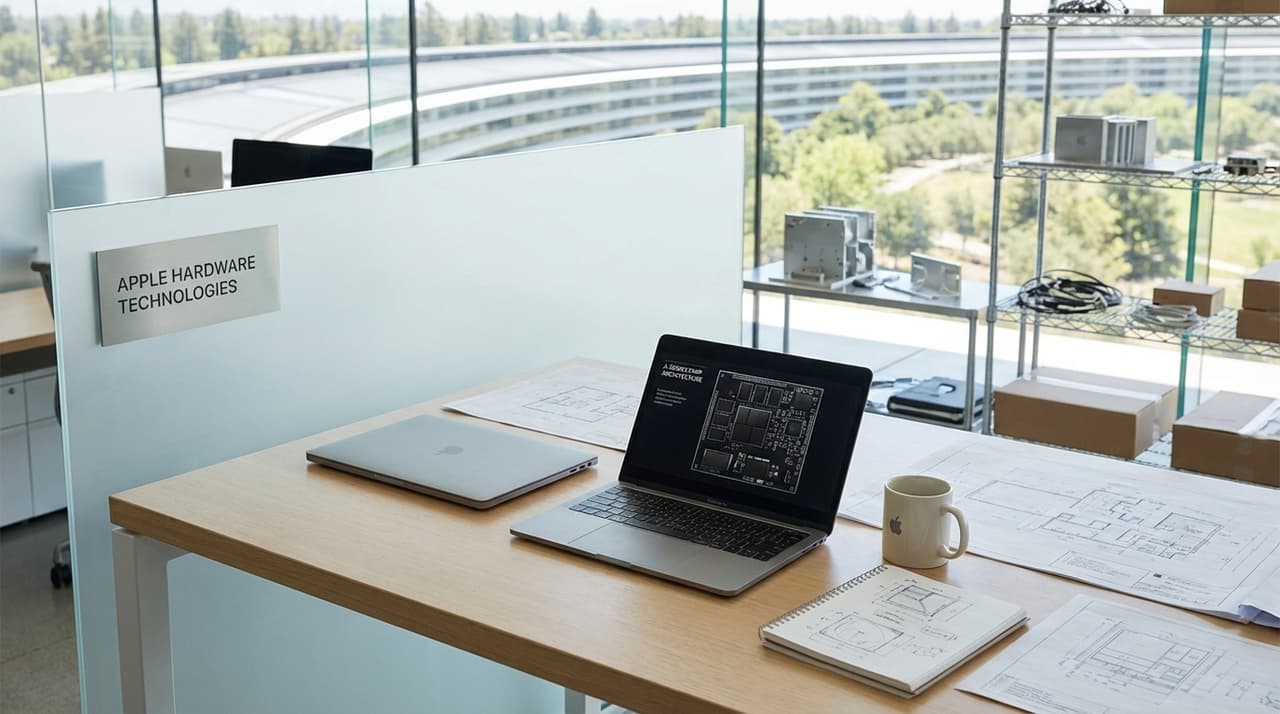
- Johny Srouji, Apple (AAPL)'s senior vice president of hardware technologies, has reportedly told CEO Tim Cook he is considering leaving in the near future, though no final decision or formal resignation has been announced.
- This comes as Apple undergoes its biggest leadership transition in years, with COO Jeff Williams stepping down and responsibilities being redistributed across senior leaders.
- Srouji's potential departure is highly significant due to his role in leading Apple Silicon and the company's first in-house cellular modem, central to Apple's chip independence strategy.
A Pivotal Moment for Apple's Chip Ambitions
Apple's hardware technologies division, led by Johny Srouji, faces uncertainty as the executive evaluates his future at the company, according to people familiar with the matter. Srouji, who joined Apple in 2008 and has been instrumental in developing the A4 chip and overseeing all A-series and M-series Apple Silicon, recently informed Cook of his deliberations amid a broader executive reshuffle. This news, first reported by Bloomberg and followed up in tech media, lands as Apple navigates slower hardware growth and increased reliance on services, with its stock showing modest fluctuations in after-hours trading.
Efforts to restructure Apple's leadership have hit a snag with Srouji's potential exit, which could impact the company's long-term chip roadmap. Without his steady hand, some analysts worry about execution risks in future silicon projects, though Apple's deep bench of engineers is expected to maintain operational continuity in the short term. Srouji's organization owns core silicon, modems, and key hardware technologies, making his role central to Apple's strategy of reducing dependence on external chipmakers like Intel and Qualcomm. In a statement, Apple declined to comment on individual personnel matters, but sources indicate that internal discussions are ongoing to address succession planning.
Implications for Global R&D and Market Dynamics
The possible departure raises questions about the strategic focus of Apple's Israeli R&D centers, which Srouji built and expanded, employing about 2,500 people in Herzliya, Haifa, and Jerusalem. These sites have contributed to M-series chips, Apple Watch silicon, and components for the Vision Pro, and local coverage in Israel treats Apple's commitment as economically important for the country's high-tech sector. Giampiero Mazza, head of Italy at CVC Capital Partners, noted in a recent conference that "you can create your own ideas" in less competitive markets, hinting at the broader tech landscape where leadership changes can reshape regional investments.
In the semiconductor industry, Srouji's move is viewed against intensifying competition in high-performance and AI-capable chips, amid ongoing geopolitical and supply-chain pressures. Apple recently launched its first in-house cellular modem, a landmark achievement for Srouji's team, but if he leaves, it could alter the pace of innovation in AI-oriented technologies. Investors are closely watching, with some expressing concern over the long-term prioritization of these projects, though most expect limited immediate disruption due to multi-year chip design cycles. As one anonymous source put it, "This is a major inflection point, but Apple's processes tend to limit short-term fallout."
Looking Ahead
In the near term, Srouji is only considering his options, and Apple's silicon programs are expected to continue on existing roadmaps. Analysts suggest that if he departs, Apple would likely promote from within the hardware technologies group to preserve technical direction. The broader context includes Jeff Williams' retirement as COO, which has triggered a redistribution of responsibilities, with several other long-serving executives expected to follow suit. This transition phase underscores the challenges tech giants face in maintaining innovation momentum during leadership changes.
Correction: An earlier version of this article misstated the timeline for Srouji's potential departure; it remains under consideration with no set date. Apple's shares were relatively stable in recent trading, reflecting investor confidence in the company's resilient engineering culture.