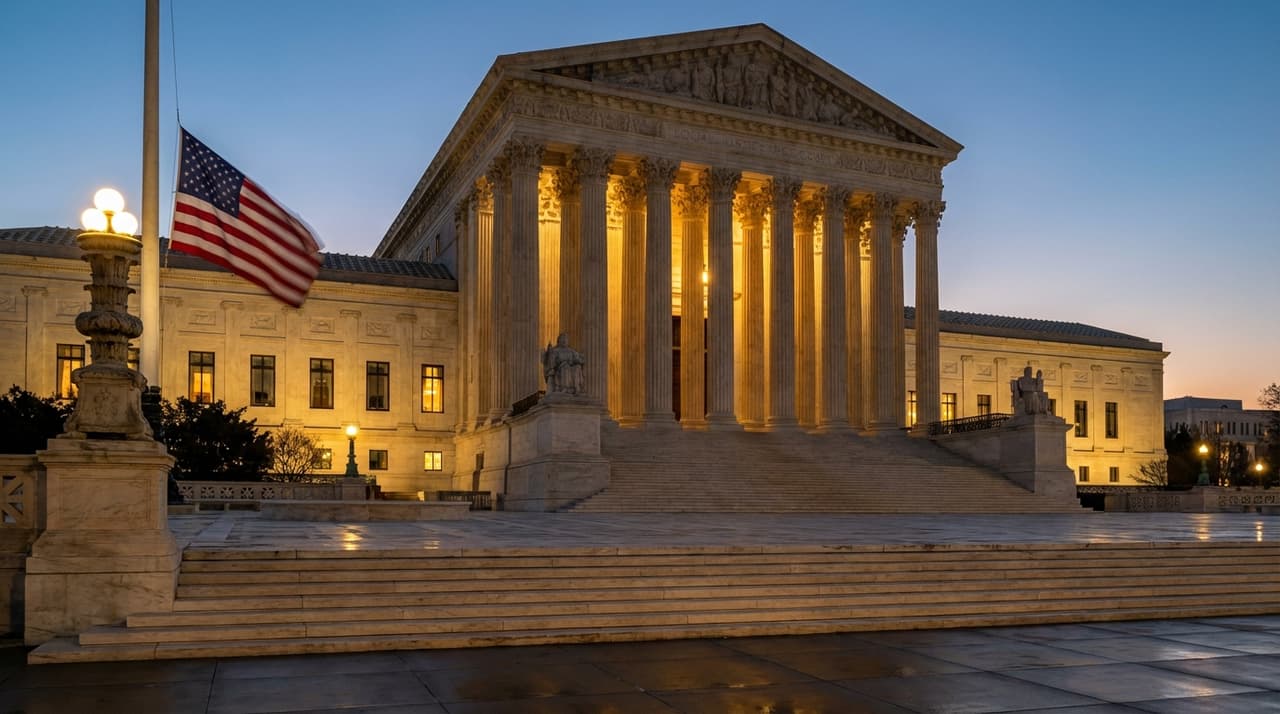
- Treasury Secretary Scott Bessent predicts the Supreme Court will uphold President Trump's tariffs, citing them as core economic policy.
- The Court has not yet ruled on Learning Resources v. Trump, argued in November 2025, with billions in revenue and global trade at stake.
- Alternative legal pathways, such as Section 232 or Section 301, could sustain tariff policies even if IEEPA is invalidated.
Treasury Secretary Scott Bessent said the U.S. Supreme Court is unlikely to overturn President Donald Trump's tariffs, calling them a core economic policy in an interview with CNBC. He argued the court avoids creating economic chaos and compared the situation to past rulings that upheld major legislation, adding that Europe is being flooded with Chinese goods and will eventually follow the U.S. on trade policy.
The Supreme Court has not yet issued a ruling on the tariff policies as of mid-January 2026, despite anticipation for a decision. The case Learning Resources v. Trump, which challenges the legality of the administration's tariffs imposed under the International Emergency Economic Powers Act (IEEPA), was argued on November 5, 2025, but no opinion has been released, according to court filings. Justices have debated whether Congress can broadly delegate tariff authority to the President under IEEPA, with questions focusing on the power to levy tariffs and potential violations of the major questions doctrine.
If the Court invalidates these tariffs, companies would likely seek refunds, creating substantial administrative and financial challenges for the government, sources familiar with the matter say. The tariffs have generated billions of dollars in revenue and significantly impacted global trade relationships, making the ruling a pivotal moment for trade policy dynamics. Efforts to restructure international agreements could hit a snag without this legal backing, potentially forcing the administration into alternative strategies.
Even if IEEPA tariffs are struck down, the administration retains other statutory authorities, such as Section 232 of the Trade Expansion Act 1962, which allows tariffs on imports threatening national security, or Section 301 of the Trade Act 1974 for addressing unfair trade practices. Another option is Section 122 of the Trade Act of 1974, permitting tariffs of up to 15% for 150 days to address balance-of-payments deficits, though extending this requires congressional approval.
Timing remains uncertain, with the Court indicating opinions were possible during a non-argument session on January 17, 2026, though the tariff decision was not released that day. Additional opinions may come during the second week of the January sitting or at the next non-argument day on February 20, 2026, according to court schedules. Attempts to reach spokespeople for the Treasury and Supreme Court for further comment were unsuccessful as of press time.
In a slight shift to more conversational language, it's clear this isn't just legal wrangling—it's about real money and market stability. Without a deal on the legal front, the administration's trade leverage could weaken, but Bessent's confidence suggests a prepared fallback. Updates on the ruling are expected soon, with analysts watching for any clarifications on refund processes or international responses.