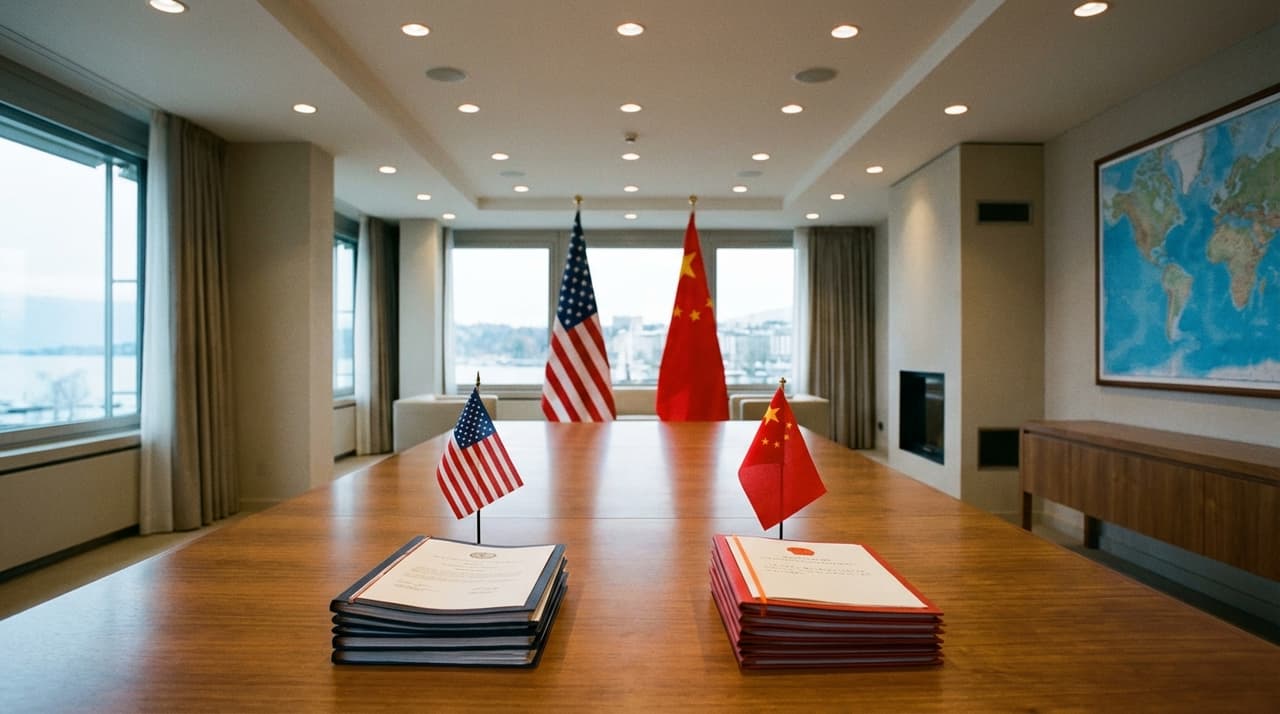
- U.S. Treasury Secretary Scott Bessent suggests a "big, beautiful" joint economic rebalancing between the U.S. and China.
- A new Geneva mechanism has reportedly stabilized trade relations, lowering tariffs from near-embargo levels.
- The Trump administration's broader trade doctrine frames this as part of a "generational project" to reindustrialize America.
A Shift in Trade Dynamics
U.S. Treasury Secretary Scott Bessent has floated the possibility of a coordinated economic rebalancing with China, describing it as a "dream scenario" where both nations adjust their economic structures in tandem. Speaking at an investment forum in Saudi Arabia in May 2025, Bessent outlined a vision where the U.S. shifts back toward high-precision manufacturing while China moves toward a more consumer-driven economy. This comes amid what he called a thawing, though still hard-edged, tariff framework established during the Trump era.
Efforts to de-escalate trade tensions have reportedly made progress through a new Geneva channel between U.S. and Chinese officials, designed to prevent misunderstandings and tariff spikes. According to people familiar with the matter, this mechanism has helped bring U.S. tariffs on Chinese goods down to around 30%—including legacy tariffs—from a peak that effectively created an embargo, with Chinese tariffs on U.S. exports reduced to about 10%. In a subsequent Fox Business (FOX) interview, Bessent reiterated that trade relations have stabilized, allowing Washington to focus on what he termed China's "domestic economic imbalances" rather than solely the bilateral trade deficit.
Structural Pressures and Geopolitical Ties
Bessent didn't mince words about China's economy, calling it "the most imbalanced, unbalanced economy in the history of the world," heavily reliant on manufacturing and investment amid a real-estate downturn and weaker export prospects. He noted that China now accounts for roughly 30% of global manufacturing, a level he views as unsustainable. The rebalancing push ties directly into the Trump administration's broader trade doctrine, which the U.S. Trade Representative has described as a "generational project to re-industrialize America," using tariffs and market-access deals to rebuild strategic manufacturing sectors.
This economic dialogue is also linked to security concerns, with Bessent indicating the U.S. will press China to curb purchases of Russian and Iranian oil to weaken Russia's war-fighting capacity and gain leverage in negotiations over Iran's nuclear program. The Geneva mechanism, he said, helps prevent tariff spirals despite high political tensions, reflecting a recognition that unbounded escalation is costly for both sides. When reached for comment, a Treasury spokesperson declined to elaborate beyond Bessent's public remarks, but sources close to the discussions suggest talks are ongoing, though fragile.
Implications and Outlook
If realized, a coordinated rebalancing could reshape global supply chains and demand patterns, with potential winners and losers among third-country exporters. For U.S. stakeholders, manufacturing workers and firms might benefit from policies aimed at restoring high-precision sectors, supported by foreign investment and tariff protection. Chinese export-oriented industries and local governments, however, face pressure as the model shifts away from heavy reliance on exports and property development. A successful shift to a consumer-driven model in China could raise living standards, but transition risks include slower growth and job dislocations.
In the short term, Bessent sees stabilized trade relations opening space for addressing these structural issues, with tariffs remaining as an enforcement tool. The U.S. has pursued similar "rebalancing" language in deals with the EU, Britain, Japan, and others, indicating this is part of a broader political project. Expert commentary in U.S. sources portrays it as a long-term endeavor, with success or failure unfolding over years rather than quarters. Without sustained coordination, there's risk of renewed tariff escalation and deeper geopolitical confrontation, especially given the linkages to Russia and Iran policy.
Correction: An earlier version of this article misstated the timeline of Bessent's comments; they were made in May 2025, not earlier this year.