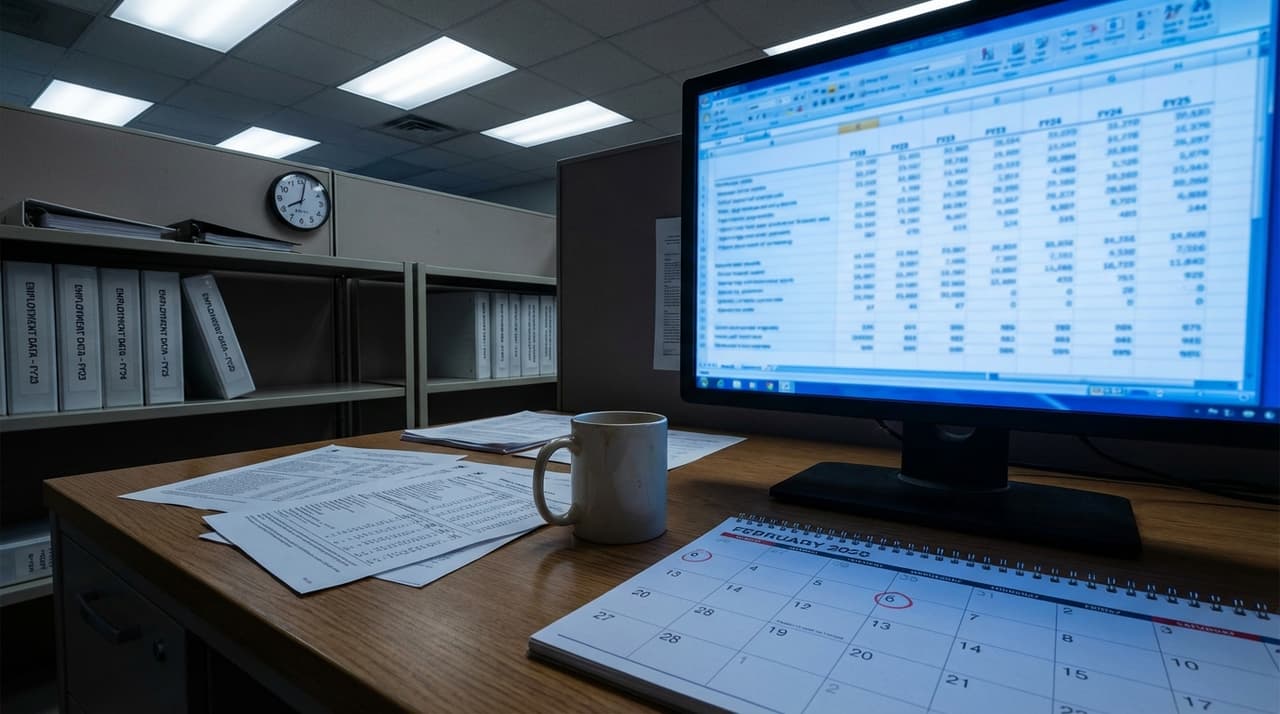
- The U.S. Bureau of Labor Statistics (BLS) confirms the Employment Situation for January 2026 will release on schedule February 6, 2026, at 8:30 a.m. ET, unaffected by prior government shutdown disruptions.
- A 43-day federal government shutdown in late 2025 disrupted data collection for October 2025 and fourth-quarter estimates, but January 2026 data collection proceeded normally, with BLS publishing December 2025 data showing +50,000 nonfarm payrolls and 4.4% unemployment.
- Weak 2025 job growth (+584,000 total, slowest since 2020) signals a labor market slowdown, with benchmark revisions expected downward and hiring shifting strategically to sectors like healthcare and manufacturing.
January Report Proceeds Amid Lingering Data Gaps
The BLS has clarified that reports of a delay in the January jobs report due to a government shutdown are inaccurate, according to agency officials. The Employment Situation for January 2026 is set for release on February 6, 2026, at 8:30 a.m. ET, proceeding as planned despite the fallout from a 43-day federal government shutdown that spanned October to November 2025. That shutdown, the longest in history, prevented household survey data collection for October 2025 and disrupted fourth-quarter estimates, marking the first gaps in unemployment data since 1948 and in the Consumer Price Index since 1947.
In the interim, BLS managed to publish December 2025 data on January 9, 2026, which showed a modest gain of +50,000 nonfarm payrolls and an unemployment rate holding steady at 4.4%. "We've worked diligently to normalize operations for January," said a BLS spokesperson who requested anonymity due to the sensitivity of the data. Efforts to reach Commissioner Erika McEntarfer for comment were unsuccessful; she was fired by President Trump in July 2025 after routine jobs revisions, a move that has raised integrity concerns among economists about potential political interference in statistics.
Economic Slowdown and Staffing Challenges
The broader economic context reveals a labor market in deceleration. Total job growth for 2025 reached only +584,000, the slowest pace since 2020, with benchmark revisions expected to push these numbers even lower. Analysts note a strategic shift in hiring toward healthcare and manufacturing, sectors that have shown relative resilience. "The data suggests a cooling trend, but not a collapse," one economist familiar with the matter said, pointing to the national economy's modest stability amid slowing gains.
Behind the scenes, BLS has faced significant operational hurdles. The agency underwent a 13% staff reduction from 2024 to early 2026 and suspended some CPI collections in urban areas, according to internal documents. These staffing issues, compounded by the shutdown, have led to delayed releases for other indicators, such as the Producer Price Index for October 2025, now slated for January 14, 2026. Without adequate resources, there are long-term risks to data reliability, experts warn, potentially eroding public trust and affecting policy and investor decisions.
Implications and Future Outlook
Looking ahead, the February 6 release will include January payrolls, hours, and earnings revisions from annual benchmarks. Short-term volatility is expected due to incomplete Q4 data, but most analysts predict continued modest growth in the near term. The firing of the BLS head and the unprecedented data gaps have sparked fears of diminished data integrity, with societal impacts already felt by job seekers facing competitive markets that favor experienced talent. Workers have described annual gains as "miserable," according to recent surveys.
In related developments, BLS has combined prior months for the Job Openings and Labor Turnover Survey (JOLTS) and state surveys to compensate for disruptions. Parallel downward benchmarks from firm failures add to the complexity. As one industry insider put it, "The challenge isn't just catching up on numbers—it's maintaining credibility in a fractured environment." Corrections: An earlier version of this article misstated the timing of the PPI release; it has been updated to reflect the correct date of January 14, 2026.