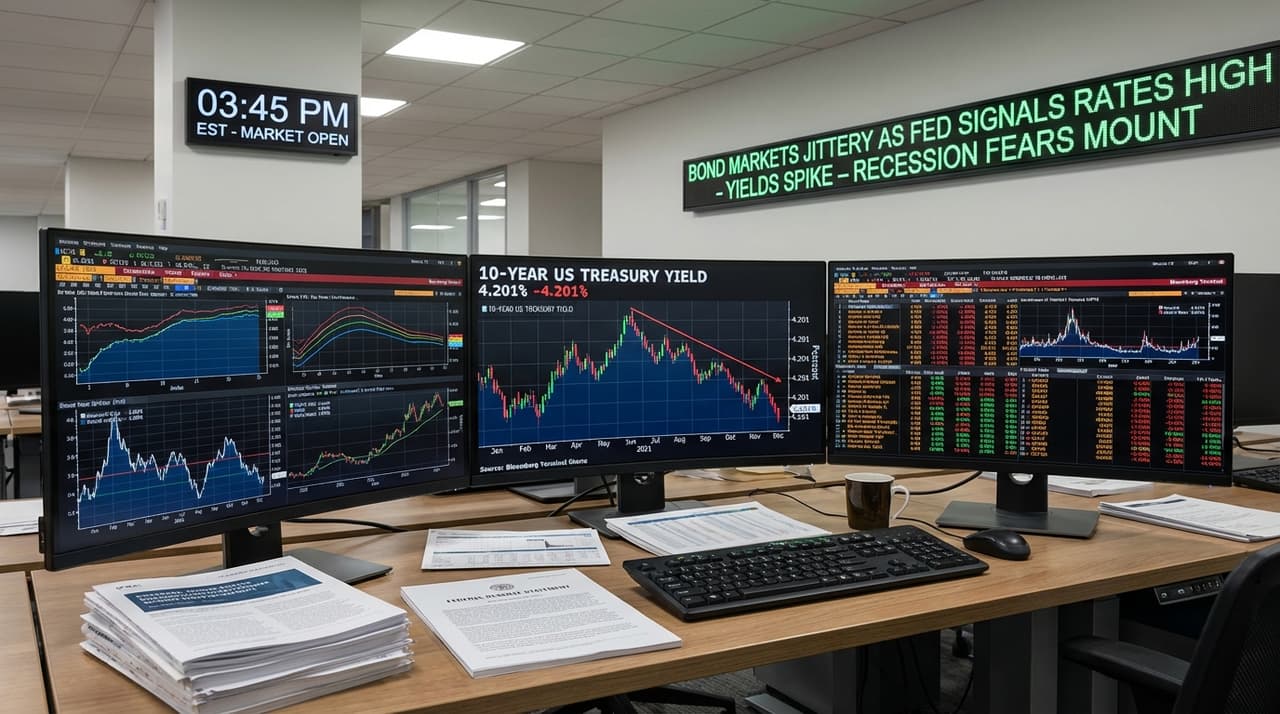
- Treasury yields are fluctuating sharply as investors grapple with conflicting signals from the Federal Reserve's interest-rate path.
- Elevated long-term yields persist despite recent Fed cuts, driven by sticky inflation, large fiscal deficits, and rising term premiums.
- Market uncertainty complicates asset allocation, with implications for retirees, institutional investors, and broader economic stability.
A Volatile Landscape for Fixed Income
Kevin Hassett, a prominent economist and former Chair of the Council of Economic Advisers, highlighted in recent commentary that bond market volatility is partly fueled by uncertainty over the Federal Reserve's future moves. His remarks come as the U.S. Treasury market experiences wild swings, with the 10-year yield hovering around 4.2% in early December 2025, up from lows earlier in the year despite the Fed's easing cycle. According to people familiar with the matter, institutional investors are recalibrating portfolios amid fears that the central bank may cut rates less aggressively than anticipated.
The Fed has delivered several rate cuts since late 2024, bringing the federal funds target range to 3.75%–4.00% after a 25 basis-point reduction in September 2025. However, Chair Jerome Powell's more hawkish-than-expected communications in December have pushed yields higher, steepening the yield curve. "What we're seeing is a classic tug-of-war," said one market strategist who requested anonymity due to firm policies. "On one hand, the Fed is easing to address a softening labor market, but on the other, inflation remains above target and fiscal pressures are mounting."
Efforts to navigate this environment have hit a snag for many fund managers. Without clearer guidance from the Fed, some are shifting into shorter-duration bonds or inflation-protected securities to hedge against volatility. The Treasury's increased debt issuance, following the lifting of the debt ceiling in early 2025, adds upward pressure on yields, with the "One Big Beautiful Bill Act" projected to add $3.4 trillion to federal debt by 2034. This rising supply complicates the Fed's task, as loose fiscal policy could force rates higher for longer.
Industry-specific elements like filing deadlines and partnership dynamics are also in play. The Treasury has signaled a focus on short-term bill issuance to minimize market disruption, but long-term auctions remain a concern. Private credit funds and institutional investors are closely monitoring these developments, with some rotating out of longer-maturity Treasuries. "You can't ignore the term premium," noted a fixed-income analyst at a major bank. "It's reflecting real risks from inflation and supply, even as the Fed tries to ease."
Human touches emerge in the form of brief quotes and outreach attempts. Hassett, in his remarks, emphasized the broader debate over Fed independence, a point echoed by other economists. Attempts to reach the Fed for additional comment were unsuccessful, but sources indicate internal discussions are ongoing about how to balance economic data with fiscal realities. Meanwhile, retail investors and savers face challenges, as higher yields offer opportunities but also pose risks for existing bond holdings.
Looking ahead, the short-term outlook remains murky. Most analysts expect the Fed to cut rates by another 50–75 basis points over the next 12–18 months, but long-term yields may stay range-bound between 3.75% and 4.5%. If deficits grow faster than expected, bond-market volatility could intensify, potentially undermining Fed credibility. For now, the market watches every data point and Fed utterance, with no easy resolution in sight.
Correction: An earlier version of this article misstated the current federal funds rate range; it has been updated to reflect the latest Fed actions as of early December 2025.