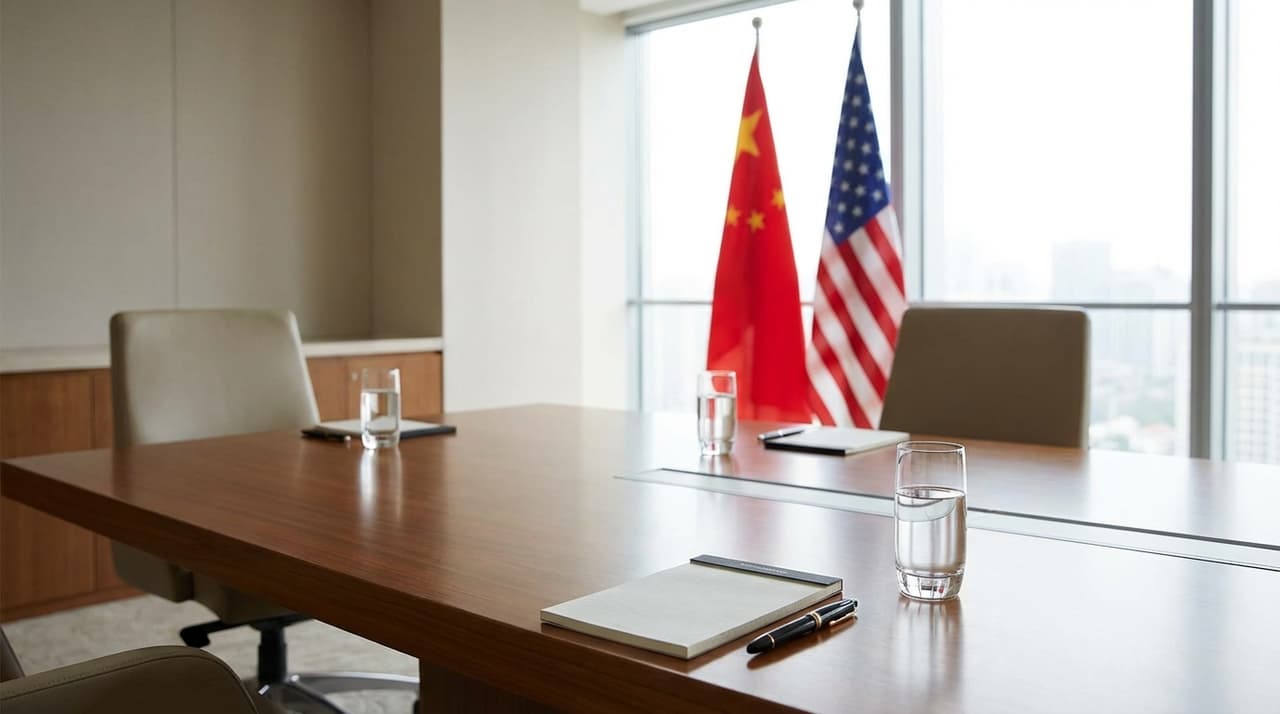
- China's commerce minister Wang Wentao met with AMD (AMD) Chair and CEO Lisa Su in Beijing, discussing China–US economic relations and AMD's business in China.
- Wang emphasized China's role as a stabilizing force in the global semiconductor supply chain, urging the US to provide stable expectations for businesses.
- Lisa Su reiterated that China remains a strategic priority for AMD, with plans to increase investment and collaborate with local partners.
A Diplomatic Gesture in the Chip War
China's commerce minister Wang Wentao recently held talks with AMD Chair and CEO Lisa Su in Beijing, according to a statement from the Ministry of Commerce. The meeting focused on China–US trade and economic relations, with Wang highlighting China's efforts to grow "new quality productive forces" and create opportunities for foreign companies. Sources familiar with the matter say the discussion aimed to reassure US chip firms amid ongoing export controls.
Wang described China as a "stabilizing force" for the global semiconductor supply chain, calling for global cooperation and urging the US to "draw clear security boundaries" to provide stable expectations for businesses. This comes as US export controls on advanced AI chips and accelerators have limited what companies like AMD can sell in China, shaping their strategies in one of the world's largest markets. "What institutional investors like us are really focused on is regulatory stability," a senior executive at a global investment firm noted, echoing sentiments from similar high-level meetings.
Lisa Su, who has led AMD for nearly a decade, said China is a priority in AMD's global strategy, with plans to continue increasing investment and working with Chinese partners to provide better products and services. AMD, a major US semiconductor company known for its Ryzen CPUs, EPYC server chips, and Instinct AI accelerators, has seen its revenue mix shift toward data center and AI segments, driving growth even as PC demand remains cyclical. Attempts to reach AMD for additional comment were unsuccessful, but industry insiders suggest the company may develop China-specific chip variants to comply with export rules, similar to approaches by competitors like Nvidia (NVDA).
The meeting fits a pattern of recent economic diplomacy, where Chinese officials have met with CEOs from Micron (MU), Qualcomm (QCOM), and Nvidia to manage tensions and encourage investment. In the short term, expect AMD to maintain and possibly expand local partnerships and R&D collaboration within regulatory bounds. However, regulatory uncertainty persists, and if US controls tighten further, AMD's ability to sell advanced AI accelerators in China could be constrained, though demand for mid-range products may remain substantial. China's push for domestic chip alternatives could intensify competition over time, but for now, such meetings aim to avoid complete decoupling in a sector central to global economic competition.
Correction: An earlier version of this article misstated the timing of related meetings; it has been updated to reflect that discussions with other US chip CEOs have occurred in recent years.