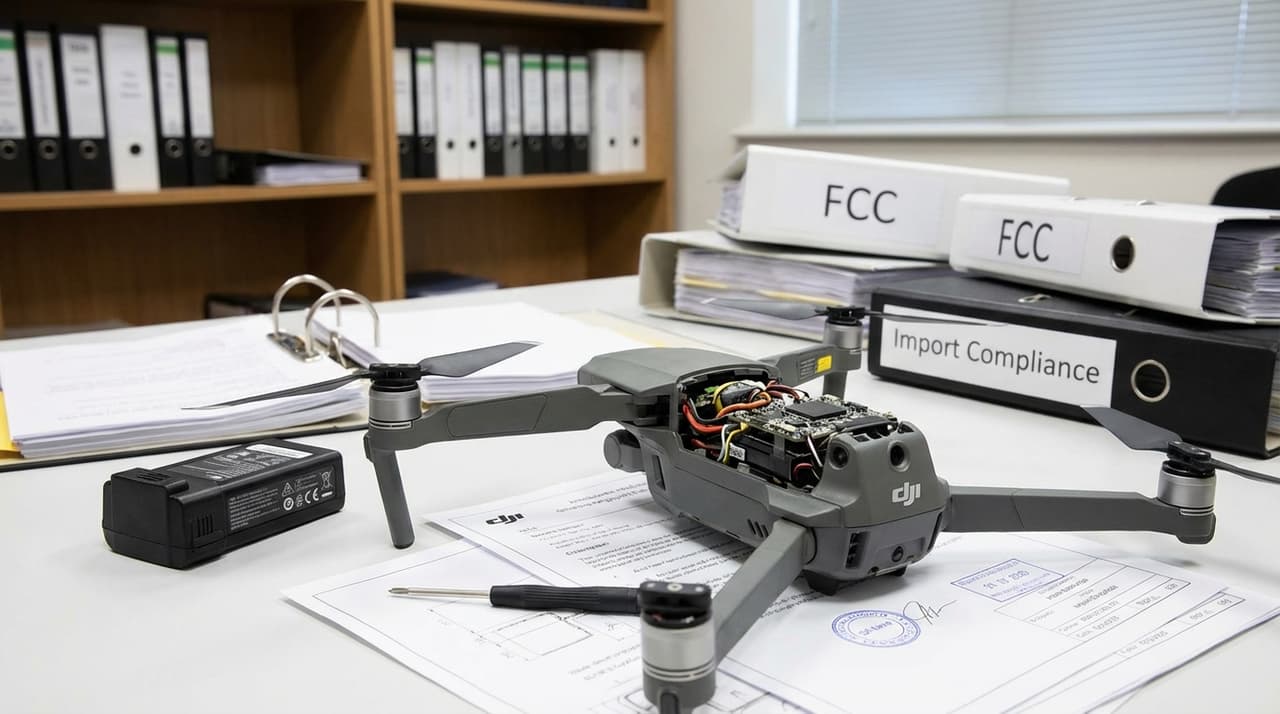
- The U.S. FCC added DJI and all foreign-made drones to its 'Covered List' on December 22, 2025, blocking new import and sales approvals over national security risks.
- China's Commerce Ministry urged the U.S. to reverse this 'wrong action' and warned of necessary measures to protect Chinese companies if it persists.
- The move accelerates U.S.-China tech decoupling, with DJI—holding over 90% global market share—facing restricted U.S. access for new models, while U.S. firms grapple with supply chain hurdles.
In a sharp escalation of bilateral tech tensions, the U.S. Federal Communications Commission (FCC) has effectively barred approvals for new imports and sales of DJI drones and all foreign-made drone components, citing surveillance and data exfiltration risks. The decision, dated December 22, 2025, places these items on the agency's 'Covered List,' a move that China's Commerce Ministry swiftly condemned as discriminatory and vowed to counteract.
According to people familiar with the matter, the FCC action follows a White House inter-agency review and builds on years of U.S. scrutiny targeting firms like DJI and Autel, another Shenzhen-based drone maker. 'This overgeneralizes security concerns to suppress Chinese companies,' a ministry spokesperson said in a statement, urging the U.S. to 'correct its wrong actions' and warning that China will take necessary measures if the U.S. persists. Efforts to reach DJI for immediate comment were unsuccessful, but the company has previously expressed disappointment and pledged to protect its rights.
Without a reversal, the ban could trap U.S. drone manufacturers in a supply chain bind, as China dominates critical components like LFP battery cells, with a 99% global share, and over 90% of battery components such as cathodes and anodes. 'We're facing production hurdles without exemptions, which might delay American drone dominance,' an industry insider noted, speaking on condition of anonymity. Market data shows DJI controls more than half of the U.S. commercial drone market, though existing drones remain unaffected for now.
Regulatory filings indicate the FCC's shift to a category-level ban from company-specific targets, mirroring earlier blacklists for Huawei and ZTE. This accelerates a broader decoupling in tech and materials, with China potentially retaliating via export curbs on items like graphite or cathodes. In the short term, U.S. consumers and retailers can still use and sell existing drones but will lose access to new foreign options, limiting choice and innovation.
Industry reactions have been mixed. The Association for Uncrewed Vehicle Systems International (AUVSI) welcomed the move for security reasons but urged balanced waivers to avoid overreach. Meanwhile, China Daily reported DJI's emphasis on validated safety, highlighting the firm's global dominance. As negotiations over waivers for allies continue, experts see a bifurcated global drone ecosystem emerging, with U.S. policy incoherence—banning components it lacks—potentially taking five or more years to resolve. For now, the focus remains on ongoing diplomatic efforts and the immediate market fallout, with both sides digging in for a protracted tech standoff.