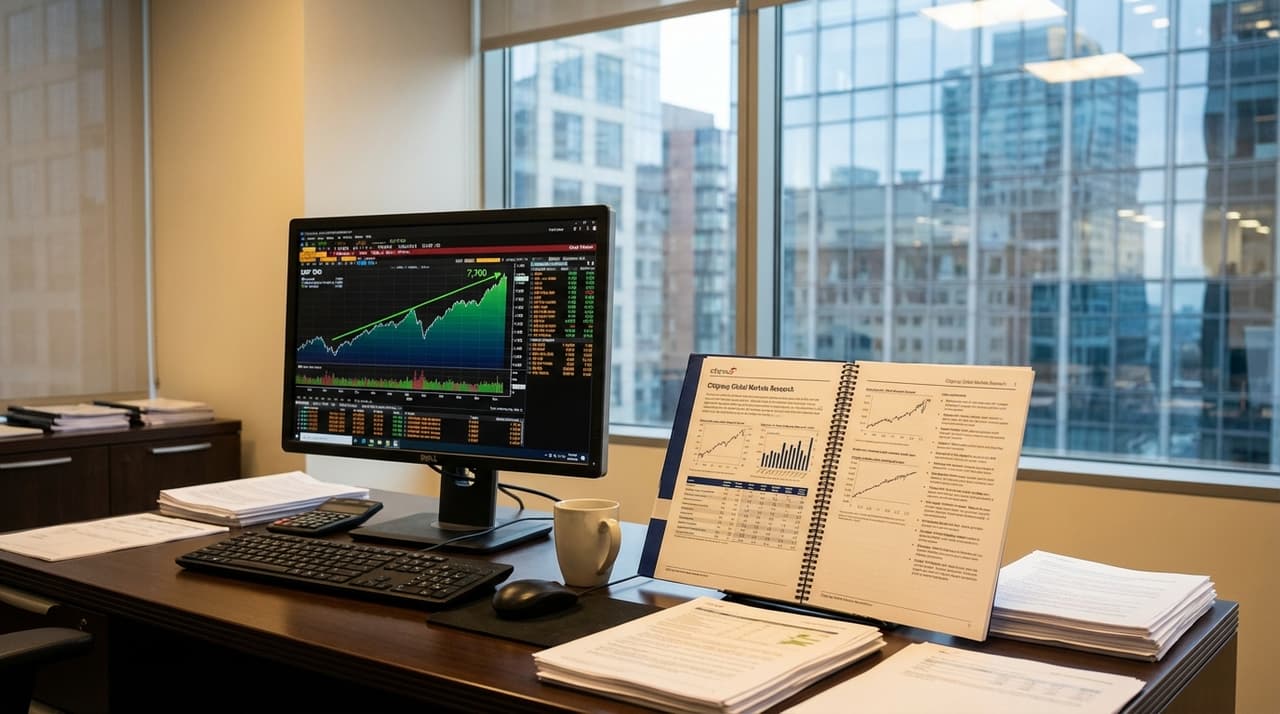
- Citigroup projects S&P 500 to reach 7,700 by end-2026, implying about 13% upside from late December 2025 levels, driven by accommodative Federal Reserve policy and above-consensus earnings growth.
- The forecast hinges on a shift from AI "enablers" like hyperscalers to "adopters" across broader sectors, fueling a "Great Broadening" that favors value, cyclicals, small-caps, and financials.
- With this base case, Citi emerges as the most bullish among major Wall Street banks, slightly outpacing the Street consensus of around 7,500, amid expectations of resilient U.S. economic performance.
In a move that underscores growing optimism for U.S. equities, Citigroup has released its 2026 S&P 500 forecast, setting a base case target of 7,700 by year-end. This projection, the last from a major Wall Street bank, suggests roughly 13% upside from late December 2025 levels, according to strategists including Scott Chronert, Drew Pettit, Patrick Galvin, and Rob Rowe. The outlook arrives as markets navigate the bull market's fourth year, with Citi citing a combination of Federal Reserve rate cuts, fiscal stimulus, and a pivotal transition in artificial intelligence adoption as key drivers.
Behind the numbers lies a detailed earnings narrative. Citi expects S&P 500 earnings per share to climb to $320, surpassing the Street consensus of $310, supported by above-consensus economic growth. "We're seeing a cyclical recovery that's more robust than many anticipate," one strategist familiar with the matter said, pointing to resilient consumer spending and corporate investment. The forecast assumes two Fed rate cuts in early 2026, faster than currently priced in, which could push the 10-year Treasury yield down to 3.75% and bolster equity valuations. Fiscal impulse from U.S. legislation, referred to internally as the "OBBBA," is also factored in, providing a tailwind amid what Citi describes as a "Goldilocks" environment of stable inflation.
A central theme in Citi's analysis is the anticipated broadening of market performance. After two years of narrow gains dominated by AI enablers—such as hyperscalers that account for about 40% of the S&P 500's weight—the strategists predict a shift toward AI adopters across sectors like industrials, financials, and small-caps. This "Great Broadening" could reduce concentration risks and drive a rotation into value and cyclical stocks, with small-cap indices like the Russell 2000 (IWM) (IWM) poised for catch-up. "AI is a boom, not a bubble, but its benefits are spreading," Rob Rowe emphasized in a recent CNBC interview on December 26, 2025, highlighting how productivity gains might initially pressure unemployment but ultimately support broader earnings growth.
Market implications are already stirring. Citi's target, which implies a forward price-to-earnings ratio of about 24x based on its $320 EPS estimate, contrasts with current valuations near 25x, suggesting room for multiple expansion if earnings deliver. The bank outlines a bull case of 8,300 if earnings and productivity exceed expectations, versus a bear scenario of 5,700 on disappointments. In recommendations, strategists advise overweighting value, cyclicals, and small-caps, while noting that growth stocks will need "beats and raises" to justify elevated levels. Efforts to reach other major banks for comment on the divergence from consensus were unsuccessful, but industry sources indicate that targets generally cluster around 7,500, making Citi's outlook notably more aggressive.
Looking ahead, short-term volatility is expected from AI dispersion and sector rotation, but Citi remains confident in a sustained rally if fundamentals hold. The forecast aligns with global equity optimism yet remains U.S.-centric, acknowledging geopolitical uncertainties navigated in 2025. For investors, this signals a potential shift in portfolio strategies, with broader market participation offering opportunities beyond mega-cap tech. As one insider put it, "It's about catching the next wave of AI-driven growth, not just riding the first one."