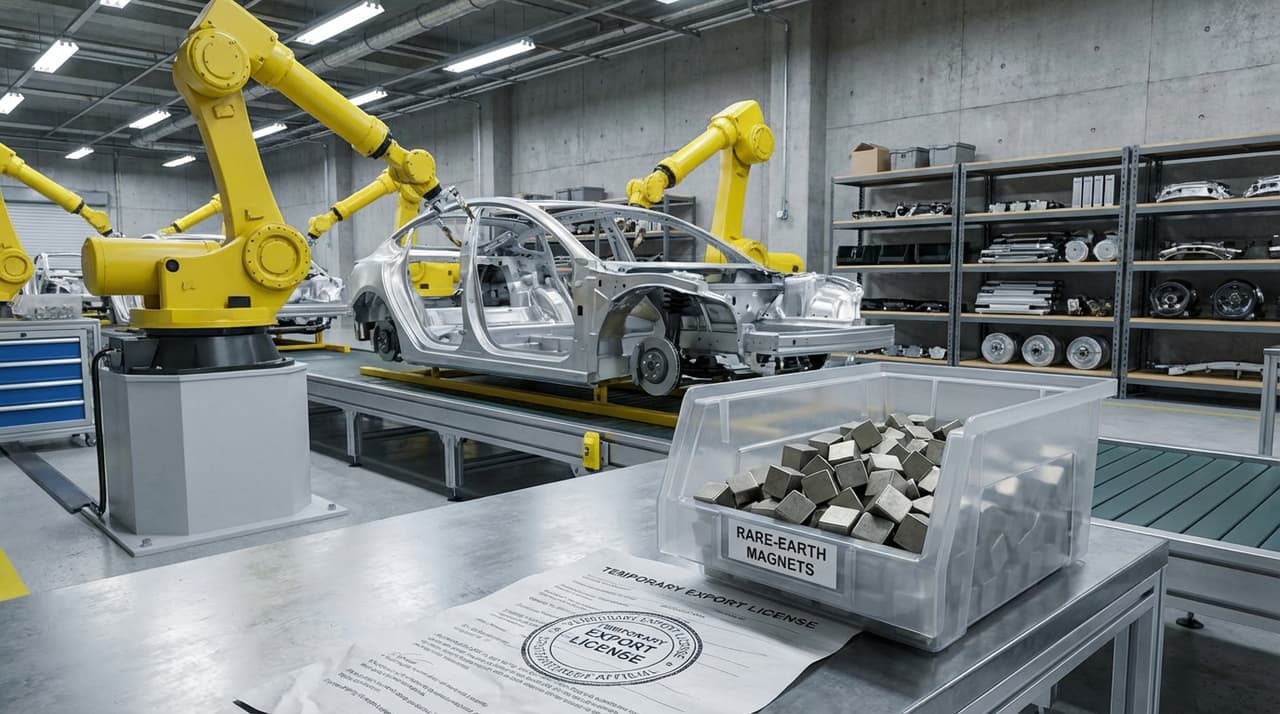
- Ford's rare-earth suppliers receive temporary export licenses from China, providing six-month relief from restrictions.
- The licenses follow production halts and CEO Jim Farley's description of Ford's magnet situation as "hand-to-mouth."
- Industry experts warn of continued vulnerability, with China controlling 90% of rare-earth magnet production.
In a move that offers temporary respite to strained automotive supply chains, Chinese authorities have granted temporary export licenses to rare-earth suppliers serving Ford Motor Company (F), according to people familiar with the matter. The licenses, valid for approximately six months, represent a partial easing of restrictions implemented in April 2025 that had severely disrupted production across U.S. automakers.
The approval came after China announced export permit requirements for medium- and heavy-rare-earth elements critical for high-performance magnets—components essential for electric motors, alternators, and advanced vehicle systems. Ford had temporarily halted production of its Explorer SUV in May due to insufficient magnet supplies, with CEO Jim Farley describing the company's situation as "hand-to-mouth" even after the licenses were granted in June.
Efforts to stabilize the supply chain have hit multiple snags, according to industry sources who spoke on condition of anonymity. Despite high-level negotiations between U.S. and Chinese officials in June 2025—including discussions between President Trump and Chinese President Xi Jinping—Beijing continues to insist it will strictly regulate exports "in line with laws and regulations." The temporary nature of the licenses appears designed to retain China's bargaining leverage rather than provide permanent relief.
Ford's finance chief indicated that rare-earth issues "will continue" despite the temporary licenses, suggesting automakers anticipate an ongoing "stop-and-go scenario" through at least late 2025. The company did not respond to multiple requests for comment on current inventory levels or production forecasts.
Industry analysts warn that without reliable rare-earth access, automotive suppliers would be unable to produce critical components. The Alliance for Automotive Innovation, representing major global carmakers, wrote to the Trump administration voicing concerns about potential plant shutdowns. Stellantis (STLA) reported spending "tough hours" securing supply, while General Motors (GM) has invested in alternative-magnet startups like Niron to hedge future risks.
China controls approximately 70% of global rare-earth element mining, 85% of refining capacity, and roughly 90% of rare-earth alloy and magnet production—creating what experts describe as a "severity of the chokehold" on supply. The situation underscores how rising global EV content has increased dependency on these materials and exposed U.S. industry to Chinese supply leverage.
As negotiations continue, automakers face the reality that no viable alternative sources exist at scale for at least three years, according to industry assessments. The temporary licenses expire in late 2025, setting up another potential crisis point unless extensions are granted or alternative solutions emerge.