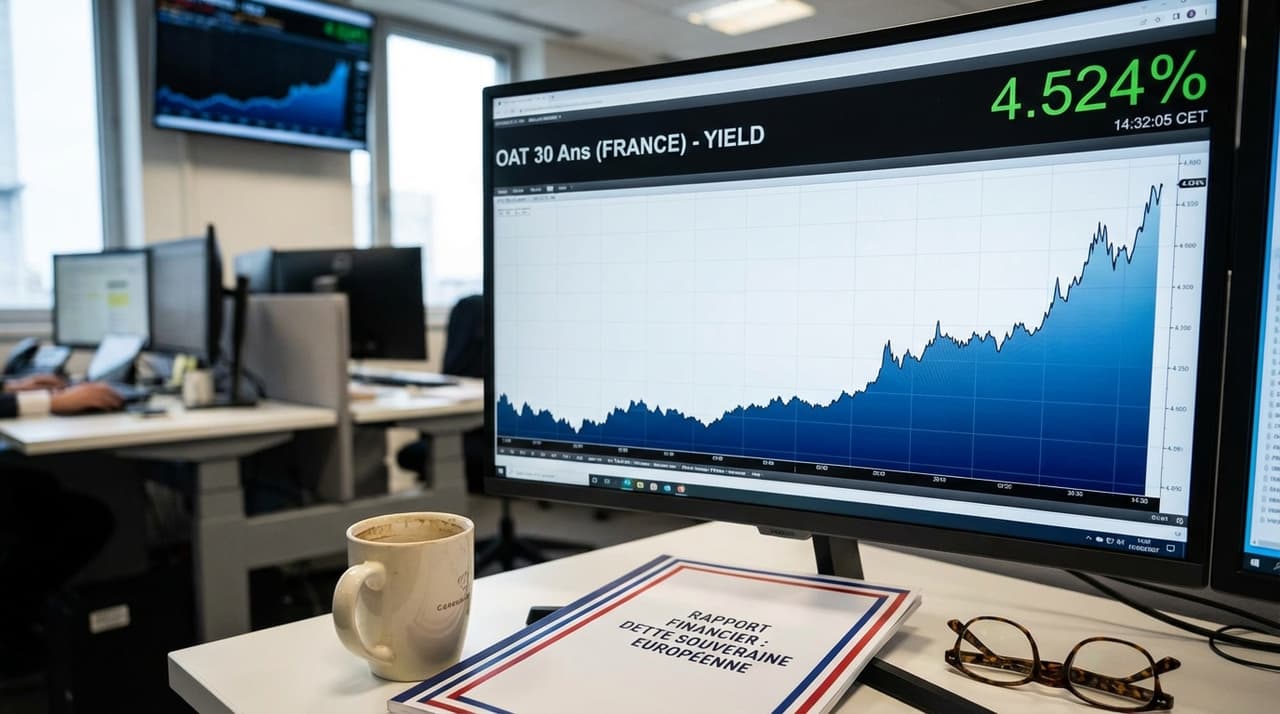
- The French 30-year government bond yield has risen 7 basis points to 4.524%, marking its highest level since the post-global financial crisis period around 2009.
- This surge reflects broader pressure on long-term euro-area yields, driven by concerns over fiscal deficits and debt sustainability in France and other EU members.
- The move signals a structural shift from the ultra-low-rate era, with implications for government borrowing costs, financial conditions, and investor portfolios.
France's 30-year sovereign bond yield climbed to 4.524% on Thursday, up 7 basis points from the previous session and reaching its highest point since 2009, according to market data. The yield has been trading in the mid-4% range in recent weeks, now testing new cycle highs around 4.5%+, which represents an increase of roughly 90–100 basis points compared to a year ago. This uptick coincides with a generally higher euro-area yield curve, as lingering worries about fiscal trajectories and debt sustainability weigh on investor sentiment.
Efforts to stabilize long-term funding costs have hit a snag, with the yield breaking toward the upper end of its recent range of 4.0–4.5%. The rise reflects higher term premia and markets pricing in "higher for longer" real rates across advanced economies, a trend visible in similar moves for U.S. and other euro-area long bonds. One market analyst, speaking anonymously due to lack of authorization, noted that "without a credible fiscal plan, France could face persistently elevated borrowing expenses, squeezing out other spending priorities."
Political context adds to the pressure, as the European Central Bank has shifted from ultra-loose to a more restrictive monetary stance. Although policy rates have likely peaked, markets no longer expect a rapid return to near-zero rates, anchoring higher long-term yields. EU fiscal-rule debates and enforcement, such as deficit procedures, influence investor perceptions of French debt, affecting its spread versus safer benchmarks like Germany. Attempts to reach officials at the French finance ministry for comment were unsuccessful by press time.
For the French government and taxpayers, higher 30-year yields mean more expensive long-term borrowing, potentially raising debt-service costs over time. This could crowd out other expenditures, complicating efforts to fund green and digital transitions. Households and businesses may feel the pinch too, as long-term sovereign yields serve as a key reference for mortgage and corporate bond pricing; sustained increases tend to translate into tighter financial conditions.
In the financial sector, banks, insurers, and pension funds holding long-dated OATs face mark-to-market losses when yields spike, but new investments can be made at higher returns, aiding long-term liability matching. Historical context underscores the shift: France's 30-year yield last saw similar levels in the late 2000s, with an all-time high above 5% in 2008, before collapsing during the euro-area crisis and ECB's quantitative easing era. The recent climb back to mid-4% levels marks a clear break from that ultra-low-rate regime.
Looking ahead, analysts project the French 30-year yield to ease modestly over the next 12 months but remain elevated around or slightly above 4%, a stark contrast to pre-2022 norms far below that level. In the short term, volatility is expected around fiscal headlines, ECB communication, and U.S. yield moves, with potential for further spikes if inflation or deficit concerns intensify. Long term, a "higher for longer" plateau seems likely relative to the 2010s, unless growth or inflation weaken sharply.
Parallel developments show other long-dated euro-area bonds, such as those from Italy and Spain, experiencing significant yield rises, with more pronounced moves where fiscal risks are perceived as higher. Globally, the U.S. 30-year Treasury yield has also climbed, trading above 4.8% recently, highlighting a widespread shift to higher long-term real rates as central banks unwind quantitative easing and markets reassess debt dynamics. This story is developing, and updates will follow as more data emerges.