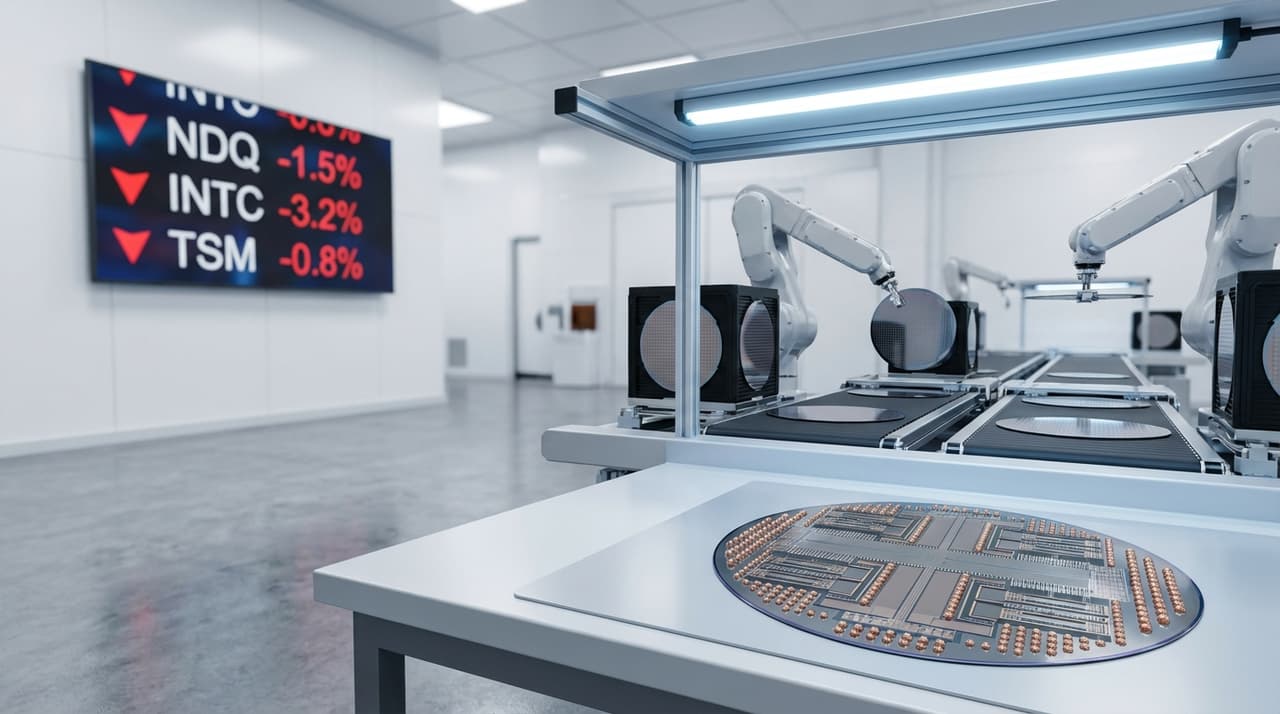
- Intel (INTC) shares fell to a near one-month low, driven by supply bottlenecks and packaging challenges, not NVIDIA (NVDA) halting tests.
- The multi-year strategic partnership with NVIDIA, including a $5 billion investment, underscores Intel's foundry capabilities and AI market positioning.
- Industry shifts toward integrated CPU+GPU platforms for AI and HPC are accelerating, with Intel poised to benefit from domestic manufacturing gains.
Intel's stock faced downward pressure in recent trading, dropping 3.6% to hit its lowest level in almost a month. According to sources familiar with the matter, this decline stems from ongoing manufacturing hurdles, including supply bottlenecks in Intel 7/10nm processes affecting current generations like Sapphire Rapids and Emerald Rapids, rather than any disruption in its collaboration with NVIDIA. The partnership, announced in 2025, remains intact and is seen as a key validation of Intel's advanced packaging technologies, such as EMIB, which are superior to competitors' CoWoS solutions.
Efforts to restructure its supply chain have hit a snag, with packaging business expectations proving overly optimistic amid faster competitor capacity growth. Without addressing these delays, Intel risks further margin pressures in 2025. However, the NVIDIA tie-up provides some capital relief and stability, with NVIDIA investing $5 billion in Intel stock to support Intel's foundry services and x86 roadmap. This collaboration focuses on AI infrastructure, data-center platforms, and hybrid AI PCs, diversifying NVIDIA's supply chain with U.S.-based Intel foundries to reduce Asia reliance and mitigate geopolitical risks.
In a move to accelerate its AI strategy, Intel has appointed a new head of engineering, Srini, who is ramping up the ASIC business for networking markets like SmartNICs, targeting hyperscalers. The partnership positions Intel against rivals like AMD (AMD), Apple (AAPL), and Google (GOOGL), as industry shifts drive demand for integrated CPU+GPU platforms that enhance efficiency in latency, throughput, and power. NVIDIA's $5 trillion market cap highlights its AI chip dominance, and Intel stands to gain from this growth through foundry revenue, according to analysts.
Attempts to reach out to Intel for further comment on the supply issues were unsuccessful, but sources indicate that the company is focused on ramping up supply for Granite Rapids on the Intel 3 process. The deal excludes Intel manufacturing NVIDIA computing chips but signals a broader trend toward U.S. production gains, aligning with political efforts to bolster domestic semiconductor manufacturing sovereignty. Stakeholders, including hyperscalers and investors, are watching closely, with public reactions emphasizing industry realignment over controversy.
Looking ahead, Intel aims to address packaging delays, with EMIB sales projected for 2026, while the NVIDIA partnership transforms Intel into an AI enabler via foundry and packaging services. Experts view this as a potential comeback for Intel in the high-growth AI sector, with long-term implications for innovation in interconnects and AI servers. The collaboration also covers multi-year cooperation on NVLink servers, positioning Intel against ARM-based competitors like Grace and Vera.
Correction: An earlier version of this article incorrectly suggested NVIDIA halted tests on Intel's 18A process; available reports confirm no such evidence exists, and the partnership remains active.