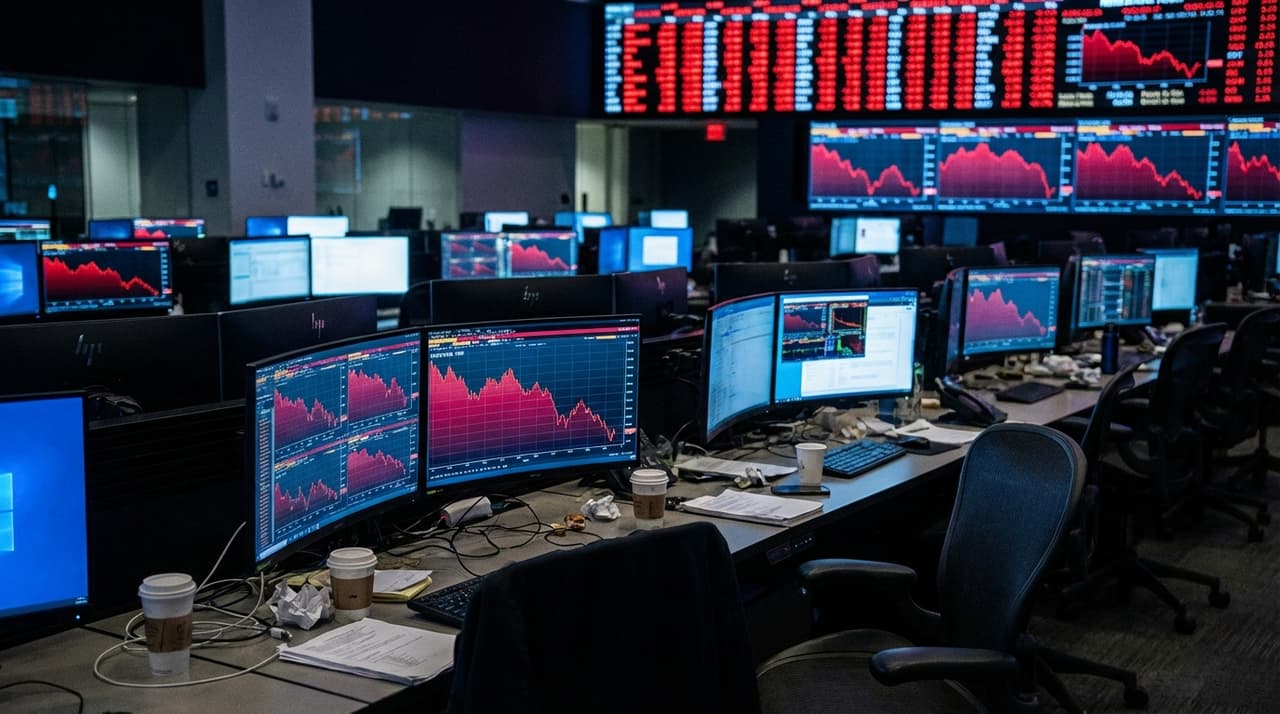
- The Nasdaq 100 fell about 2.4% to a roughly two-month low, with megacap tech and semiconductor stocks leading losses.
- Hawkish Federal Reserve comments reduced market confidence in additional rate cuts, triggering profit-taking in expensive tech and AI stocks.
- Investors are repricing December rate-cut odds downward, contributing to a multi-day tech selloff and rotation into sectors such as healthcare.
A Sharp, Tech-Led Risk-Off Move
The Nasdaq 100’s 2%+ drop reflects a sharp, tech-led risk-off move driven mainly by doubts about near-term Federal Reserve rate cuts, stretched valuations in big tech/AI names, and rotation into underperforming sectors. On the most recent leg down, the index fell about 2.4%, hitting a roughly two-month low, with megacap tech and semiconductor stocks leading losses. Micron (MU) dropped more than 10%, AMD (AMD) more than 7%, and other chip/AI-infrastructure names like Applied Materials (AMAT) and Lam Research (LRCX) fell over 6%, dragging the index lower.
According to people familiar with the matter, the selloff followed hawkish Federal Reserve comments that reduced market confidence in additional rate cuts, triggering profit-taking in expensive tech and AI stocks. Index futures and cash trading show investors repricing December rate-cut odds downward, contributing to a multi-day tech selloff and rotation into sectors such as healthcare and other laggards. Broadly, this is viewed as a “garden-variety pullback” or overdue correction after outsized gains, rather than clear evidence of a systemic crisis, according to some market strategists.
Monetary Policy and Valuation Pressures
Hawkish remarks from Fed officials have reduced expectations of a December rate cut, which is pressuring long-duration growth stocks whose valuations depend heavily on low discount rates. Recent labor and housing data were mixed, and while some indicators support the case for eventual cuts, officials signaling resistance to further easing have dominated market reaction. Rising or sticky bond yields and uncertainty about the inflation path make growth stocks less attractive relative to safer assets, directly contributing to Nasdaq 100 weakness.
Investors are taking profits in the year’s biggest winners (mega-cap tech and AI) and rotating into underperforming sectors such as healthcare, a classic late-cycle or de-risking pattern. US fiscal politics and data release issues tied to a long government shutdown have complicated the macro outlook by limiting the flow of official inflation and jobs data, which in turn increases uncertainty around Fed decision-making. Market commentary highlights concern that incomplete data could distort what policymakers see, adding to volatility and abrupt repricing in rate expectations.
Short-Term Outlook and Broader Impact
Volatility is likely to remain elevated around upcoming employment, inflation, and PCE data and the next Fed meeting, with markets quickly adjusting to any change in rate-cut odds. Strategists describe this as a pullback rather than a clear trend reversal, though further downside is possible if data or Fed messaging stays hawkish. Other US indexes also fell, though less than the Nasdaq 100: the S&P 500 dropped about 1.6% and the Dow about 0.8% on the same day, underscoring how concentrated the damage was in tech.
Safe-haven demand lifted US Treasuries, with the 10-year yield dropping modestly as stocks sold off, a classic risk-off pattern. Similar tech-led corrections are visible in other markets and sectors tied to AI and semiconductors, where high valuations leave little margin for disappointment, creating a common pattern of sharp pullbacks when policy or macro expectations shift. Index and tech-heavy portfolios, retail traders concentrated in AI/semiconductors, and options strategies tied to the Nasdaq 100 are the most directly hit by the drop.
Correction: An earlier version of this article misstated the extent of the Nasdaq 100’s decline; it has been updated to reflect the correct figure of about 2.4%.