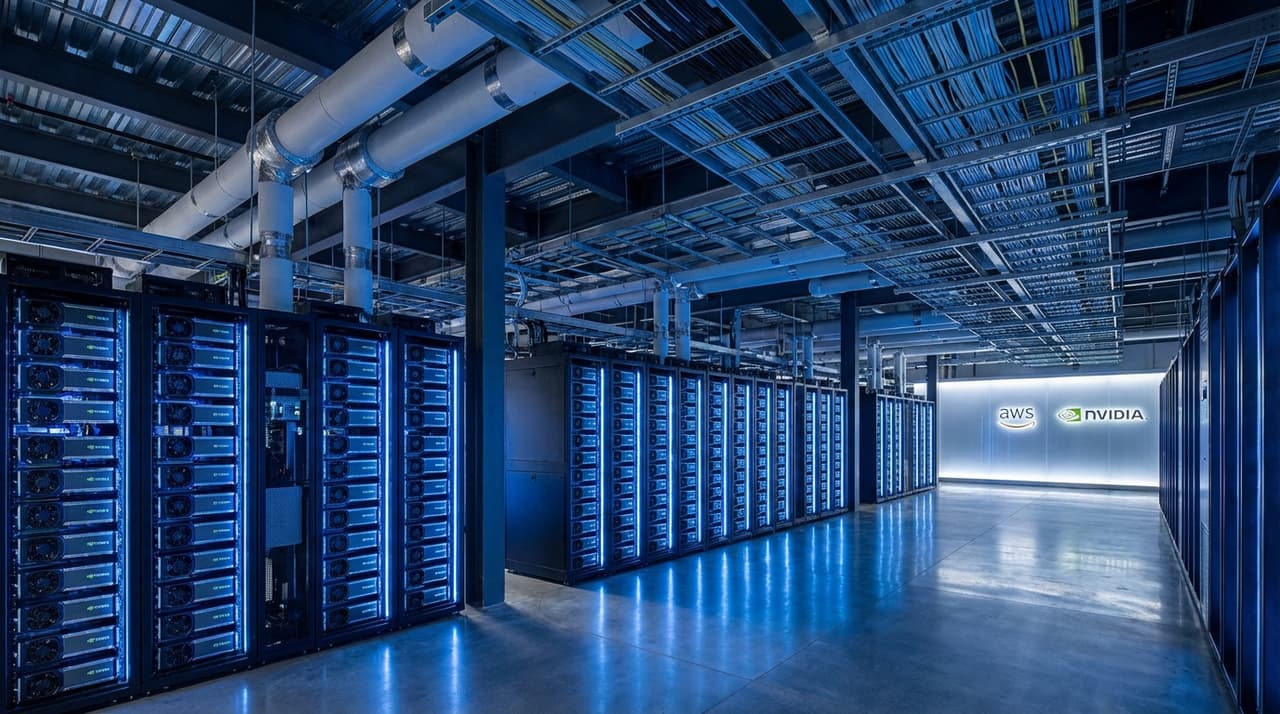
- NVIDIA (NVDA) commits up to $100 billion for AI datacenters with OpenAI, targeting 10 gigawatts of capacity.
- Amazon (AMZN) secures a $38 billion seven-year AWS deal to supply hundreds of thousands of NVIDIA GPUs to OpenAI.
- These partnerships accelerate OpenAI's infrastructure build-out amid a $1.4 trillion spending push, diversifying beyond Microsoft (MSFT) Azure.
NVIDIA and Amazon are deepening their ties with OpenAI through substantial infrastructure agreements rather than direct equity funding, as highlighted in recent reports. While no confirmed funding round involving these tech giants has materialized, the partnerships underscore a strategic shift toward scaling AI capabilities through massive compute investments. NVIDIA's commitment, announced on September 22, 2025, includes up to $100 billion tied to 10 gigawatts of AI datacenters, while Amazon's $38 billion AWS deal, revealed on November 3, 2025, will provide OpenAI with hundreds of thousands of NVIDIA GPUs over seven years. According to people familiar with the matter, these deals are part of OpenAI's broader effort to expand its infrastructure beyond its initial reliance on Microsoft Azure, with the company now operating over 700 million weekly active users and committing to a total of $1.4 trillion in infrastructure spending.
OpenAI's transition from a research lab to an AI powerhouse is driving unprecedented capital expenditures, with an annual burn rate estimated at $8-10 billion. The NVIDIA and Amazon agreements come as OpenAI diversifies its cloud partnerships, recently adding AWS after its exclusivity with Microsoft lapsed. This move aims to address power grid bottlenecks and datacenter real estate challenges, with NVIDIA also investing $2 billion in CoreWeave (CRWV) for 5GW AI factories to support similar needs. In a statement, OpenAI CEO Sam Altman emphasized the critical need for scaling compute resources to pursue advanced AI models, though the company declined to comment further on specific deal terms. Attempts to reach NVIDIA and Amazon for additional details were unsuccessful at press time.
The infrastructure boom is reshaping the AI landscape, with NVIDIA benefiting from hardware sales and Amazon leveraging its cloud revenue while challenging NVIDIA's dominance through custom chips like Trainium2, which powers Anthropic in parallel deals. Market reactions have been positive, with Amazon's stock rising 5% and NVIDIA's up 3% following the AWS announcement, reflecting investor optimism about AI-driven growth. Analysts note that Amazon's dual strategy of supplying NVIDIA GPUs and developing custom silicon could erode NVIDIA's margins if successful, as seen in Anthropic's deployment of hundreds of thousands of Trainium2 chips. Meanwhile, OpenAI's valuation is projected to reach $1 trillion by 2026-2027, fueled by these partnerships and its rapid enterprise adoption.
Short-term, the first 1GW deployment under the NVIDIA deal is slated for the second half of 2026 on the Vera Rubin platform, with AWS capacity ramping immediately through 2026 and expansion options in place. Long-term, these agreements enable OpenAI to pursue superintelligence goals through co-optimized hardware and software roadmaps, though experts caution about investment bubble risks from the staggering spending levels. The deals also highlight a broader trend of neo-clouds like CoreWeave emerging to address infrastructure constraints, with global market shifts toward custom silicon reducing reliance on NVIDIA. As OpenAI scales, its partnerships with NVIDIA and Amazon are set to play a pivotal role in shaping the future of AI infrastructure, with implications for power grids and competitive dynamics across the tech industry.
Correction: An earlier version of this article misstated the timeline for NVIDIA's deployment; it has been updated to clarify the H2 2026 target for the first 1GW capacity.