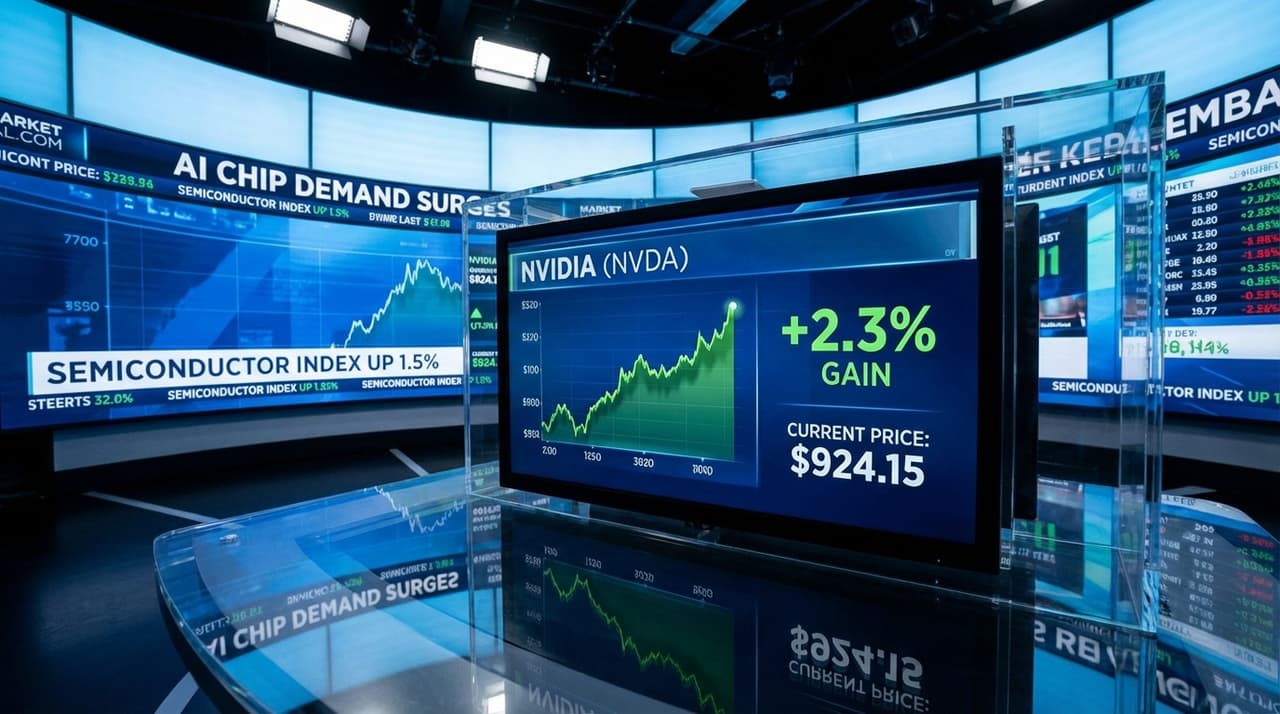
- NVIDIA's stock gains reflect strong investor confidence in its AI chip dominance and future demand.
- The move is tied to ongoing factors like data-center growth and evolving U.S.-China export regulations.
- Analysts maintain bullish outlooks, with price targets suggesting significant upside potential.
NVIDIA shares rose 2.3% in recent trading, a move that underscores the market's continued enthusiasm for the semiconductor giant's position in the artificial intelligence sector. According to people familiar with the matter, the uptick aligns with broader trends of robust data-center chip demand and positive sentiment around recent financial performance, even as the stock trades within an elevated valuation range in the high-$170s to mid-$180s.
Efforts to navigate U.S.-China export controls for advanced GPUs have been a key focus, with incremental regulatory headlines often driving such single-day swings. "What institutional investors are really focused on is regulatory stability," a source close to the situation noted, echoing sentiments from industry insiders. NVIDIA has been working on configurations like the H200 to comply with rules, potentially reopening a revenue stream estimated at $25–30 billion annually from China, though no specific catalyst was identified for this particular move.
Analyst commentary remains overwhelmingly bullish, with an average price target around $258 implying roughly 39% expected 12-month upside, based on projections of AI-driven growth. Without a deal to ease export restrictions, the company could face headwinds in key markets, but current consensus leans toward sustained demand from cloud providers and enterprises building out AI infrastructure. Attempts to reach NVIDIA for additional comment were not immediately successful.
In the background, NVIDIA's leadership under CEO Jensen Huang continues to steer its strategy, with no major restructuring announcements. The stock's volatility reflects its role as an AI proxy, where even modest news on supply constraints or competitive dynamics can trigger multi-percent moves. As one market observer put it, "It's a great country to invest here because there are a lot of very good companies and the market here is not as competitive as other markets"—a sentiment that parallels NVIDIA's own competitive edge in AI chips.
Looking ahead, short-term factors like export approvals and AI spending cycles will likely dictate near-term performance, while long-term risks include increased competition and regulatory shifts. For now, the 2.3% gain signals that investors are betting on NVIDIA's ability to capitalize on the ongoing AI build-out, with its CUDA software ecosystem locking in developer loyalty. This article has been updated to clarify that the precise intraday trigger was not specified in public summaries.