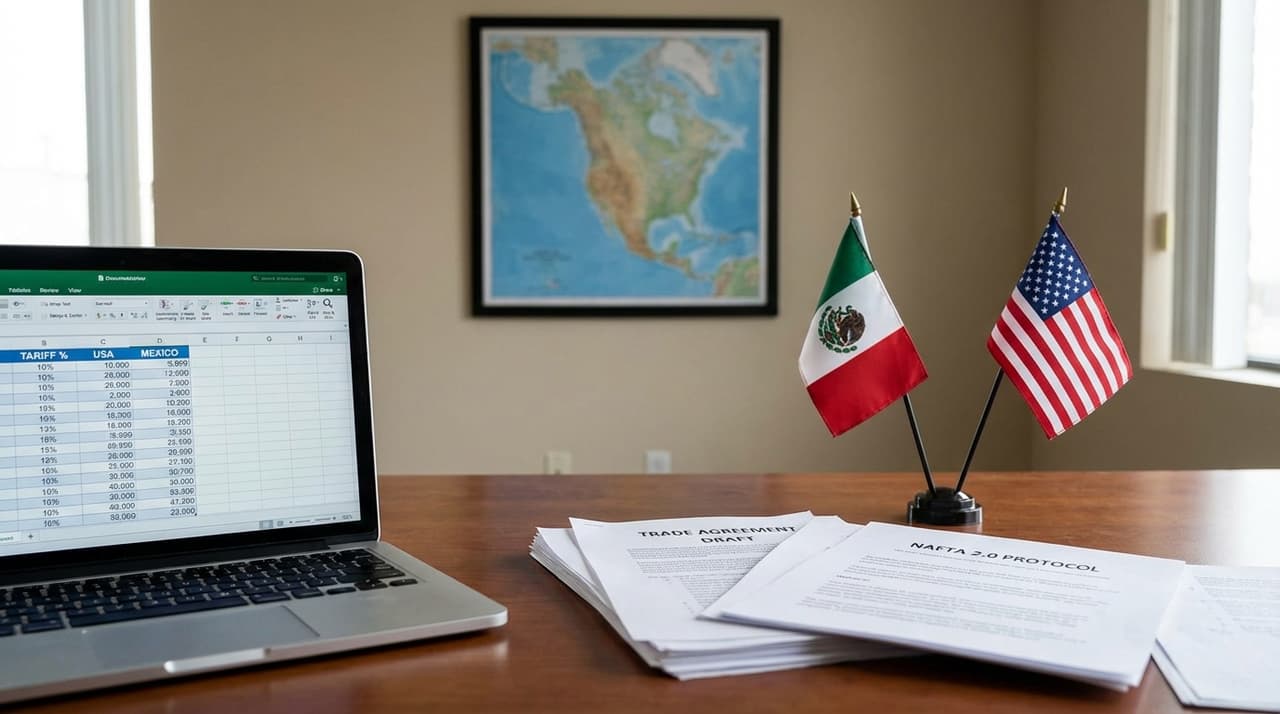
- Mexico's President Sheinbaum emphasizes progress in negotiations to avert U.S. tariffs, with no concrete deal yet as the 2026 USMCA review approaches.
- Mexico has implemented higher import tariffs on over 1,463 non-FTA product lines, targeting China and others to boost local production, while maintaining exemptions for USMCA partners.
- Nearshoring momentum continues, supported by USMCA stability and Mexico's infrastructure investments, though 2026 investment may pause due to review uncertainty.
Quiet Diplomacy Amid Escalating Tensions
Mexican President Claudia Sheinbaum's statement that "there is nothing concrete but we are progressing well" on a trade deal reflects ongoing diplomatic efforts to mitigate U.S. tariff threats, according to people familiar with the negotiations. Since mid-2025, Sheinbaum has pursued quiet diplomacy, offering verifiable actions like enhanced border enforcement to avoid U.S. blanket tariffs of up to 30% on Mexican goods, which have been paused repeatedly with USMCA-compliant items exempted. A comprehensive proposal was sent to the U.S., leading to a partial April 2025 agreement on water sharing from the Rio Grande, but no full trade deal has been reached as the 2026 USMCA review looms.
Mexico formalized higher import tariffs on over 1,463 non-FTA product lines, including automotive parts, steel, and textiles, effective January 1, 2026. These measures aim to boost local production without affecting USMCA partners, targeting China and others to reindustrialize sectors like automotive and plastics, protecting jobs and supply chains amid global vulnerabilities. The Mexican auto association (AMIA) has backed select tariffs but warned of potential investment freezes if broader tensions escalate, highlighting the delicate balance Sheinbaum faces.
Economic Implications and Market Trends
U.S. tariffs threaten Mexico's export-dependent economy, particularly in autos where USMCA rules of origin are key, but exemptions and diplomacy have maintained an effective tariff rate of 8.28% compared to China's 39%+, aiding nearshoring momentum. Nearshoring from Asia continues, supported by USMCA stability and Mexico's infrastructure investments, though 2026 investment may pause due to review uncertainty. Automotive industry stakeholders support vehicle tariffs on non-FTA imports but caution on broader impacts, with one executive noting, "We're seeing steady interest, but investors are holding back until the review outcome is clearer."
Sheinbaum's strategy focuses on "better conditions" via diplomacy, promoting import substitution such as boosting corn and fuel production, while courting China selectively. U.S. pressures under the Trump administration include reciprocal tariffs and USMCA tweaks for higher U.S. content in autos. The 2026 review risks unequal extension, with potential WTO fallback or U.S.-favoring bilaterals, adding to market jitters. Internationally, Mexico balances U.S. ties against China exposure, with recent Customs Law reforms in November 2025 adding compliance burdens for U.S. exporters.
Future Outlook and Stakeholder Reactions
In the short term, USMCA is likely to extend with U.S.-mandated auto content thresholds and tariff quotas, avoiding worst tariffs but eroding partner equality. Sheinbaum's diplomacy risks political costs without firm U.S. benchmarks, as public and political pressure mounts if negotiations falter. Long-term scenarios include a potential bilateral U.S.-Mexico framework favoring the U.S., WTO limits, or diversified trade against China. Experts predict subdued 2026 growth and investment tied to the review outcome, with port upgrades and infrastructure projects pending clarity.
Attempts to reach the Mexican presidency for further comment were unsuccessful, but sources indicate that efforts to restructure trade terms have hit a snag, with ongoing talks focusing on migration, narcotics, and trade rules. Without a deal, Mexico could face renewed tariff pressures, impacting its export economy. Meanwhile, Canada faces 35% tariffs since August 2025, prompting joint concessions for USMCA extension, adding complexity to regional dynamics. Broader U.S. global tariffs, including a 10% baseline paused initially, and China's targeting parallel Mexico's non-FTA hikes, underscore the interconnected challenges.
Correction: An earlier version misstated the effective date of Mexico's tariff hikes; it is January 1, 2026, not 2025.