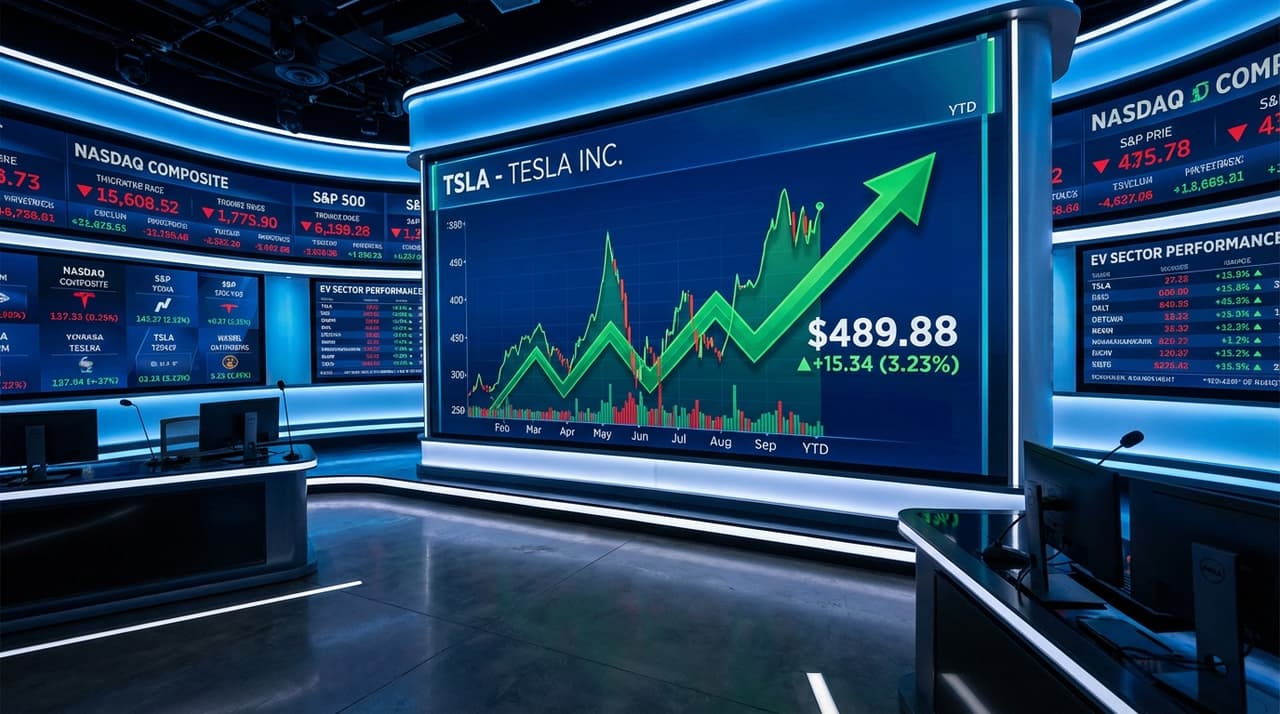
- Tesla (TSLA)'s stock reaches an all-time high closing price of $489.88 per share, valuing the company at over $1.5 trillion.
- CEO Elon Musk's refocus on EV business and a proposed $1 trillion compensation package drive investor optimism amid AI-driven rallies.
- Recent volatility includes a 21.75% drop over four weeks, highlighting market sensitivity to autonomy milestones and economic factors.
Tesla shares surged to a record high, closing at $489.88 per share around December 16, 2025, pushing the electric vehicle giant's market capitalization above $1.5 trillion. This milestone caps a dramatic rebound from a first-quarter collapse where shares nearly halved due to global sales declines, according to recent market data. By December 19, the stock traded at $481.20, down 0.45% for the day, but still reflecting a 13.92% gain over the past 12 months. The rally has been fueled by a combination of leadership shifts, economic tailwinds, and advancements in autonomous driving technology.
In April 2025, CEO Elon Musk stepped back from leading the Department of Government Efficiency (DOGE), refocusing on Tesla's core EV operations and sparking a 25% stock rally over four days. "Musk's renewed commitment to Tesla is a key driver of investor confidence," said a source familiar with the matter, who spoke on condition of anonymity. Efforts to reach Tesla for additional comment were not immediately successful. This move, coupled with a proposed $1 trillion compensation package for Musk approved in November—which boosted shares 17% weekly—has reinforced perceptions of his long-term involvement. In mid-September, Musk personally bought back $1 billion in Tesla stock, driving a 7-8% surge and signaling strong insider belief in the company's trajectory.
The broader economic landscape has played a significant role. Tesla benefited from the roaring AI trade and market rallies, including a May 2025 US-China trade truce that lowered tariffs for 90 days, contributing to a 17% stock rise. Fed comments in November securing a December rate cut added a 10% weekly gain, amid positive US economic indicators like higher stock indices. However, the path hasn't been smooth: global EV sales pressures earlier contributed to Q1 declines, and recent data shows a 21.75% drop over the prior four weeks, underscoring ongoing volatility. Analysts note that Tesla's AI-driven optimism, centered on projects like the Robotaxi and Dojo supercomputer, alongside potential synergies with SpaceX—such as AI chips in space—has fueled recovery, but debates persist over whether valuation is running ahead of fundamentals.
Looking ahead, short-term momentum hinges on key developments like the imminent removal of safety drivers for Robotaxi services in Austin, which could boost autonomy revenue. Rumors of a SpaceX IPO launch might further aid Tesla through AI chip and datacenter synergies, according to industry insiders. In the auto sector, peers like Aptiv (APTV) and BMW (BMW.DE) have shown gains amid broader market rallies, with the Nasdaq up 1.31% recently. Forecasts predict Tesla could reach $465.99 by quarter-end, but risks remain if financial growth lags behind the current hype. As one investor put it, "Tesla's surge excites shareholders, but we're watching closely to see if the fundamentals catch up to the stock price."