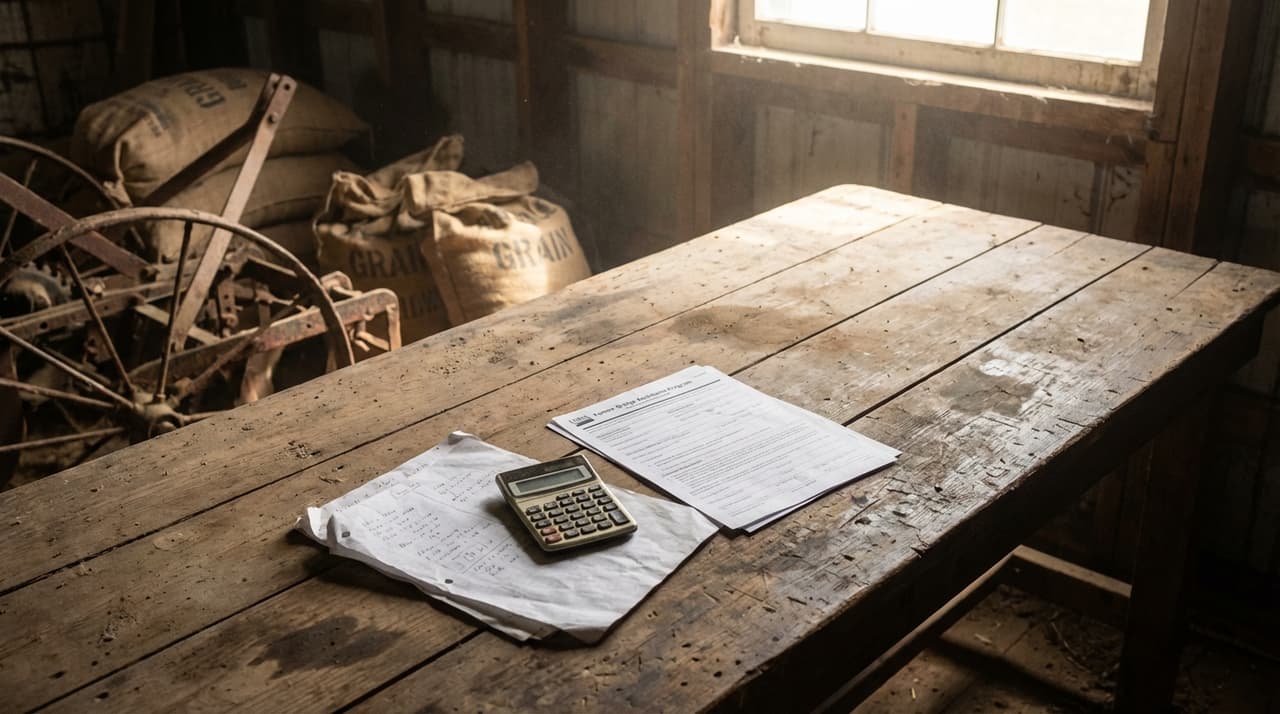
- The White House will announce a $12 billion aid package for U.S. farmers hit by low crop prices and export losses from tariff-driven trade disputes.
- Up to $11 billion will be delivered as one-time direct payments to crop farmers through a new USDA program, with the remainder for uncovered crops.
- The move revives a strategy used during the 2018–19 U.S.-China trade war and comes ahead of the 2026 midterm elections.
A Familiar Response to Trade War Pain
President Trump is set to unveil a $12 billion farm aid package, according to White House officials, aiming to support U.S. agricultural producers grappling with the fallout from renewed trade conflicts. The package, framed publicly as $15.5 billion in Singapore dollars, will be announced at an event with producers of corn, cotton, sorghum, soybeans, rice, cattle, wheat, and potatoes, signaling a targeted approach to sectors most affected by export disruptions.
Efforts to mitigate the economic strain on farming communities have accelerated in recent weeks, with the administration leaning on authority under the Commodity Credit Corporation Charter Act to expedite payments. The funding will be administered by the USDA’s Farm Service Agency, leveraging existing infrastructure that previously disbursed about $28 billion in aid during Trump’s first term. This latest intervention underscores the persistent challenges in U.S.-China trade relations, where soybean purchases "completely stalled" earlier in 2025 before partially resuming after an October agreement between Trump and Xi Jinping.
Direct Payments and Political Timing
Up to $11 billion of the package will flow to crop farmers through a new USDA program called Farmer Bridge Assistance (FBA), designed to provide one-time direct payments. The remainder is earmarked for crops not covered by FBA, ensuring broader sectoral support. This comes on top of the Emergency Commodity Assistance Program (ECAP), which authorized up to $10 billion in late 2024 and has already paid out more than $9 billion, mainly to corn and soybean growers, according to recent USDA data.
The announcement, expected to feature Treasury Secretary Scott Bessent and Agriculture Secretary Brooke Rollins, arrives amid mounting frustration among Republican lawmakers over rural economic distress. With the 2026 midterm elections looming, the aid is seen as a crucial move to shore up support in farming communities that voted overwhelmingly for Trump in 2024. "This is about stabilizing cash flow in the short term," said one person familiar with the matter, who noted that export markets have dried up and federal safety-net programs have shrunk during Trump’s second term.
Structural Dependencies and Market Realities
While the aid may boost nominal net farm income—projected to jump 40.7% in 2025 to $179.8 billion—about $40.5 billion in direct government payments will account for 78% of that increase, highlighting heavy reliance on federal support. Crop receipts are forecast to decline 2.5% to $236.6 billion, with soybean prices lingering near 2020 lows despite a recent futures rally on hopes of renewed Chinese demand. Production expenses, meanwhile, are projected to rise 2.6% to $467.4 billion, squeezing margins even with aid.
Critics argue that repeated emergency payments create cyclical dependency, masking structural issues like export competitiveness and market volatility. Complex compliance rules and payment caps—reportedly between $125,000 and $250,000 per farm—could disproportionately affect smaller operations with limited administrative capacity. Larger farms, however, are better positioned to navigate the paperwork and capture a greater share of benefits, according to industry analysts.
Looking Ahead: Short-Term Relief vs. Long-Term Risks
In the short term, the $12 billion package is expected to temper political backlash and provide liquidity to farmers facing a cost-price squeeze. But without a more durable trade policy or market diversification, analysts warn that further rounds of aid may be necessary if the U.S.-China conflict persists. The earlier trade war pushed China to deepen its reliance on Brazilian soybeans, a shift that continues to constrain U.S. exporters and shape global supply chains.
Policy and market experts describe the package as critical but stopgap, mirroring the 2018–19 models without resolving underlying vulnerabilities. As one analyst put it, "It’s a Band-Aid on a wound that needs stitches." The administration has not indicated plans for broader farm-policy reform, relying instead on Farm Bill extensions and ad-hoc measures. Attempts to reach the USDA for additional comment on implementation timelines were not immediately successful.
Correction: An earlier version of this article misstated the total value of the aid package in Singapore dollars; it is $15.5 billion, not $15 billion.