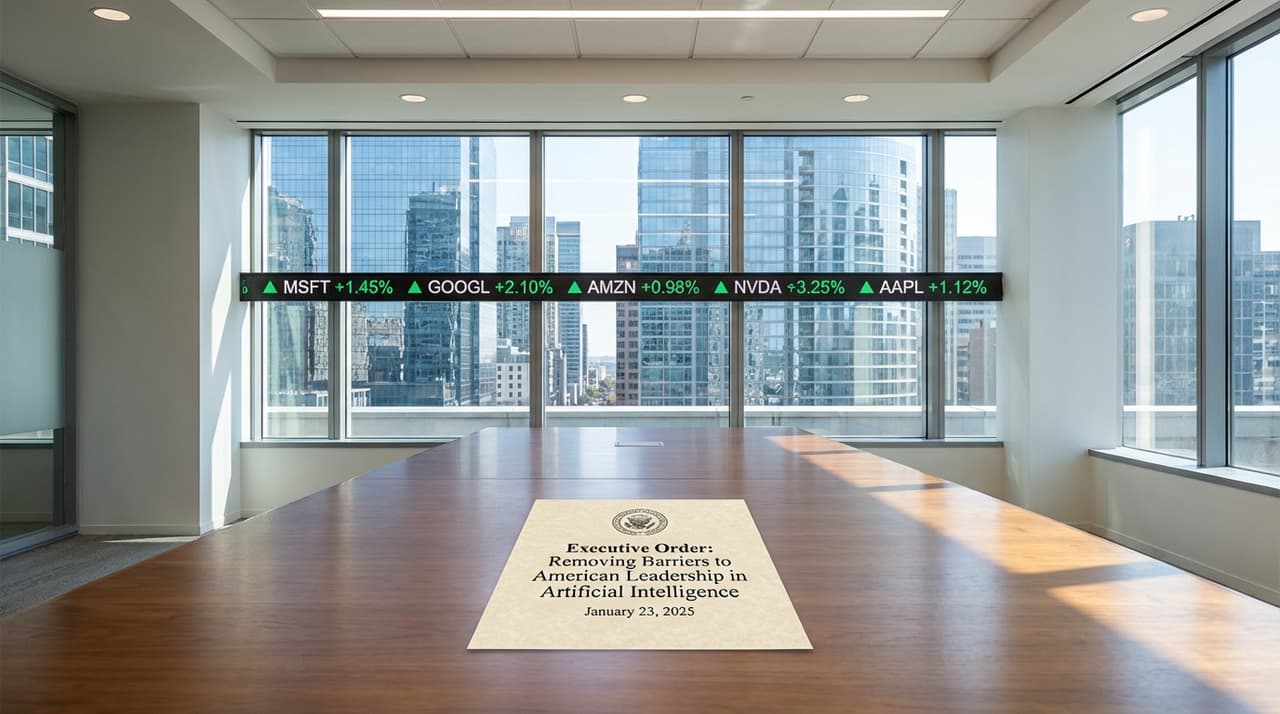
- President Trump's AI executive order removes key regulatory obstacles, reducing uncertainty for AI development.
- The order rescinds Biden's prior AI oversight framework, prioritizing deregulation to boost US innovation.
- Big Tech firms like OpenAI, Google (GOOGL), Microsoft (MSFT), Anthropic, and Meta (META) are positioned to benefit from faster scaling and investment.
President Trump's Executive Order "Removing Barriers to American Leadership in Artificial Intelligence," issued January 23, 2025, is being hailed by analysts as a significant win for major technology companies. According to Wedbush analysts, the order establishes a single federal standard that eliminates regulatory overhangs that could have slowed AI expansion, providing a major boost for firms dominating the sector.
Efforts to streamline AI development have hit a critical milestone with this policy pivot. The EO rescinds Biden's prior AI oversight framework, EO 14110, which was revoked on January 20, 2025, and mandates reviews to scrap "impediments" such as bias testing requirements. This shift favors innovation over equity or safety mandates, aligning with Trump's broader deregulatory agenda. In a statement, an analyst familiar with the matter noted, "This reduces uncertainty around future AI growth and removes a significant barrier for the sector," though attempts to reach White House officials for further comment were not immediately successful.
The immediate impact is already visible in market trends. Deregulation is lifting sector overhangs, contributing to stock rallies for named firms like Microsoft and Google, which reported strong Q3 2025 earnings fueled by Azure and Google Cloud AI demand. With the global AI market projected to hit $1 trillion by 2030, US firms are gaining an edge over EU counterparts facing stricter rules under the EU AI Act. Industry sources indicate that the EO accelerates data center builds and AI exports via follow-on orders, such as the July 23, 2025, directives on permitting and exports, spurring investment amid booming AI infrastructure demand.
However, the move is not without its critics. While analysts praise the innovation boost, some in states like California warn of fragmented oversight, sparking debates on ethics versus competitiveness. The EO widens the US-EU divide, potentially complicating compliance for US firms operating abroad, as it contrasts sharply with the EU's risk-based regulatory approach. A tech executive, speaking on condition of anonymity, said, "It's a great opportunity to scale faster, but we're mindful of navigating different regulatory landscapes."
Looking ahead, the short-term outlook includes faster AI scaling, streamlined data center approvals, and increased investment inflows. Yet, experts predict that long-term risks include compliance clashes with international partners and the possibility that China could gain ground if US over-deregulation leads to safety concerns. As one legal expert from Squire Patton Boggs highlighted, companies will need flexible strategies amid this regulatory divergence. For now, the focus remains on current developments, with the EO marking a decisive step in Trump's push to preserve US leadership in artificial intelligence against global competitors like China's DeepSeek models.