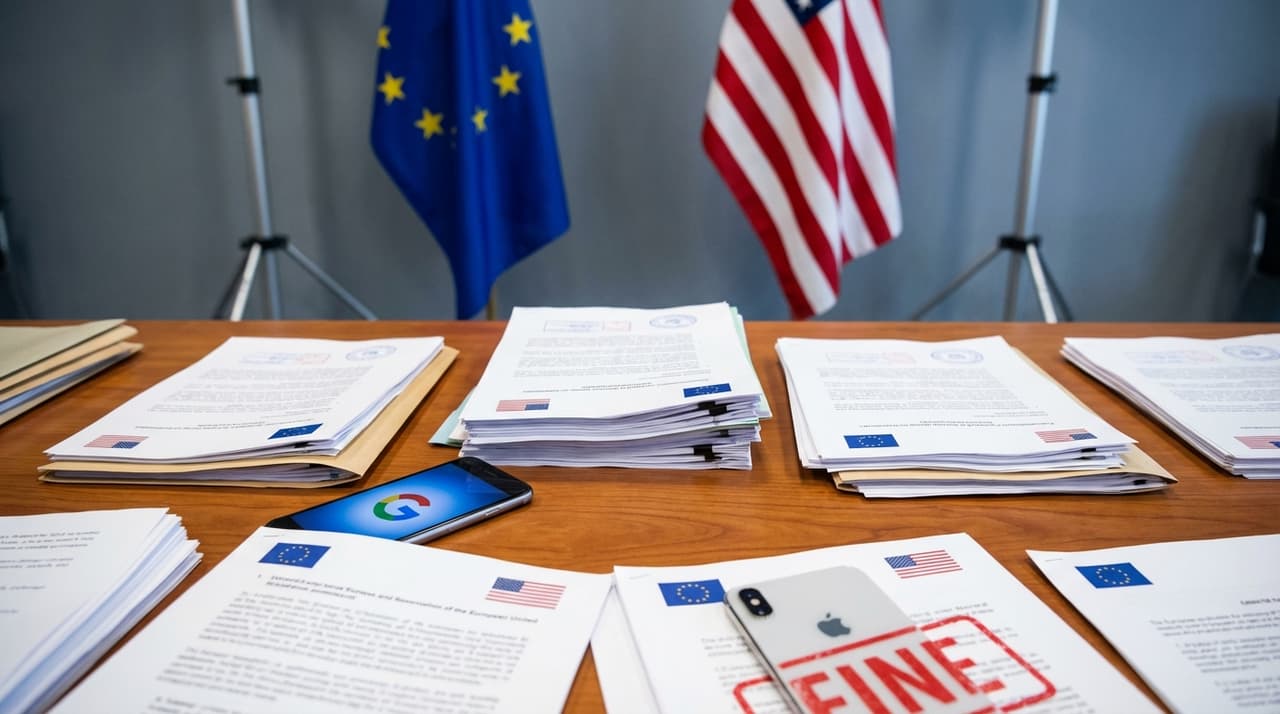
- Trump criticizes EU fines as discriminatory, vowing retaliation via tariffs and investigations.
- Recent EU actions include billions in penalties on Google (GOOGL), Apple (AAPL), Meta (META), and X (TSLA) for DMA/DSA violations.
- Tensions risk unraveling a recent U.S.-EU trade deal and escalating into a broader trade war.
Efforts to ease transatlantic tensions have hit a snag as former President Donald Trump publicly lambasts European Union fines on U.S. technology companies, calling them "very unfair" and threatening swift retaliation. According to people familiar with the matter, Trump views these penalties as economic warfare, with his administration preparing to leverage tariffs and Section 301 investigations to protect American firms.
The EU has imposed significant fines in recent months, including a €2.95 billion penalty on Google in September 2025 for antitrust breaches under the Digital Markets Act, followed by €500 million on Apple, €200 million on Meta in April, and €120 million on X in December 2025 for similar violations. These actions stem from regulations like the DMA and Digital Services Act, which mandate stricter content removal, data restrictions, and fair competition for digital "gatekeepers." Without a deal to curb these fines, U.S. companies could face mounting compliance costs that erode their European profits, which account for roughly 20-30% of revenue for some giants.
In a Truth Social post last August, Trump vowed to fight what he termed discriminatory EU digital rules, and last month, his administration barred several EU officials, including Thierry Breton, from entering the U.S. over allegations of censorship. The U.S. Trade Representative has accused the EU of harassment through fines and taxes, with retaliation potentially targeting European firms such as Spotify (SPOT) and Siemens (SIEGY). "What institutional investors like us are really focused on is regulatory stability," a source close to the discussions noted, echoing concerns from the financial sector about the volatile climate.
Despite the pressure, the EU plans tougher enforcement in 2026, including cloud probes on Amazon (AMZN) and Microsoft (MSFT) slated for November 2025, which could further strain relations. The recent U.S.-EU trade framework from July 2025, which cut tariffs to 15%, is now at risk, imperiling a $1.5 trillion economic relationship. Industry shifts are underway, with the U.S. pushing deregulation abroad to mirror its domestic AI order, while the EU eyes initiatives like the Digital Networks Act to promote digital sovereignty and reduce dependence on U.S. and Chinese tech.
Public reactions have been mixed: EU officials cry intimidation over the travel bans, while Silicon Valley increasingly sees the bloc as an adversary. Critics argue that fines, though aiding journalism revenue sharing, may hobble U.S. platforms and lead to higher prices for consumers due to potential tariffs. As one analyst put it, "It's much more of a convergence between competition and protectionism, with both sides digging in."
Short-term, a Section 301 probe is likely to result in tariffs on EU goods, potentially unraveling the July deal and prompting EU retaliation that could hit U.S. energy exports. Long-term, experts predict a transatlantic conflict that accelerates digital independence, with tit-for-tat fines continuing into 2026 antitrust trends. The situation remains fluid, with ongoing negotiations and market watchers closely monitoring real-time developments.