- President Trump hosts first-ever White House visit by a Syrian president, pledging support for Syria's stability and welcoming the country into the US-led anti-Islamic State coalition.
- The meeting follows the removal of terrorist designations from Syrian President Ahmad al-Sharaa and Interior Minister Anas Khattab, marking a dramatic shift in US-Syria relations after the fall of the Assad regime.
- The US announces plans to lift economic restrictions on Syria and provide compliance clarity for investors to facilitate reconstruction, with bipartisan congressional support for repealing stringent sanctions.
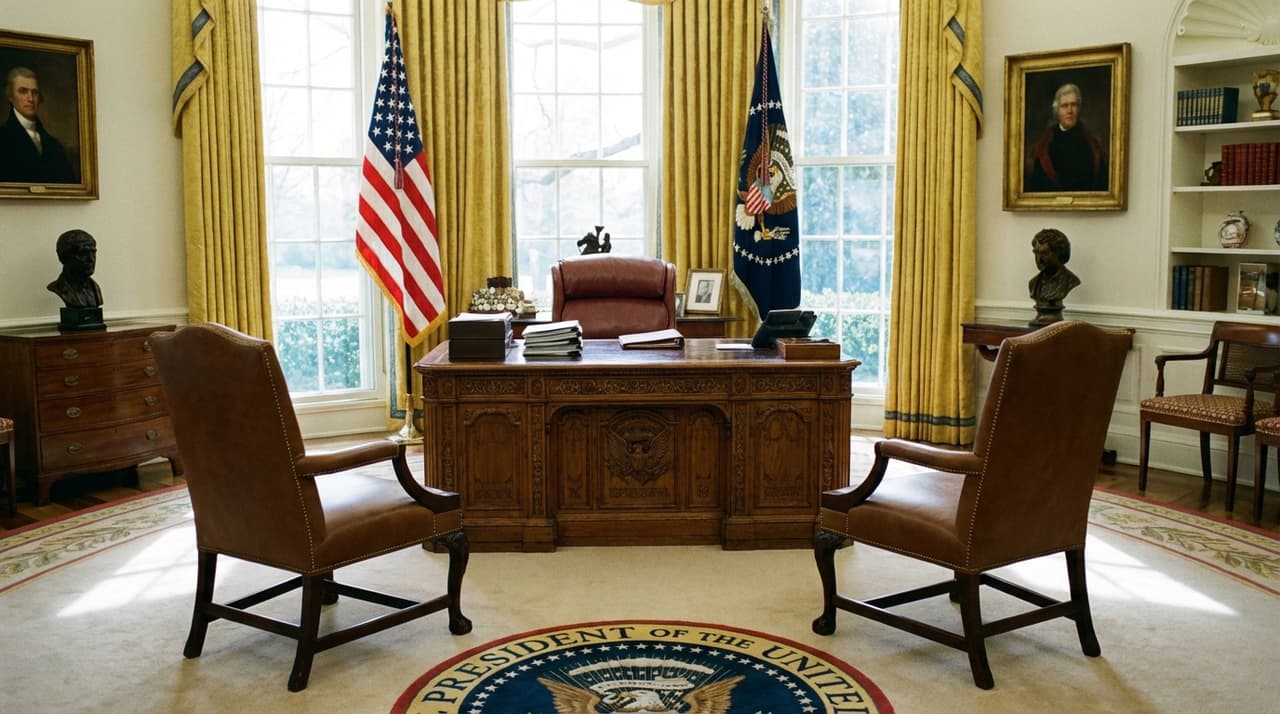
President Trump met with Syrian President Ahmad al-Sharaa at the White House on November 10, 2025, in a closed-door Oval Office session that included Syria's Foreign Minister Asaad Hassan al-Shaibani, US Secretary of State Marco Rubio, and US Special Envoy to Syria Thomas Barrack. According to people familiar with the matter, Trump expressed strong support for al-Sharaa, stating "I liked him...I get along with him" and vowing to "do everything we can to make Syria successful."
This historic meeting—the first official White House visit by a Syrian president—comes just days after the United States removed terrorist designations from al-Sharaa and Khattab, recognizing progress made since the fall of the Assad regime in December 2024. The move followed a UN Security Council vote (14-0 with one abstention) to lift similar sanctions, signaling that "Syria is in a new era since Assad and his associates were toppled." Al-Sharaa's rehabilitation is particularly notable given his history as the former leader of an al-Qaeda-designated terror group who once had a $10 million US bounty on his head and served time in Abu Ghraib prison.
Syria has now become the 90th country to join the US-led global coalition against the Islamic State group, which includes approximately 80 countries working to prevent extremist resurgence. The meeting focused primarily on counterterrorism cooperation and regional security efforts, with Trump indicating plans for additional meetings with al-Sharaa to continue these efforts. Efforts to reach the Syrian delegation for further comment were unsuccessful as of press time.
In a significant economic development, the US announced plans to lift economic restrictions on Syria and provide compliance clarity for investors to facilitate reconstruction. There is ongoing congressional effort to fully repeal stringent sanctions imposed in 2019, with bipartisan support arguing that these sanctions have become obstacles to Syria's stability and economic development. The Trump administration indicated this represents "Syria's chance at greatness," though the long-term success will depend on al-Sharaa's ability to consolidate power, address terrorist threats, and navigate regional dynamics—particularly given Syria's historical ties to Iran and Russia.
Correction: An earlier version of this article misstated the number of countries in the anti-Islamic State coalition; it is approximately 80 countries, not 90.