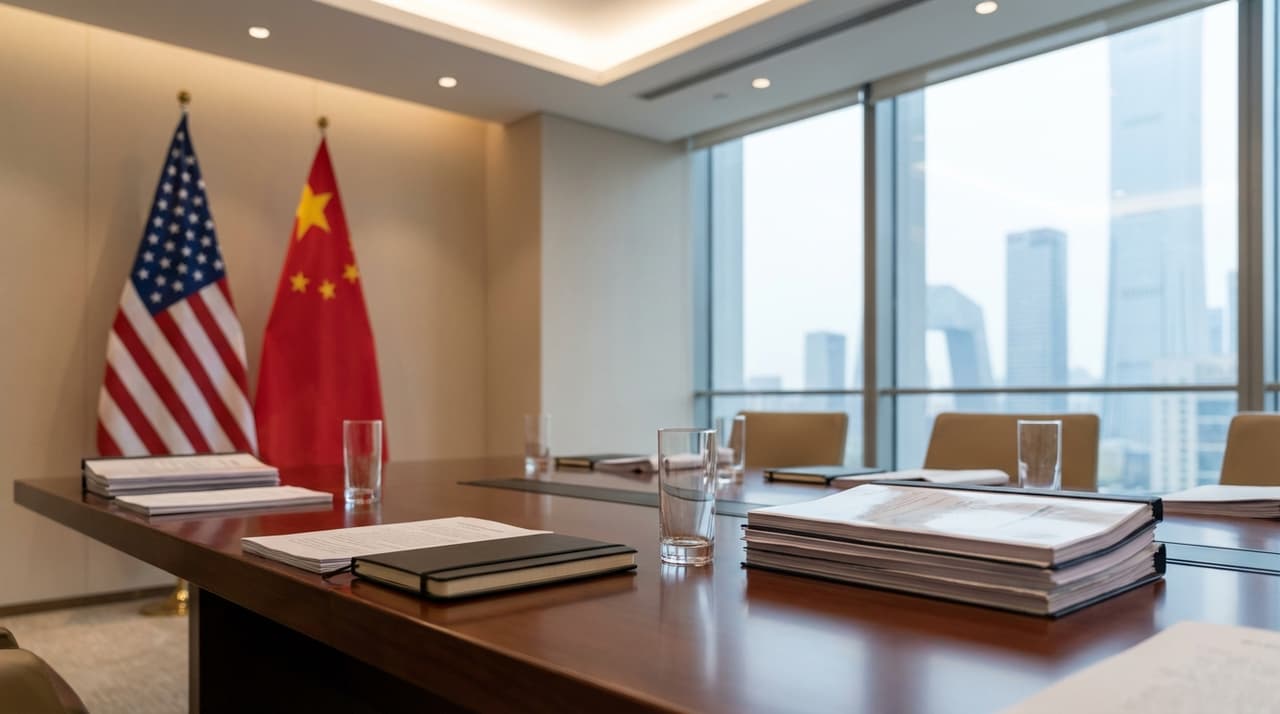
- President Donald Trump accepts Xi Jinping's invitation to Beijing in April 2026, marking the second in-person meeting of Trump's second term.
- U.S. Treasury Secretary Scott Bessent signals up to four Trump-Xi meetings in 2026, aiming to stabilize global markets amid ongoing trade tensions.
- Key unresolved issues like semiconductors and critical minerals loom, even as China commits to purchasing 87.5 million metric tons of U.S. soybeans over three and a half years.
President Donald Trump said he accepted Xi Jinping's invitation to visit Beijing in April 2026, according to people familiar with the matter, setting the stage for a critical diplomatic engagement that could shape the trajectory of U.S.-China relations. This meeting, part of a broader strategy by both governments, follows their first in-person encounter of Trump's second term in Busan, South Korea, on October 30, 2025, which focused narrowly on trade while avoiding the most sensitive strategic issues in public, notably Taiwan.
U.S. Treasury Secretary Scott Bessent has indicated there could be up to four Trump-Xi meetings in 2026, including the April Beijing visit, a U.S. state visit for Xi later in the year, a G20 gathering at Trump's Doral resort, and a possible APEC meeting in Shenzhen. This flurry of planned diplomacy is explicitly framed as a way to maintain a fragile trade truce and provide stability for global markets, which have been rattled by years of tariffs and export controls. Bessent noted that China is on schedule to purchase at least 87.5 million metric tons of U.S. soybeans over three and a half years, underscoring agriculture's central role in the deal and its importance for U.S. farm states.
Yet, key unresolved frictions persist, particularly around semiconductors and critical minerals, where export controls and industrial policy on both sides continue to generate uncertainty for supply chains. Efforts to reach a more comprehensive agreement have hit a snag, with officials on both sides acknowledging that deeper strategic rivalries complicate economic negotiations. Without a deal, companies in technology and manufacturing sectors face ongoing volatility, as these issues are expected to be on or near the agenda in April.
According to U.S. officials, Trump and Xi agreed to cooperate on ending Russia's war in Ukraine, while the U.S. position that Taiwan's status has not changed was reaffirmed publicly. However, Xi has hardened rhetoric on Taiwan in recent months, and regional tensions—especially involving Japan's potential role if conflict breaks out—remain high. Allies in Asia, such as Japan and South Korea, are closely watching for any U.S. concessions on security issues in exchange for economic gains, which fuels debate over trust and alignment in the region.
Analysts describe Beijing's approach as blending "great power competition" with Xi's "art of struggle," using engagement with Trump to seek economic relief while preserving long-term strategic leverage. In the short term, multiple high-level meetings in 2026 are expected to reduce the risk of sudden escalation and support a relatively stable economic environment, particularly for trade-exposed sectors. But longer term, experts warn that structural rivalry over technology, security architecture in the Indo-Pacific, and Taiwan's status will persist, so any stability from the April visit is likely to be tactical rather than transformational.
Policy analysts highlight the April Beijing summit as a "key event to watch" for signs of whether both governments can compartmentalize strategic competition and maintain economic engagement. Attempts to reach out to the White House and Chinese embassy for additional comments were not immediately successful. Meanwhile, other major powers like the EU and Japan are simultaneously hedging and diversifying supply chains away from over-reliance on either the U.S. or China, reflecting a broader global trend of de-risking amid U.S.-China competition.
Correction: An earlier version of this article misstated the timeline for soybean purchases; it has been updated to reflect the three-and-a-half-year period as confirmed by U.S. officials.