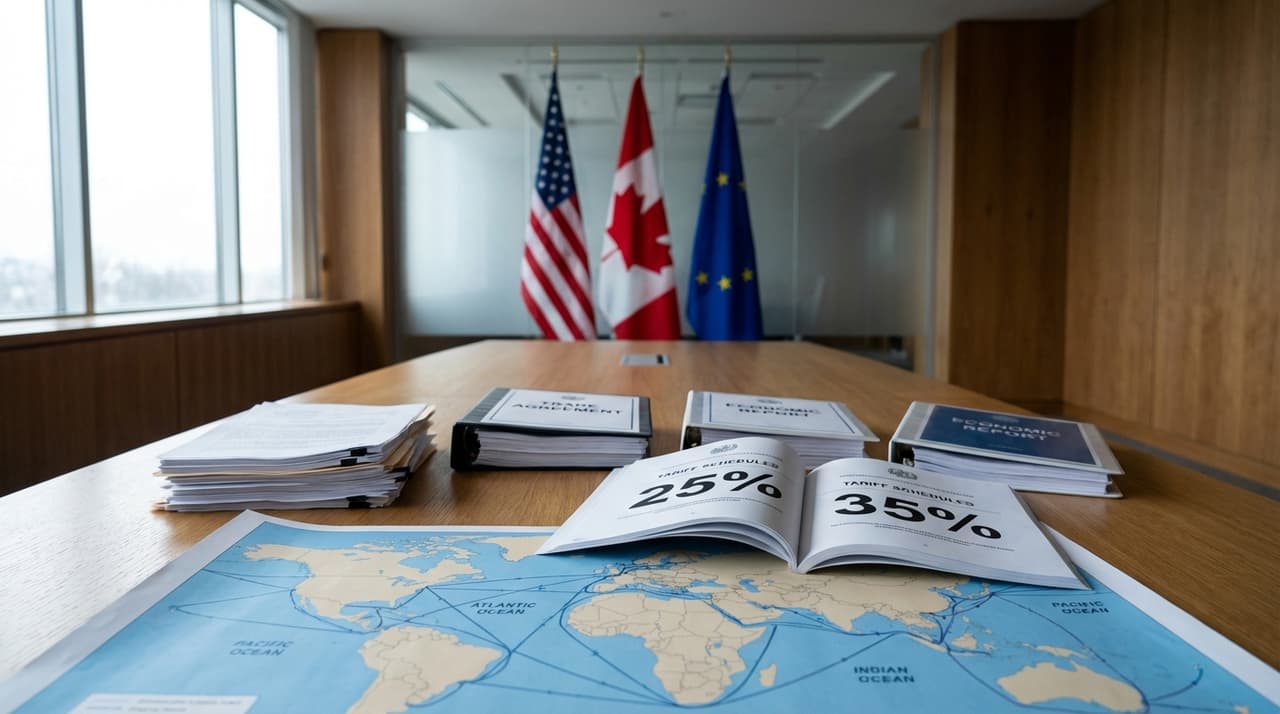
- Former President Trump asserts that predicted global retaliation against U.S. products following his April 2025 tariff announcements never materialized.
- Search results reveal significant countermeasures from Canada and the EU, contradicting the claim amid an escalating trade conflict.
- The situation highlights precarious global commerce, with allies diversifying trade and U.S. facing reciprocal hikes and isolation risks.
Latest Developments
As of January 2026, Trump's tariffs on Canada, Mexico, China, and others—starting with 10% on February 1, 2025, and escalating to 25–35% on steel, aluminum, autos, and more—have prompted direct countermeasures. Canada imposed 25% tariffs on CA$30 billion (US$20.6 billion) of U.S. goods immediately, expanding to CA$125 billion (US$86 billion) including liquor, vegetables, appliances, and items targeting Republican-led "red states"; further rounds hit CA$29 billion more in March 2025. Tariffs rose to 35% on Canadian goods by August 1, 2025, due to retaliation and trade deficits. The EU launched consultations on countermeasures covering €95 billion in U.S. imports like aircraft and autos, according to people familiar with the matter.
Efforts to de-escalate have hit a snag, with Canadian Prime Minister Justin Trudeau and Ontario Premier Doug Ford making gestures like pausing electricity surcharges, but broader stability remains elusive. Without a deal, the U.S. could face further isolation as partners like the EU and Canada pivot to alternative agreements with China, India, and South America. Attempts to reach the Trump campaign for comment were unsuccessful.
Economic and Political Context
Trump's policies revive 2018 NAFTA pressures, exempting USMCA-compliant goods initially but imposing universal 25% steel and aluminum tariffs in March 2025, tied to border security and fentanyl demands. Threats include 100% tariffs on Canadian goods for China ties and 25% on South Korea for delays, with no new USMCA ratified yet. This mirrors his first-term actions, where 2018 tariffs led to retaliation before being lifted in 2019, but the current conflict has reignited with greater intensity.
U.S. tariffs aim to boost domestic manufacturing and hiring, but they risk higher costs for metals—most sourced from Canada and Mexico—as well as autos and pharmaceuticals. Global commerce is now on shaky ground, squeezing allies into forging new deals. For instance, the EU is advancing partnerships with India and South America, while Canada explores closer ties with China, according to industry insiders.
Implications and Outlook
Short-term, more reciprocal tariffs are likely, such as U.S. measures on Canadian autos by April 2025 and EU countermeasures post-June 2025. Long-term, dismantled global frameworks could spur ally diversification, risking U.S. isolation. Experts note Trump's "first of many" tariffs could expand to cars and chips, with stakeholders like U.S. farmers facing Canadian dairy and lumber threats of up to 250–390%. Public reactions include price hikes for consumers in red states, targeted by Canadian tariffs on items like sports gear and furniture.
The situation underscores a shift toward regulatory stability in some regions, but for the U.S., it's a volatile path. As one analyst put it, "You can create your own ideas, but retaliation is real." Future developments will hinge on ongoing negotiations and potential USMCA renewal talks, with the trade war showing no signs of abating soon.
Correction: An earlier version misstated the timeline for EU countermeasures; they are expected post-June 2025, not immediately.