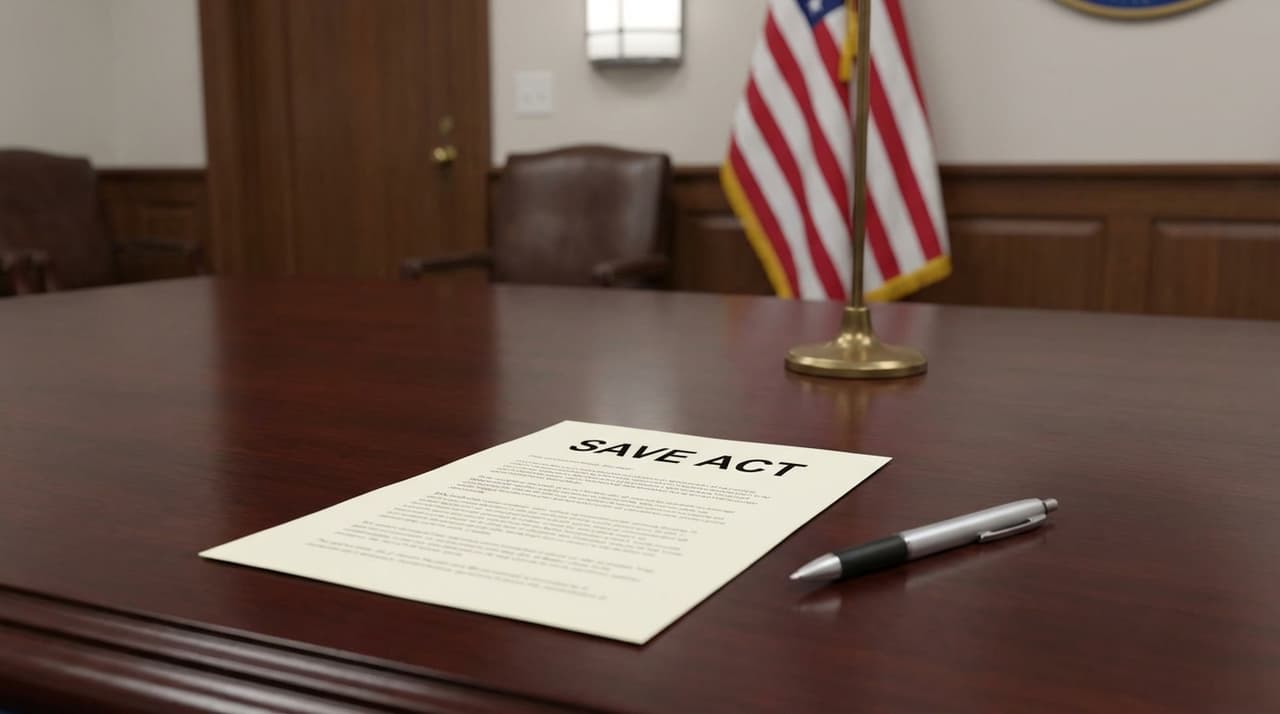
- President Trump is pursuing voter ID requirements through executive action and legislative efforts, including the SAVE Act, which passed the House but stalled in the Senate.
- The initiative faces strong opposition from Democrats and constitutional challenges, as elections are traditionally managed by states, with legal battles likely headed to the Supreme Court.
- Despite broad public support for voter ID, implementation complexities and political divisions cast doubt on near-term nationwide adoption.
President Donald Trump has intensified his call for mandatory voter identification, leveraging executive authority and legislative channels to advance what he terms essential election security measures. In August 2025, Trump announced plans to sign an executive order requiring voter ID for every vote, declaring "Voter ID Must Be Part of Every Single Vote. NO EXCEPTIONS!" This move represents a significant escalation in his longstanding claims of election fraud, which he reiterated in recent social media posts alleging irregularities in the 2020 election.
Efforts to restructure election laws have hit a snag in Congress, where the SAVE Act (Secure America Through Verification), which would require proof of citizenship to vote in federal elections, passed the House in 2025 but remains stalled in the Senate. According to people familiar with the matter, Senate Democrats are united against the measure, with Minority Leader Chuck Schumer stating in April 2025 that "The SAVE Act is dead on arrival," noting it requires 60 votes to pass. Republican support, however, remains robust; Senator Mike Lee has called the act essential to "SAVE America."
Without a deal, Trump's executive order could face immediate legal challenges, as experts argue he lacks constitutional authority over elections, which are reserved to states with Congressional oversight. Trump has hinted at using emergency powers to bypass normal legislative processes, claiming that "states are merely an 'agent' for the Federal Government in counting and tabulating the votes." This stance marks a departure from conservative principles on federalism and could trigger swift court actions, with ultimate resolution likely determined by the Supreme Court.
Public opinion adds a layer of complexity: an October 2024 Gallup poll shows 84% of U.S. adults support requiring a photo ID to vote, including 98% of Republicans and two-thirds of Democrats. Yet, Democratic-led states like California are actively resisting, with legislation banning local enforcement of voter ID requirements and a voter ID initiative nearing enough signatures for a November ballot measure. California Governor Gavin Newsom has challenged Trump's fraud claims, asking for evidence that undocumented people were actually voting in the state.
Implementation hurdles further cloud the outlook. Currently, 36 states have some form of ID requirement, but they vary widely in accepted ID types and enforcement mechanisms, particularly for mail ballots. A nationwide mandate would demand significant standardization and coordination across state systems, raising practical concerns about deadlines and voter access. As negotiations continue behind the scenes, the political and legal landscape remains fluid, with market watchers noting potential impacts on election-related sectors if uncertainty persists.
Correction: An earlier version of this article misstated the number of states with voter ID requirements; it is 36, not 35.