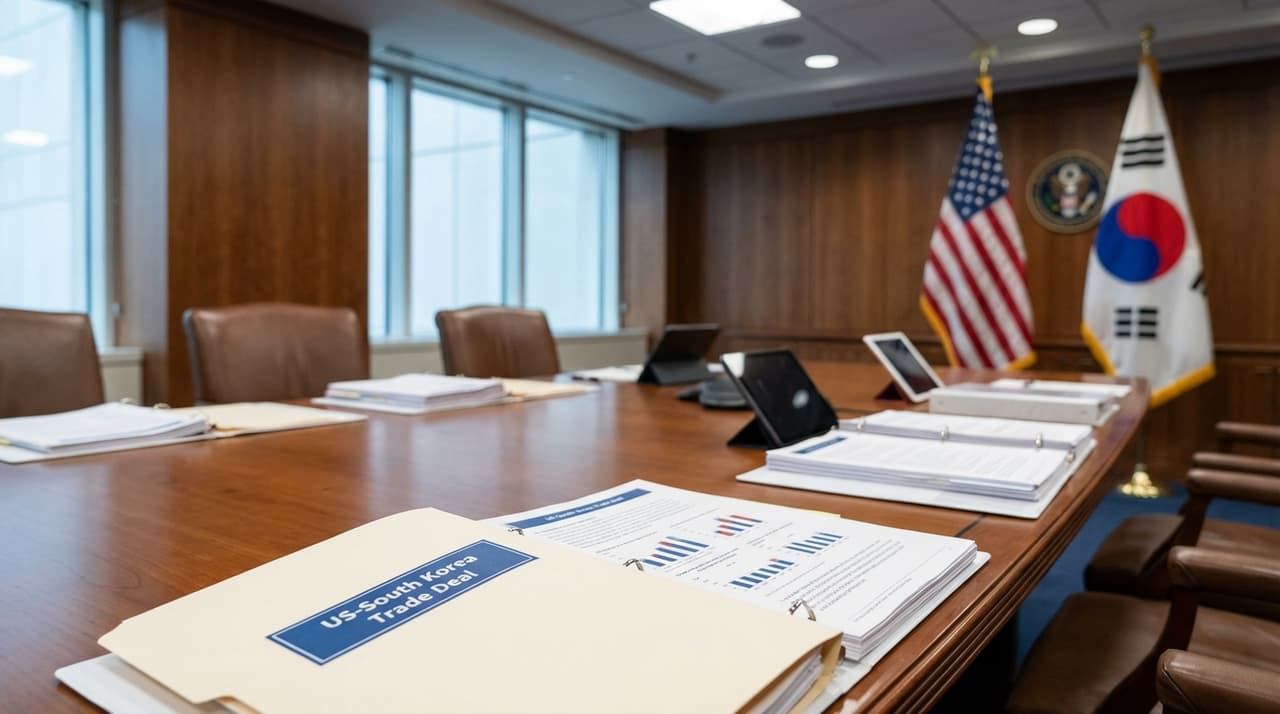
- President Trump threatens 25% tariffs on South Korean imports, citing delays in ratifying a July 2025 trade deal, but signals willingness to negotiate with "we'll work something out."
- South Korea dispatches its trade envoy to Washington for talks and accelerates efforts to pass the US investment bill in its National Assembly, aiming for a "rational solution."
- Markets initially dip but rally over 2%, viewing the threat as a negotiation tactic, with Asian stocks nearing records and gold surpassing $5,000/oz amid broader trade volatility.
President Trump's abrupt threat to impose 25% tariffs on South Korean imports has sent shockwaves through diplomatic channels, though financial markets are largely dismissing it as a high-stakes bargaining chip. The move, which targets key exports like cars and pharmaceuticals, stems from frustrations over Seoul's legislature delaying ratification of a July 2025 trade deal that included $350 billion in South Korean investments into the US in exchange for capping tariffs at 15%. According to people familiar with the matter, Trump accused Seoul of stalling, but later tempered the rhetoric by stating "we'll work something out," suggesting negotiation rather than immediate escalation.
South Korea's presidential office was not pre-notified of the threat, a detail that underscores the unpredictability of the situation. In response, officials have committed to finding a "rational solution" and are urgently pushing the US investment bill through the National Assembly. The KOSPI index initially fell 1% at the open on the news, but it rallied over 2% by midday as investors interpreted the move as a tactical ploy. "This is classic Trump—using tariffs as leverage to force action," said one market analyst who requested anonymity due to the sensitivity of ongoing talks. "The lack of an effective date for the tariffs signals this is more about pressure than policy."
Behind the scenes, efforts to restructure trade terms have hit a snag, with Seoul dispatching its trade envoy to Washington for urgent discussions. Without a deal, South Korean exporters could face significant headwinds; analysts warn that reverting to 25% tariffs from the current 15% cap could slash 2026 auto operating profits by up to 23% and erode competitiveness against Japanese and European rivals. Stakeholders like Hyundai (HYMTF) and Kia (000270.KS) are closely monitoring the talks, as profit hits loom large. A spokesperson for South Korea's trade ministry declined to comment on the specifics but emphasized that "dialogue remains open."
This episode fits into Trump's broader tariff "roller coaster," which has recently included threats of 50% tariffs on India and a stalled US-EU deal after a disagreement over Greenland. In a parallel development, India and the EU finalized a free trade agreement after 20 years of negotiations, potentially boosting EU GDP by 10 basis points and offering some offset to US tariff pressures. Meanwhile, the UK is pragmatically engaging China, with Prime Minister Keir Starmer set to meet Xi Jinping, avoiding a binary choice between US and Chinese interests.
In Seoul, a small anti-US protest outside the embassy denounced "interference," reflecting societal tensions, but broader public reaction has been minimal. The US is South Korea's second-largest trading partner, making the stakes particularly high for exporters and workers in affected industries. As talks progress, the focus is on whether Seoul can fast-track the investment bill to avert tariffs. Market sentiment remains cautiously optimistic, with Asian stocks nearing record highs and gold prices soaring past $5,000 per ounce, indicating a flight to safety amid the uncertainty. For now, the threat hangs in the balance, with both sides signaling a preference for compromise over confrontation.