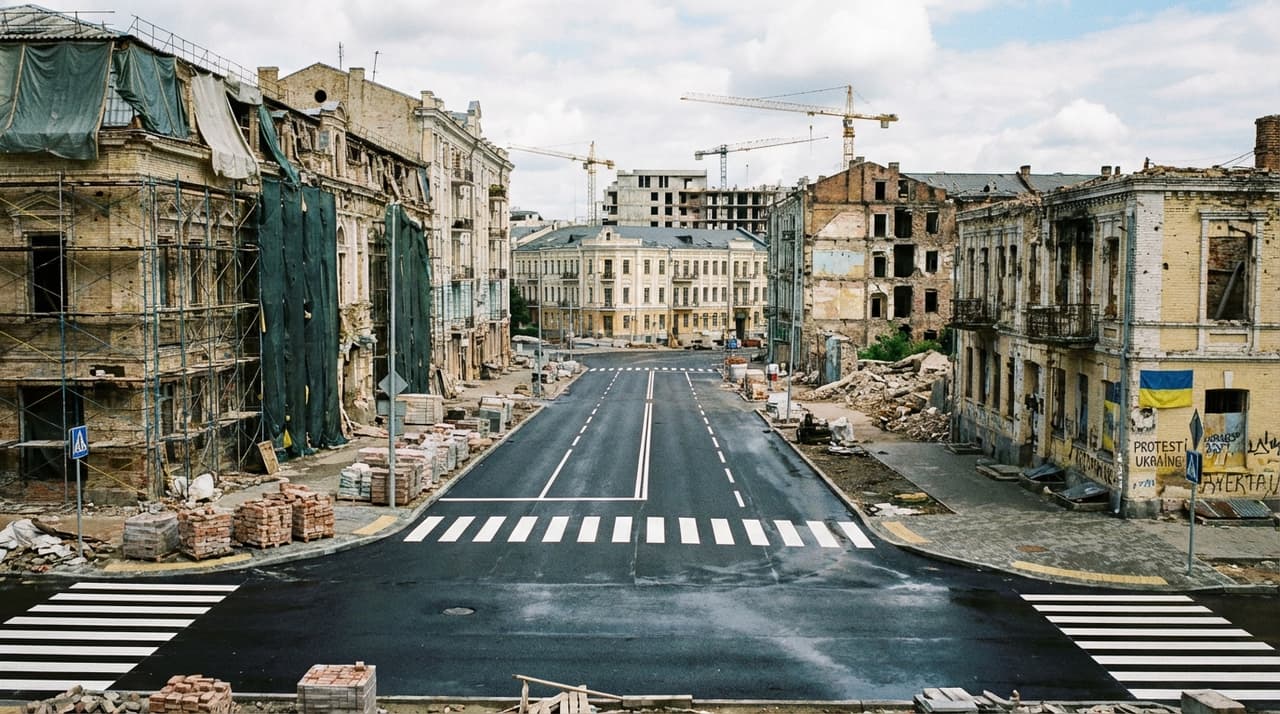
- Ukraine's 2025 reconstruction requires $17.3 billion, with $7.37 billion secured, leaving a $9.96 billion shortfall.
- International mechanisms like the EU's Ukraine Investment Framework aim to unlock billions in investments across key sectors.
- Reconstruction emphasizes "building back better" with local empowerment and EU integration, but ongoing security threats complicate efforts.
Ukraine's postwar reconstruction, one of Europe's largest economic undertakings, is advancing with measurable progress but faces significant financial hurdles. President Volodymyr Zelenskyy is actively engaging international partners to shape the recovery strategy, which addresses both immediate infrastructure damage and long-term economic modernization aligned with European Union integration. According to recent assessments, the total reconstruction cost is estimated between $486 billion and over $1 trillion, with housing alone accounting for nearly $84 billion in needs.
For 2025, priority reconstruction needs are pegged at $17.3 billion, with $7.37 billion already secured through the state budget, grants, and donor loans. This leaves a financing gap of $9.96 billion, according to people familiar with the matter. Over the past three years, Ukraine has restored 46% of damaged medical facilities and 28% of educational institutions, while more than $1 billion has been allocated to compensate for destroyed housing. In 2024 alone, at least $1.2 billion was disbursed for housing sector recovery, and over 2,000 kilometers of emergency repairs were completed on roads and highways.
Energy infrastructure protection and repair stands as a particularly urgent priority due to ongoing Russian attacks, which have disrupted logistics and planning. Efforts to secure funding have hit a snag, with private sector mobilization recognized as essential since government resources and donor money cannot cover all needs. The European Union has established a dedicated support mechanism for 2024-2027, with the Ukraine Investment Framework providing €1.4 billion in new guarantee and grant agreements to unlock €3.2 billion in support to financial intermediaries and beneficiaries. These agreements are expected to drive €10 billion in investments across municipal and social infrastructure, housing, energy, and private sector development.
Ukraine's reconstruction strategy emphasizes "building back better" rather than simply restoring pre-war conditions, focusing on institutional reform, local empowerment, and EU integration. "Rebuilding is guided by long-term vision rather than short-term fixes," one official noted, speaking on condition of anonymity. The local-first model aims to empower communities through democratic processes, with reconstruction funds flowing directly to local governments. However, without more predictable funding, preferably in grant form, the decade-long projection for completion could face delays.
The fourth Ukraine Recovery Conference, scheduled for July 10-11, 2025, in Rome, will continue high-level discussions on recovery strategy. Zelenskyy's engagement with North American and European partners reflects Ukraine's commitment to coordinating its recovery with broader geopolitical goals, but ongoing shelling and combat operations remain critical challenges. Attempts to reach Ukrainian officials for further comment were unsuccessful at press time.
Correction: An earlier version of this article misstated the total reconstruction cost range; it has been updated to reflect the correct estimate of $486 billion to over $1 trillion.