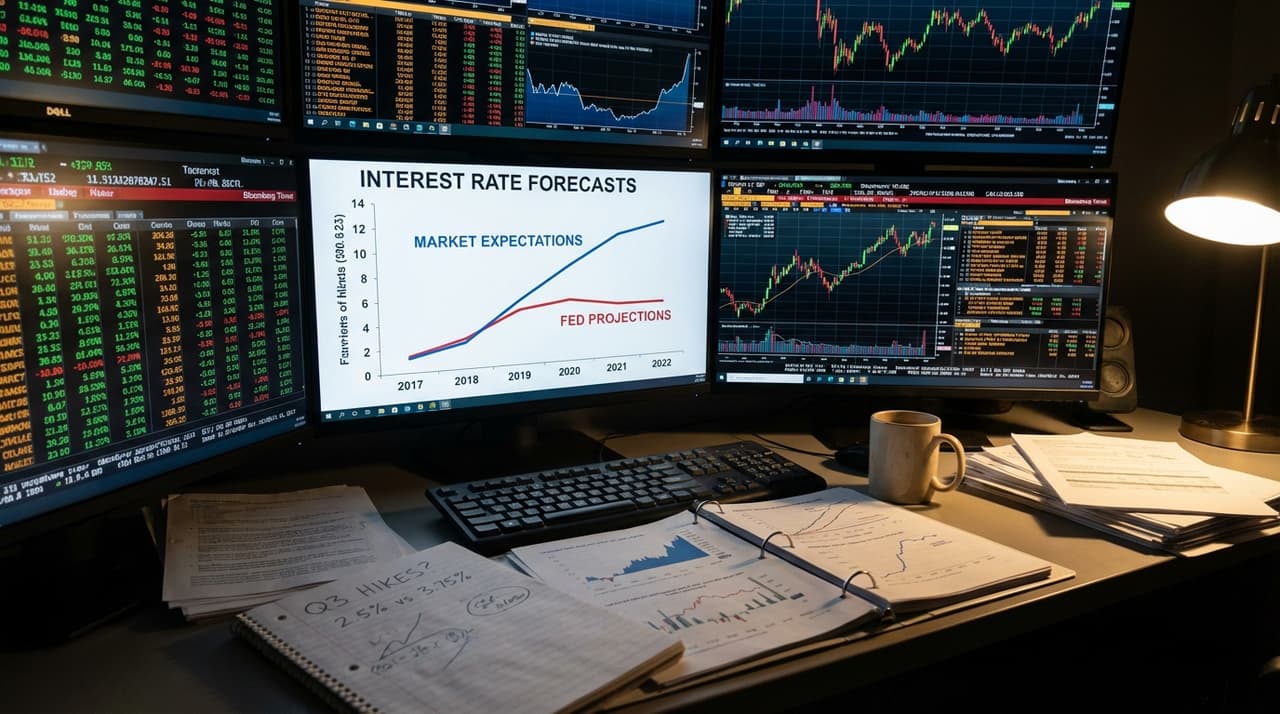
- Market pricing embeds 58 basis points of easing in 2026, slightly above the Fed's median projection of one cut.
- Recent robust jobs and retail sales figures have failed to shift futures expectations, highlighting a dovish tilt amid elevated inflation concerns.
- The divergence reflects ongoing uncertainty over the economic outlook, with policymakers showing wide dispersion in rate forecasts.
US rate futures continue to price in two Federal Reserve rate cuts for 2026, totaling approximately 50 basis points of easing, even after stronger-than-expected jobs and retail sales data emerged this week. This stance slightly outpaces the FOMC's median projection of just one cut, according to people familiar with market positioning, underscoring a persistent gap between investor sentiment and official guidance.
The Fed implemented its third rate cut of 2025 on December 10, lowering the federal funds rate to 3.5%-3.75% as anticipated. In its statement, the central bank noted that inflation has risen since earlier in the year and remains above the 2% target, a point reiterated by sources close to the discussions. Despite this hawkish tone, futures markets have held firm, with pricing now embedding 58 basis points of easing for 2026, according to real-time data from major exchanges.
Efforts to align market expectations with the Fed's outlook have hit a snag, as robust economic indicators—including upgraded 2026 GDP growth to 2.3% from 1.8% and steady unemployment at 4.4%—fail to sway traders. One trader, who requested anonymity due to the sensitivity of the matter, said, "The data is strong, but the market is betting on underlying weaknesses or a dovish shift later next year." This contrasts sharply with the FOMC's December 2025 "dot plot," which maintained the end-2026 target at 3.25%-3.5%, though internal dispersion saw one policymaker projecting as low as 2%-2.25%.
Without a clearer signal from the Fed, volatility in rate expectations is likely to persist, especially with Chair Powell's term ending in May 2026, which could heighten uncertainty around the policy path. Analysts note that the market's dovish positioning may reflect concerns over potential AI-driven deflation risks or a sharper economic slowdown than current data suggests. In a brief comment, an economist highlighted, "Further cuts might signal economic weakening, affecting households via higher inflation or recession fears," though attempts to reach Fed officials for additional insight were unsuccessful.
Looking ahead, short-term fluctuations in rate expectations are expected with incoming data, while long-term forecasts from firms like Schwab and Morningstar suggest limited easing unless the economy weakens sharply. This article was updated to clarify that the 58 basis points of easing refers specifically to 2026 pricing.