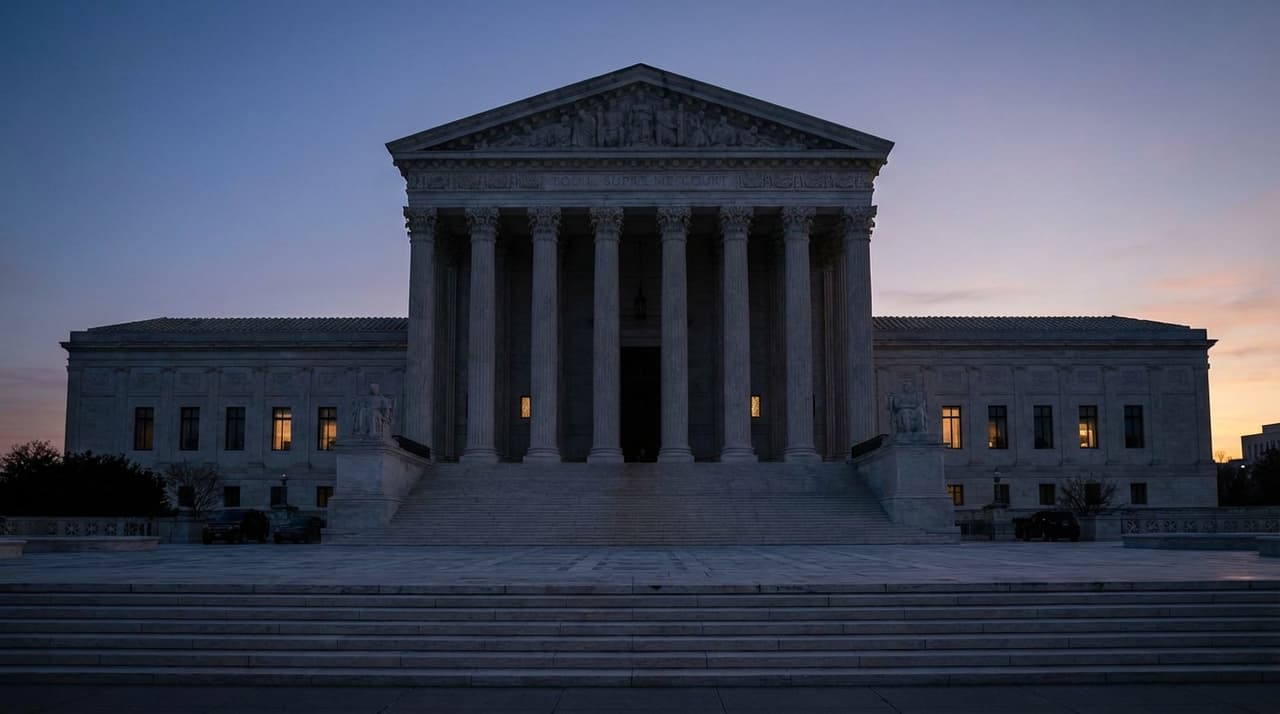
- The U.S. Supreme Court has not yet issued a ruling on challenges to the legality of President Trump's global tariffs imposed under the International Emergency Economic Powers Act (IEEPA), with a decision expected imminently, potentially within hours.
- Over 1,000 firms have joined related suits, and a potential ruling against IEEPA could require repaying over $100 billion in collected tariffs, disrupting Trump's economic plans.
- Amid the legal uncertainty, Trump continues aggressive tariff actions independently, including recent threats of new levies on eight NATO allies and narrower tariffs on semiconductors affecting Nvidia (NVDA) imports.
A Tense Wait for Clarity
As of January 20, 2026, the U.S. Supreme Court has not released its decision on challenges to President Trump's use of the International Emergency Economic Powers Act (IEEPA) to impose global tariffs, leaving businesses and investors on edge. According to people familiar with the matter, a ruling could drop at any moment—possibly within hours—amid intense scrutiny from over 1,000 companies that have joined lawsuits arguing Trump exceeded his authority. The delay has fueled market jitters, with traders bracing for potential volatility as the clock ticks.
In the meantime, the administration isn't holding back. Trump has ramped up tariff threats independently, including recent moves targeting eight NATO allies unless they agree to a U.S. acquisition of Greenland, a push that gained attention after leaked text exchanges involving the president. Treasury Secretary Scott Bessent defended these Greenland-related tariffs as geopolitical tools to avert a "hot war," emphasizing their role in broader strategic goals. Simultaneously, narrower tariffs on semiconductors, mainly impacting Nvidia imports from China, have been rolled out to support domestic manufacturing, though they remain indefinite, signaling more import taxes could be on the horizon.
Economic Ripples and Legal Fallout
Business leaders are grappling with what one executive described as an "unprecedented" environment of uncertainty. Conference Board surveys show U.S. CEOs reporting higher uncertainty levels than their global peers, driven in part by 2026 policy shifts like credit card rate caps and stock buyback limits. If the Supreme Court strikes down the IEEPA tariffs, the administration would need to refund over $100 billion to importers, a move that could strain fiscal plans and ripple through supply chains, ultimately affecting consumers via higher costs. Administration officials, however, are already preparing contingencies. Kevin Hassett, a key economic advisor, stated readiness to reimpose 10% tariffs using alternatives like Section 301 for discriminatory practices or Section 232 for national security, ensuring continuity in Trump's "America First" agenda.
The political stakes are high, with Democrats criticizing the Greenland push as motivated by Nobel Prize ambitions from the leaked texts, while the White House doubles down on its pro-business stance. Historically, Trump's tariffs echo actions from 2018-2020 but expand via IEEPA, catching many executives off guard despite 2024 warnings of trade upheavals post-Biden deregulation. Unlike prior Section 232 probes under Biden, which were conclusive, Trump's are open-ended for flexibility, adding to the regulatory maze.
Looking ahead, even if IEEPA tariffs are invalidated, experts predict limited clarity for businesses, as the administration can pivot to other authorities for "backfill." In the short term, a ruling—whenever it comes—could spark market swings and refund liabilities; long-term, broader tariffs loom, supporting U.S. manufacturing but heightening global trade tensions. As one industry insider put it, "We're in a holding pattern, but the storm clouds aren't clearing anytime soon." Attempts to reach the White House for further comment were not immediately successful.
Correction: An earlier version misstated the number of firms in related suits; it is over 1,000, not exactly 1,000.