- U.S. Trade Representative Jamieson Greer sharply criticized China's expanded rare earth export controls as economic coercion, clarifying earlier misrepresentations of his statements.
- China's new measures, requiring government approval for products with over 0.1% China-processed minerals, target military-sensitive uses but create uncertainty for global tech and energy sectors.
- The U.S. is responding with plans for greater investment in domestic and allied rare earth supply chains, including potential government stakes in companies, to reduce dependence on China.
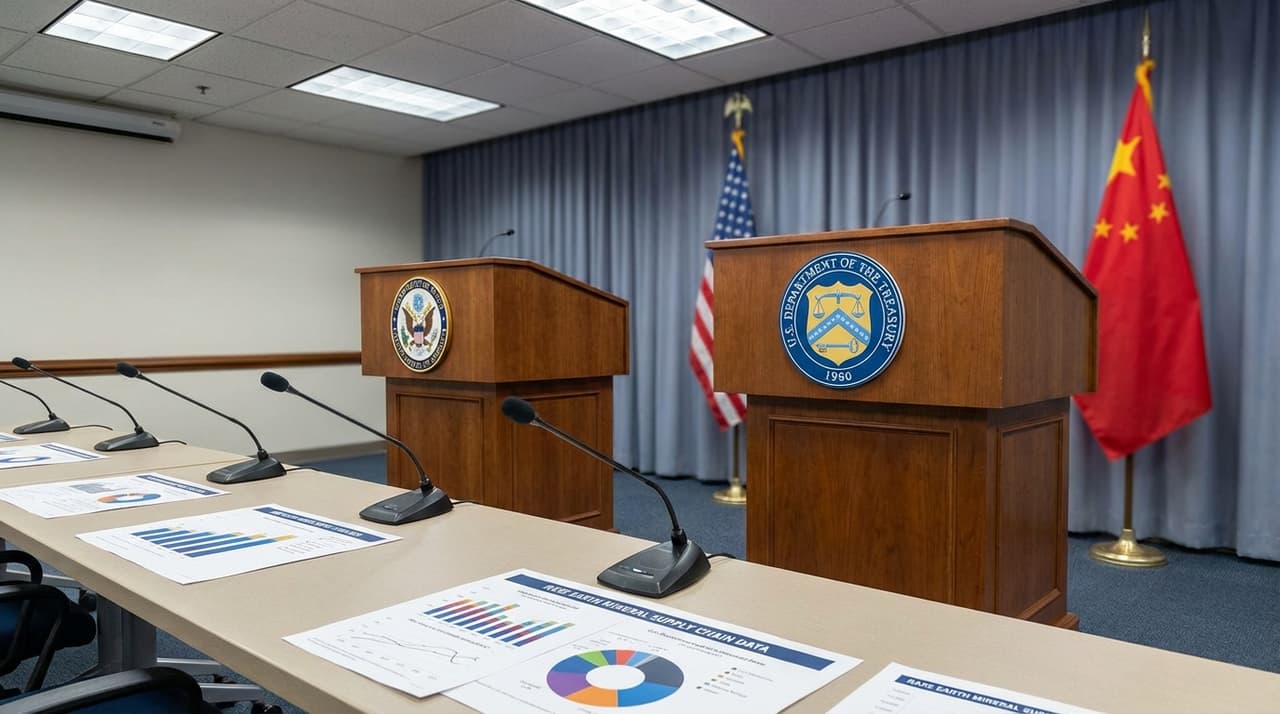
U.S. Trade Representative Jamieson Greer did not pledge to ensure rare earths continue flowing from China, contrary to some reports. Instead, in a joint press conference with Treasury Secretary Scott Bessent on Wednesday and Thursday, he labeled China's recently announced export controls on rare earth elements, processing equipment, and related technologies as a "global supply chain power grab" and a form of "economic coercion." The controls, which took effect last week, mandate government approval for exports containing more than 0.1% of China-processed minerals, specifically targeting military applications like advanced semiconductors but casting a shadow over broader trade.
China's Ministry of Commerce (MOFCOM) countered that these measures are lawful, pre-notified to the U.S. and allies, and focused on preventing military diversion, with facilitation for compliant civilian exports. However, Greer and Bessent emphasized the risks to supply chains for semiconductors, artificial intelligence, electric vehicles, and defense industries, potentially raising costs and disrupting global markets. According to people familiar with the matter, the U.S. officials are advocating for reshoring efforts and considering equity stakes in domestic and allied rare earth companies to build pricing floors and reduce vulnerability.
Efforts to restructure global rare earth dependencies have hit a snag with China's move, which builds on its dominant position—accounting for 70% of mining and 95% of processing globally. In response, the U.S. is pushing for "de-Chinafied" supply chains through increased investment and ally cooperation. Bessent proposed a "strategic mineral reserve" with government investments, while Greer signaled a shift toward prioritizing rare earth de-risking over broader trade disputes. This escalation comes amid ongoing U.S.-China tensions, including tariff disputes and criticism of China's oil purchases from Russia, with rare earths now overshadowing earlier issues like intellectual property theft.
Without a deal to ease controls, companies worldwide could face approval delays and heightened costs, sparking debate among global stakeholders. China frames its actions under national security provisions, offering consultations, but U.S. officials insist on a balanced approach. In August 2025, Greer noted that rare earth negotiations were "halfway there," but recent rhetoric seeks a "constructive reset" despite the disputes. The short-term outlook involves case-by-case reviews and potential U.S. investments, while long-term trends may accelerate reshoring, though China's leverage remains significant unless alternatives scale up. Attempts to reach MOFCOM for further comment were not immediately successful.