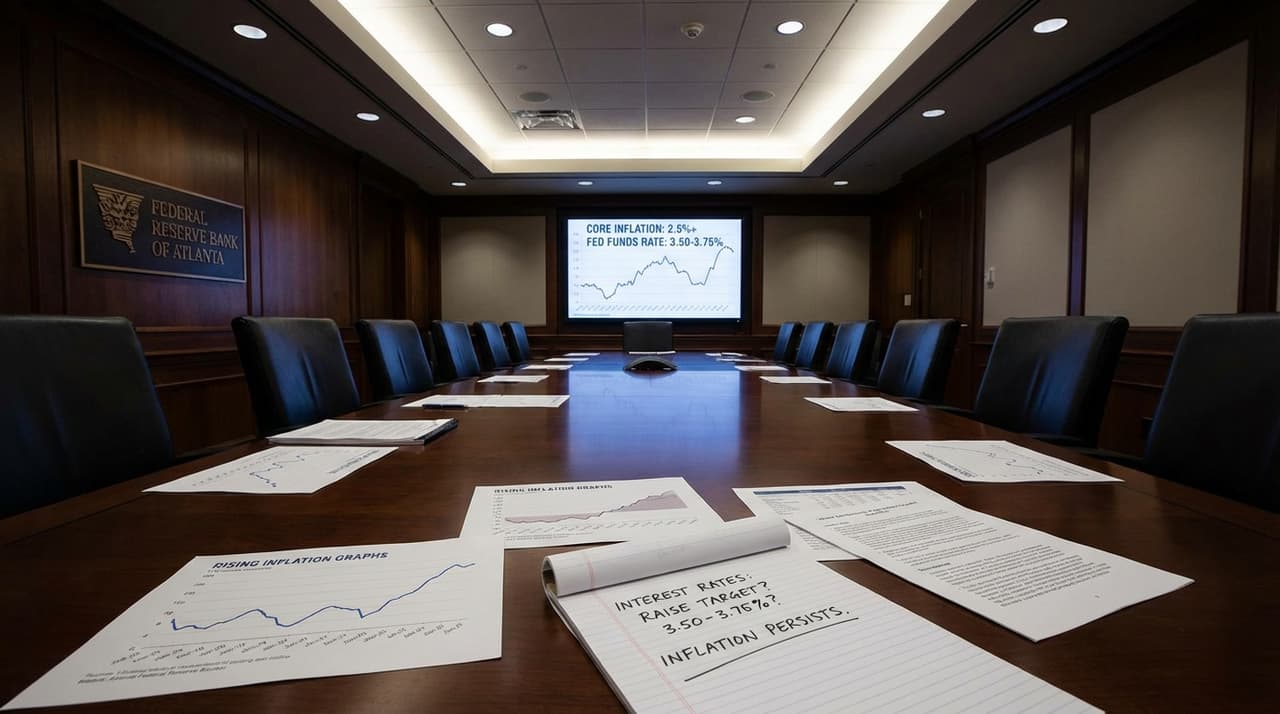
- Atlanta Fed President Raphael Bostic states he does not project any interest rate cuts for 2026, prioritizing inflation control over employment concerns.
- Bostic expects core inflation to remain above 2.5% through at least year-end 2026, supporting a "higher for longer" policy with current federal funds rates at 3.50%-3.75%.
- The Federal Open Market Committee paused rate cuts on January 28, 2026, holding rates steady after three reductions in 2025, with Bostic backing this data-dependent approach.
Atlanta Federal Reserve Bank President Raphael Bostic has taken a firm stance against interest rate cuts in 2026, underscoring a hawkish outlook driven by persistent inflation risks that he believes outweigh softening in the labor market. In recent speeches and interviews, Bostic reiterated there is no rush to ease monetary policy, emphasizing that price stability remains the top priority as inflation has stalled in the high 2s to low 3s range for two consecutive years.
Bostic's projections indicate core inflation will stay above 2.5% through at least the end of 2026, with disinflation not anticipated until late 2026 or 2027. This outlook supports maintaining the current federal funds rate target range of 3.50%-3.75%, a level he views as necessary to prevent unanchoring inflation expectations. "We need to be patient and let the data guide us," Bostic said in a recent address, according to people familiar with his remarks. "The risks of cutting too soon far exceed those of holding steady."
The Federal Open Market Committee's decision on January 28 to pause rate cuts, following three 25-basis-point reductions in 2025, reflects this cautious approach. Bostic supported the move, highlighting a data-dependent strategy that has gained broad support within the committee, though it was not unanimous—two members dissented in favor of cuts. Market reactions have been muted, with investors adjusting to the "higher for longer" narrative that limits expectations for aggressive easing. Real-time data shows Treasury yields holding steady, while equity markets exhibit slight volatility as traders digest the implications for borrowing costs.
Efforts to manage inflation have hit a snag, with sticky services inflation and upside risks from fiscal policies or tariffs complicating the path to the Fed's 2% target. Bostic noted that tariff policies' inflationary effects are lingering into early 2026, though business contacts have shown less intent to pass costs to consumers than previously expected, reducing the risk of mid-3s inflation but sustaining high-2s persistence into the first half of 2026. Without a clear disinflation trend, the Fed would be forced into maintaining restrictive policy, potentially delaying economic growth but safeguarding long-term credibility.
In the Southeast U.S., overseen by Bostic's Atlanta Fed, regional indicators show flat employment and manufacturing, alongside slight price rises and improved home and retail sales. This mixed picture reinforces Bostic's view that the economy remains resilient, with growth near 2.5% and a labor market in what he describes as a "low-hire, no-fire" mode without recession signals. Stakeholders, from businesses facing sustained borrowing costs to borrowers grappling with higher mortgage rates, are feeling the pinch, but Bostic argues this is a necessary trade-off to avoid entrenched inflation.
Looking ahead, Bostic urges patience, stating that no cuts should be expected unless clear disinflation evidence emerges. He views even 1-2 modest 25-basis-point moves in 2026 as dovish, a stance that contrasts with some of his more dovish colleagues on the FOMC. Experts predict gradual easing may only occur post-H2 2026 if economic data aligns, emphasizing that the Fed's independence amid political pressures—such as those from former President Trump—remains crucial for market confidence. As one analyst put it, "Bostic's hawkishness is a bulwark against inflationary complacency, even if it means a slower road to rate relief."