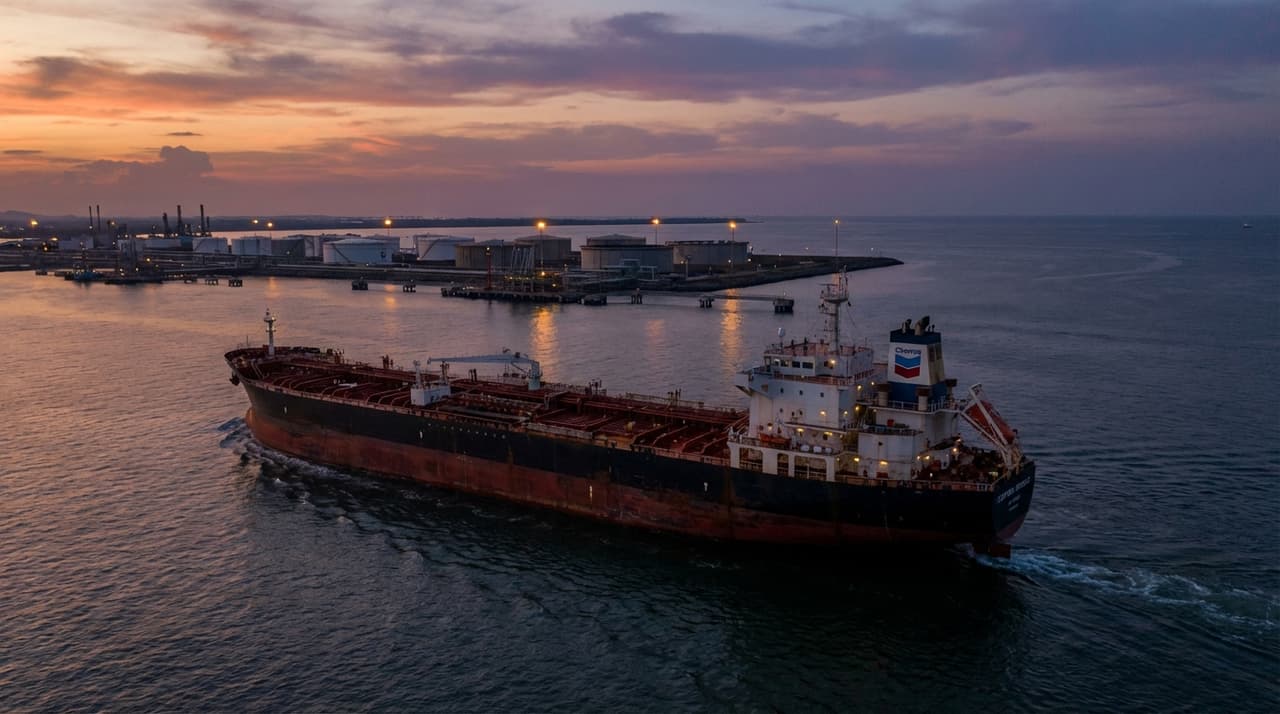
- Chevron (CVX) plans to ramp up Venezuelan crude shipments to U.S. refineries to approximately 300,000 barrels per day in March, according to people familiar with the matter.
- The move follows a brief four-day pause in early January 2026 after U.S. military activity and the arrest of Venezuelan President Nicolás Maduro disrupted operations.
- Chevron remains the only U.S. oil major authorized to operate in Venezuela under a special sanctions waiver, producing about 20% of the country's oil.
Chevron is set to increase exports of Venezuelan heavy crude to the United States to around 300,000 barrels per day in March, sources close to the company's operations said, as the oil giant stabilizes its activities following recent political upheaval. This marks a significant uptick from current output levels near 240,000 bpd from its joint ventures Petropiar and Petroboscan, which are running close to maximum capacity.
Efforts to resume exports hit a snag in early January when transportation into Venezuela was disrupted, but a Chevron-chartered tanker carrying roughly 300,000 barrels departed for the U.S. Gulf Coast on Monday, January 5, the first shipment since January 1. The company has called staff back to the country as operations normalize, though broader uncertainty persists. "We're navigating a complex landscape," one source noted, speaking on condition of anonymity due to the sensitivity of the matter. Attempts to reach Chevron for additional comment were not immediately successful.
Without this export flow, U.S. refineries configured to process heavy oil from Venezuela's Orinoco Belt would face supply constraints, potentially driving up costs. Chevron's unique position under a U.S. sanctions waiver allows it limited activity, even as President Donald Trump stated the embargo on Venezuela remains in full force. Shares in Chevron rose more than 6% intraday after Trump pledged to revive Venezuela's energy sector, reflecting investor optimism, but analysts caution that rebuilding the industry could require over $180 billion and many years of investment.
Meanwhile, Venezuela's state-owned PDVSA faces mounting inventories and reduced export capacity, with at least a dozen vessels carrying crude to China departing in early January with transponders off, defying the U.S. blockade. This could force PDVSA to deepen production cuts, contrasting with Chevron's relatively fluid operations. The political shift after Maduro's arrest has not damaged key infrastructure like the Jose export terminal, but long-term policy stability remains a critical concern for energy investments spanning decades.
As Chevron cautiously expands, the focus is on near-term supply to U.S. markets rather than extensive background rebuilding. The company's ability to avoid immediate production cuts, thanks to storage capacity not yet reached, underscores its strategic advantage in a volatile environment. For now, Venezuela's contribution to global oil supply stays below 1%, but March's planned increase signals a tentative step toward normalization amid ongoing negotiations and market watchfulness.