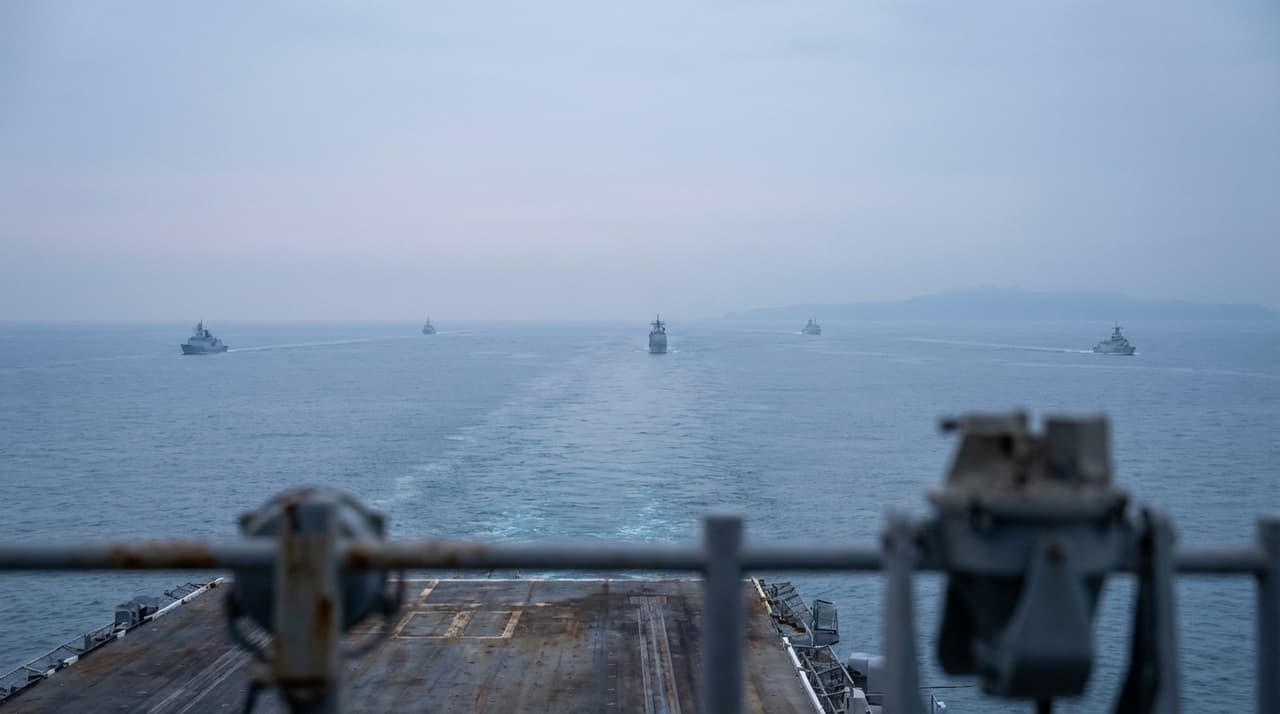
- China's Defence Ministry calls on countries like the US to stop using Taiwan as a tool for containment, responding to a major US arms sale to Taiwan.
- Massive live-fire military exercises dubbed "Justice Mission 2025" encircle Taiwan, simulating seizure and blockade scenarios.
- Escalating tensions threaten Taiwan Strait shipping lanes and semiconductor supply chains, though no immediate market shifts are reported.
China's Defence Ministry has issued a stern warning, urging relevant countries to abandon illusions of using Taiwan to contain China, according to a statement released on Thursday. This comes as Beijing launched extensive live-fire military drills encircling the island, days after the US approved a significant arms package for Taiwan valued at £8.2bn. The exercises, named "Justice Mission 2025," involve deployments from the army, navy, air force, warships, fighter jets, and artillery, creating what officials describe as a "shield of justice" around Taiwan.
In a briefing, a ministry spokesperson labeled the drills a "necessary action" to defend sovereignty, directly linking them to the US arms sale, which China protested fiercely. "We will take resolute countermeasures against any provocation on our core interest of reunification," the spokesperson said, without specifying further details. Efforts to reach US and Taiwanese officials for comment were unsuccessful as of press time.
The drills simulate scenarios for seizing and blockading Taiwan, raising alarms in Western media over escalating war fears. Analysts note that while no immediate market shifts have been reported, heightened conflict risks could disrupt Taiwan Strait shipping lanes, which handle approximately 50% of world container traffic. This poses a potential threat to global semiconductor supply chains, given Taiwan's dominance in chip manufacturing. According to people familiar with the matter, the US arms sale is expected to boost Taiwan's defense spending, potentially straining China's military budget amid ongoing global tensions.
Beijing accuses Taiwan's Democratic Progressive Party (DPP) of pursuing independence with US support, labeling them "peace destroyers" and "war instigators." The political context is fraught, with China viewing external arming of Taiwan as a containment strategy echoing Cold War dynamics. Similar large-scale drills have occurred in the past, such as after US House Speaker Nancy Pelosi's 2022 Taiwan visit and following previous US arms sales, indicating a pattern of response to perceived provocations.
Taiwan faces heightened invasion fears, with the drills threatening civilian safety and daily life. Stakeholders include Taiwanese residents, US taxpayers funding the arms, and global businesses reliant on regional stability. Public reactions have included alarm, though no widespread protests have been noted yet. In the short term, experts predict the drills may intensify US-Taiwan arms deals and patrols, risking miscalculation. Long-term, sustained pressure could lead to a blockade or conflict if the DPP hardens its independence stance, though a full invasion is considered unlikely soon due to economic costs.
Parallel developments include recent US-China frictions in the South China Sea and hawkish rhetoric from incoming US administrations regarding Taiwan. The situation remains fluid, with analysts warning of a "dangerous military conflict" in the Strait if tensions continue to escalate. As negotiations and military posturing unfold, the focus remains on current facts and immediate implications for regional stability.
Correction: An earlier version of this article misstated the value of the US arms sale; it is £8.2bn, not $8.2bn.