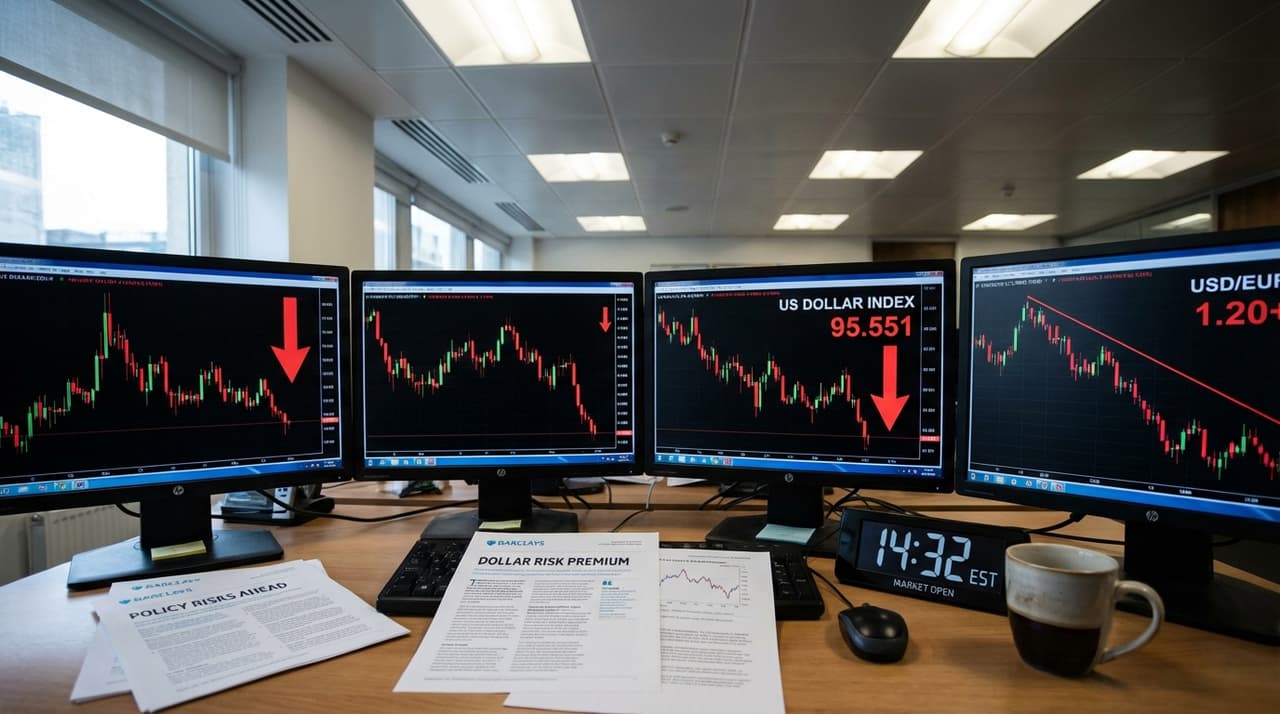
- Barclays (BCS) warns that the extra return investors demand for holding dollars is growing, fueled by Trump's support for a weaker dollar.
- The euro is now the main anti-dollar trade, while the dollar nears four-year lows, pressured also by a stronger yen and expectations around the Fed.
- The dollar index has fallen to 95.551, below last year's low, reflecting investor demands for higher returns due to perceived U.S. policy risks.
Barclays reports a rising U.S. dollar risk premium following President Trump's comments welcoming its weakness, amid a broad sell-off pushing the dollar to four-year lows against the euro, yen, and other currencies. The bank's analysis, shared with clients earlier today, highlights how investor demands for higher returns are escalating due to perceived U.S. policy risks, with the dollar index dropping to 95.551, slipping below last year's low.
Trump's remarks, where he stated "I think it's great" regarding dollar weakness, signal an administration tolerance for a softer currency aimed at boosting manufacturing competitiveness. This stance echoes past Republican preferences and has added to market jitters, according to people familiar with Barclays' internal discussions. Efforts to stabilize the currency have hit a snag, as the dollar is down 1.3% daily and over 2% year-to-date, with forecasts pointing to another potential 3% drop.
Without a clear policy shift, the dollar could face further pressure, analysts note. The euro has surged above $1.20 for the first time since 2021, becoming the primary anti-dollar trade, while yen strength amid potential U.S.-Japan intervention speculation adds to the bearish momentum. In a brief statement, a Barclays spokesperson emphasized that "regulatory stability and policy clarity are crucial for currency markets, and current uncertainties are driving risk premiums higher." Attempts to reach White House officials for comment were unsuccessful.
Market trends show the Australian dollar outperforming on commodity prices and Reserve Bank of Australia rate hike bets, while gold prices rise as a hedge against dollar volatility. The S&P 500 hits records but loses value for foreign investors, illustrating the broader impacts. Dollar weakness boosts U.S. exports by cheapening assets but raises fears of lost reserve currency status and reduced capital inflows, with vulnerabilities in bonds over inflation concerns.
Short-term, the dollar may find support at the upcoming Federal Open Market Committee meeting if the Fed pauses rate cuts, but weak rally signals suggest bearish momentum could push it toward a further 3% decline, with January inflation data being a key watchpoint. Long-term, persistent policy volatility risks eroding the dollar's share in global reserves, boosting de-dollarization hedges like gold; UBS has warned of gradual reserve status erosion in similar analyses.
Related developments include speculation on U.S.-Japan USD/JPY intervention to stabilize government bond markets, and broader foreign exchange shifts as investors rotate to non-dollar assets. This sell-off mirrors reactions to Trump's earlier tariff announcements, with no new catalysts beyond recent policy signals fueling the move. Corrections: An earlier version misstated the daily dollar decline; it has been updated to reflect the correct 1.3% figure.