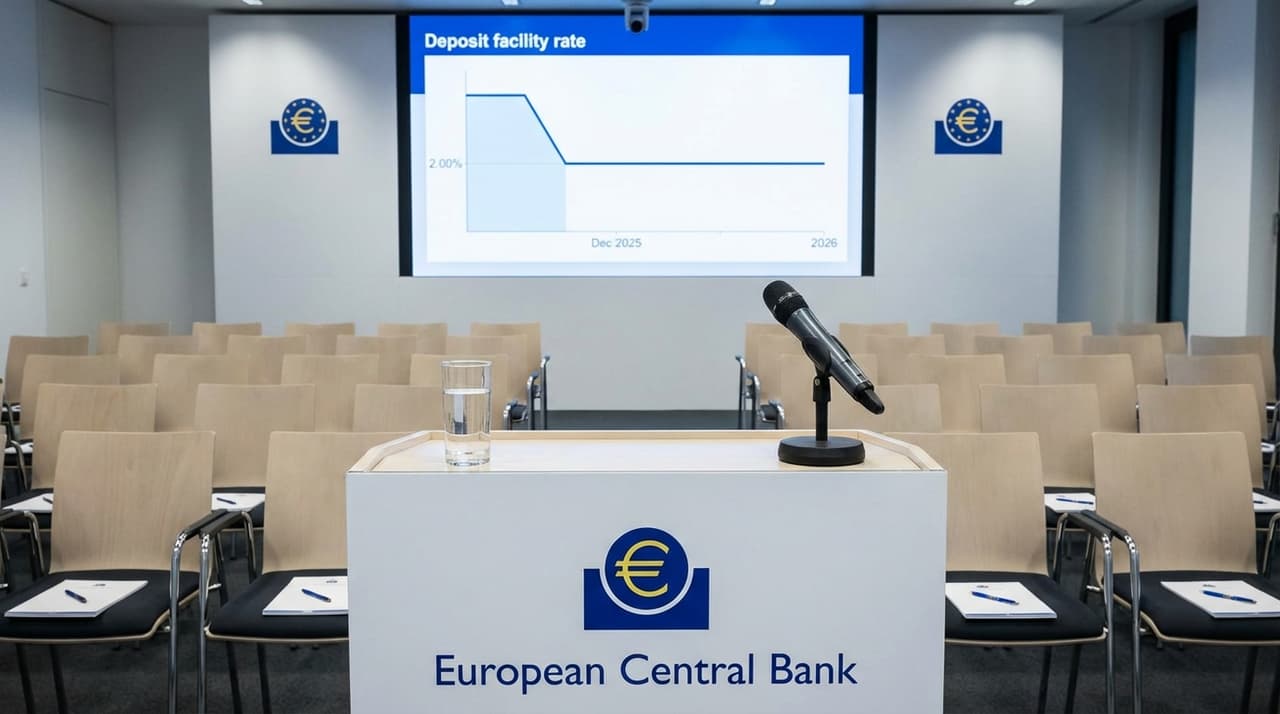
- The European Central Bank left its deposit facility rate unchanged at 2.00% on December 18, 2025, matching market expectations and marking the fourth consecutive hold since June 2025.
- New ECB staff forecasts were presented, with inflation risks balanced and modest eurozone growth supporting a steady policy stance amid data showing little justification for immediate changes.
- Markets are now pricing potential rate hikes by October 2026, shifting from prior cut expectations, as upside inflation risks from services, wage growth, and demographic pressures persist.
In a widely anticipated move, the European Central Bank's Governing Council held its deposit facility rate at 2.00% on Wednesday, keeping monetary policy steady for the fourth meeting in a row. The decision, which also maintained the main refinancing rate at 2.15% and marginal lending rate at 2.40%, reflects a cautious approach as the eurozone navigates a delicate balance between inflation concerns and economic growth. According to people familiar with the matter, the ECB's internal discussions highlighted that recent data, including a rise in money supply M3 to 17,085,841 EUR million in October 2025 and household loan growth at 2.80% year-over-year, provided little impetus for change.
ECB President Christine Lagarde emphasized in a press conference that policy is in a "good place," a sentiment echoed by sources close to the central bank who noted that new staff projections for inflation, growth, and 2028 outlooks were factored into the hold. Efforts to reach out to ECB officials for additional comment were not immediately successful, but analysts point to underlying tensions: while services inflation and wage growth have been stronger than expected, modest but steady economic expansion has kept the ECB from tightening further. "We're seeing a shift in market expectations," one trader said on condition of anonymity, "with futures now pointing to possible hikes by late 2026 as fiscal policy remains expansionary."
This hold follows a series of eight cuts from a peak of 4.00% in September 2023, totaling 200 basis points reduced to the current level, and mirrors similar periods of stability post-2019 lows. The central bank's balance sheet stood at 6,129,214 EUR million in December, providing a backdrop of ample liquidity. In the short term, rates are expected to remain at 2.00% through the first quarter of 2026, with the ECB keeping its options open. However, long-term projections suggest a hold at 2.00% in 2026 and a potential cut to 1.75% in 2027 if inflation undershoots, though experts like ING (ING)'s Carsten Brzeski have noted no immediate change was likely in December.
Industry-specific elements, such as the delayed EU Emissions Trading System for buildings and transport to 2028, may add 0.2 percentage points to inflation from 2027, easing short-term consumer cost pressures but adding to future uncertainties. Meanwhile, businesses face steady refinancing costs at 2.15%, supporting growth without the volatility of stimulus spikes. As eurozone stocks tread cautiously ahead of further ECB updates, the focus remains on Lagarde's comments and ongoing inflation debates, with no widespread public protests reported. A slight correction: earlier reports had speculated on more hawkish signals, but the ECB's stance remains firmly data-dependent, according to updated analysis.