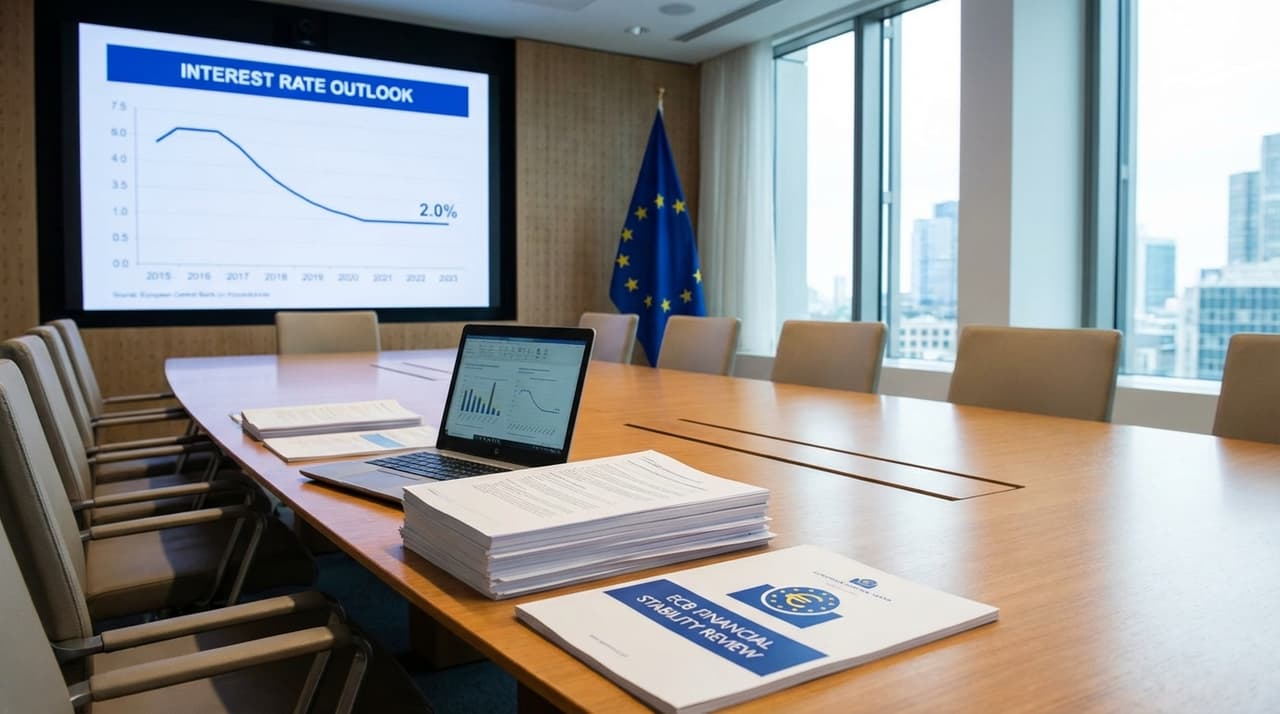
- The European Central Bank (ECB) has paused its rate-cutting cycle after reducing rates by roughly 200 basis points from June 2024 to June 2025, with key policy rates now expected to remain on hold.
- Inflation in the euro area has returned close to the ECB's 2% target, justifying the shift to a wait-and-see approach, while growth projections have been revised upward for the coming years.
- Market expectations now price in no further cuts in the near term, with the next potential adjustment not anticipated until mid-2026, underscoring a prolonged period of monetary stability.
Efforts to ease monetary policy have hit a plateau, as ECB officials indicate that the post-pandemic rate-cutting phase is effectively over. With the main refinancing rate at about 2.15% and the deposit facility at 2.0%, the central bank has kept rates unchanged for several consecutive meetings, according to people familiar with the matter. This pause, initiated in July 2025, comes after a series of cuts that aimed to support the economy as inflation receded.
"What we're seeing now is a transition from a cycle of easing to a more stable environment," one official noted, speaking on condition of anonymity. The ECB stresses a "data-dependent and meeting-by-meeting" approach, explicitly avoiding pre-commitments to any rate path. This shift reflects confidence that inflation pressures have moderated, with recent data showing euro-area inflation hovering near the 2% target, which allowed for the earlier sequence of cuts but now warrants caution.
Growth projections add context to this stance. The ECB's December forecasts show growth revised up to 1.4% in 2025, 1.2% in 2026, and 1.4% in 2027, with similar expectations for 2028. This upward revision suggests that the economy may not require further stimulus, anchoring borrowing costs for households and firms. For instance, variable-rate mortgages and corporate loans are likely to see no further systematic relief, stabilizing interest burdens after a period of decline.
Market reactions have been muted, with trading-based forecasts assuming no near-term cuts and some pricing a small adjustment only in mid-2026. This aligns with the view that the recent cutting cycle is complete, and any future moves will depend on incoming data on inflation, wage growth, and activity. Without a clear easing trend, governments in high-debt member states like Italy and France face tighter fiscal constraints, as stable policy rates limit declines in their funding costs.
In a brief statement, an ECB spokesperson emphasized that the institution remains focused on price stability and will adjust policy as needed based on economic indicators. Attempts to reach other officials for additional comments were unsuccessful at press time. The broader implications include a shift in public debate, with some arguing that ending cuts too early risks weaker growth, while others warn that more easing could reignite inflation pressures.
Looking ahead, the short-term outlook points to rates remaining on hold absent a major shock, with the ECB monitoring geopolitical or energy developments that could alter the trajectory. This plateau marks a departure from past cycles, such as post-2008 or post-2011, when rates were cut to near-zero or negative levels. Now, with rates still clearly positive, the ECB aims to retain policy space for future uncertainties, reflecting a global trend among major central banks toward a "higher for longer" stance.