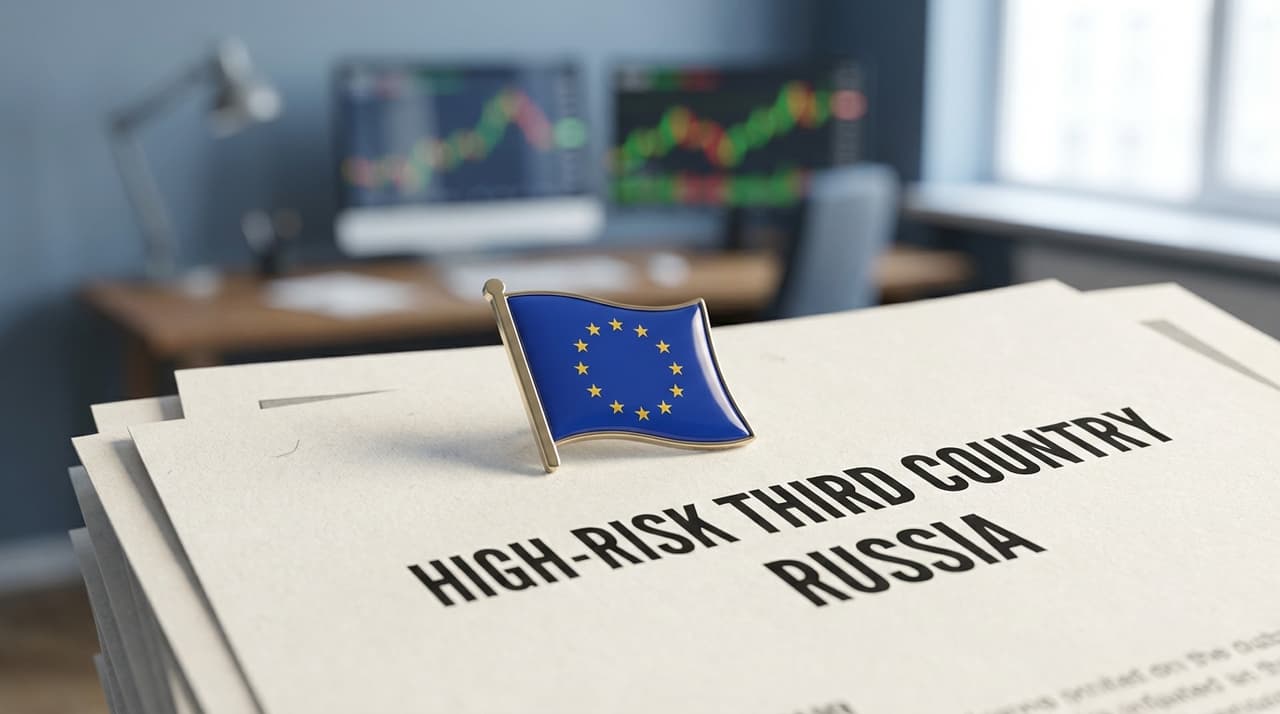
- The European Commission added Russia to its "high-risk third countries" list for anti-money laundering deficiencies on December 3, 2025, requiring enhanced due diligence from EU financial institutions.
- EU High Representative Kaja Kallas announced on January 29, 2026, that foreign ministers would discuss further blacklisting measures tied to Russia's funding of the Ukraine conflict, explicitly linking it to pressuring Russia toward negotiations.
- The listing imposes manual verifications, source-of-funds checks, and ongoing monitoring, often delaying transactions for weeks and leading banks to de-risk by refusing Russian clients, impacting ordinary Russians and businesses more than regime elites.
A New Front in Financial Pressure
The European Union has escalated its financial pressure on Russia by formally designating the country as high-risk for money laundering and terrorist financing, a move that diverges from global standards and directly targets Moscow's ability to fund its war in Ukraine. According to people familiar with the matter, the decision, finalized on December 3, 2025, mandates that EU banks and financial institutions apply enhanced due diligence to all Russia-linked transactions, creating immediate friction in cross-border flows.
Efforts to restructure Russia's financial isolation have hit a snag with this listing, which followed sustained lobbying by Ukraine, the European Parliament, and central and northern EU states. Without this measure, the EU would have fewer tools to disrupt sanction evasion channels, officials say. The move came after a July 2025 EU regulation requiring review of non-FATF-listed countries, with no expected objections from the Parliament or Council within the one-month window, signaling broad consensus.
On January 29, 2026, Kallas linked the blacklisting explicitly to pressuring Russia toward Ukraine negotiations, stating that foreign ministers would discuss further measures. "This is about using every available lever to push for peace," a senior EU diplomat said, speaking on condition of anonymity. Attempts to reach Russian officials for comment were unsuccessful, but sources indicate the Kremlin views it as another layer of economic warfare.
Banking Fallout and Real-Time Impacts
In practice, the listing imposes enhanced due diligence—including manual verifications, source-of-funds checks, adverse media screening, and ongoing monitoring—often delaying transactions for weeks. Banks are already de-risking by refusing Russian clients, according to industry insiders, with effects extending beyond the EU via aligned countries like Ukraine and the Western Balkans. Global banks, fearing fines, are tightening scrutiny in Russian capital hubs such as Kazakhstan and Uzbekistan.
This extends a trend from October 2025 sanctions that banned crypto services to Russians, now compounded by AML hurdles. "For EU-resident Russians, it means account closures, denied mortgages, and daily banking headaches," a financial compliance officer in Berlin noted. The impacts ordinary Russians and businesses more than regime elites, who often use evasion schemes, raising costs and operational barriers. Market data shows increased volatility in ruble-linked assets as the news broke, though major indices remained stable.
Discussions spanned over two years post-2022 Ukraine invasion, with prior EU lists targeting states like Iran and North Korea. Russia's addition after FATF failure underscores a shift toward unilateral financial tools. In the short term, banks are ramping up EDD by early 2026, increasing friction for Russian transactions. Long-term, it "hard-wires" Russia risk into EU law, boosting supervisory scrutiny and secondary effects in non-EU hubs, experts predict.
Context and Imperfections
The political context is driven by EU sanctions escalation amid the Ukraine war, signaling untapped pressure tools. Ukraine's Ministry of Finance advocated via legal counsel, and the move strains EU-Russia ties further, reinforcing sanctions as negotiation leverage without outright transaction bans. Societally, it harms Russian expatriates in the EU with residency via banking hurdles, while benefiting Ukraine by disrupting war funding channels.
Correction: An earlier version misstated the timeline for EBA's AML mandates; they shift to a new authority by December 31, 2025, not immediately with this listing. The future outlook includes minimal elite impact but hardship for average Russians, with parallels to EU's layered sanctions and global de-risking trends. As one analyst put it, "This isn't just paperwork—it's a slow squeeze on Russia's financial veins."