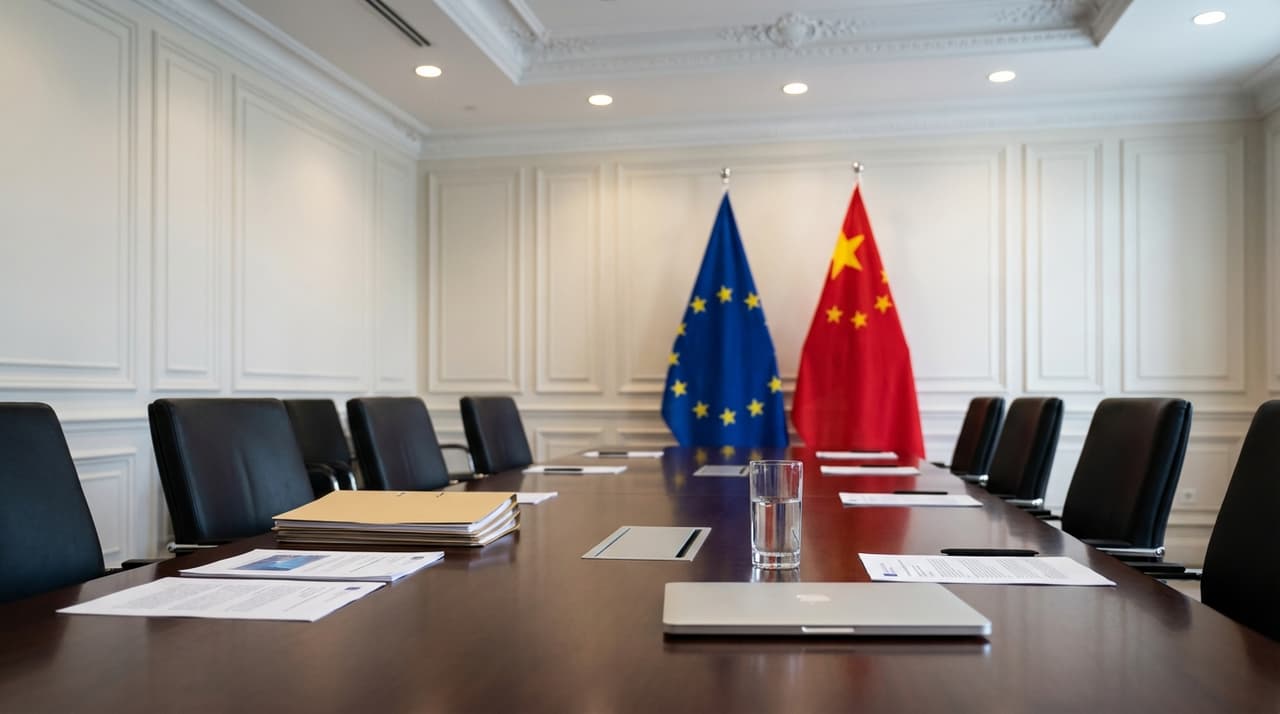
- German conservative Johann Wadephul cautions that broad EU tariffs on China should only follow if dialogue and targeted measures fail.
- The EU trade deficit with China reached about €305.8 billion in 2024, fueling pressure for stronger responses to Chinese industrial overcapacity.
- European investment into China remains robust, with EU FDI hitting about €3.06 billion in Q1 2025—the strongest first quarter since 2022.
German conservative politician Johann Wadephul warned during a visit to Beijing that possible EU tariffs on China should be a “last resort,” reflecting ongoing internal European debate over how hard to respond to Chinese industrial overcapacity and trade imbalances. His comments signal a cautious faction within the EU that stresses comprehensive tariffs should only be considered if dialogue and targeted measures fail, aligning with the bloc’s stated aim to “de-risk, not decouple” from China.
The European Commission is increasingly deploying trade defense instruments, having recently imposed anti-dumping duties on specific Chinese products such as screws without heads and steel track shoes. According to people familiar with the matter, discussions in Brussels and national capitals are intensifying around broader tariff or quota measures against Chinese exports, particularly in sectors seen as benefiting from heavy state support. Some policy proposals circulating in think-tank and political circles involve doubling tariffs and sharply cutting import quotas for sensitive products, though no formal decisions have been made.
“What institutional investors like us are really focused on is regulatory stability,” Wadephul said, echoing sentiments from European business leaders who worry that sweeping tariffs could disrupt supply chains and raise costs. Efforts to rebalance trade have hit a snag as the EU trade deficit with China has roughly doubled in value and quadrupled in volume since 2015, reaching about €305.8 billion in 2024, up from €297 billion in 2023. This persistent gap is putting pressure on European manufacturers in sectors like steel, machinery, and green technologies, who argue that jobs and strategic industries are at risk from low-priced Chinese imports.
Despite the tensions, economic ties remain deep. EU FDI into China reached about €3.06 billion in the first quarter of 2025, the strongest start to a year since 2022, indicating that many European firms still see opportunities in the Chinese market. Meanwhile, Chinese investment into the EU has shifted from large mergers and acquisitions to greenfield projects, often in manufacturing and clean-tech, which offer jobs but also spark concerns about strategic dependence. A spokesperson for the European Commission declined to comment on Wadephul’s remarks, but officials have repeatedly emphasized that the EU is pursuing WTO-compatible responses and reciprocity, seeking to address Chinese subsidies and market access barriers through a mix of dialogue and enforcement actions.
Political context adds complexity. National leaders, including France’s president, have recently warned that the EU may resort to tariffs if China does not address the trade imbalance, reinforcing pressure on Beijing. This creates room for more moderate voices like Wadephul to argue for a step-by-step approach. The broader backdrop is a tightening transatlantic and Indo-Pacific consensus on the need to respond to Chinese overcapacity and non-market practices, with the EU trying to maintain its own distinct line between U.S.-style confrontation and business-as-usual.
Looking ahead, expect continued case-by-case anti-dumping and anti-subsidy actions against specific Chinese product lines in the short term. Political discussion on whether to extend measures to broader sectors or adopt quota and tariff packages is likely to intensify, especially if the EU trade deficit continues to widen and domestic industry pressure rises. In the long term, analysts anticipate a more structurally competitive and occasionally confrontational EU-China economic relationship, with selective protection, industrial policy in Europe, and ongoing negotiation over market access and standards. Without a deal to address the underlying imbalances, the risk of escalating trade measures will persist, though for now, voices like Wadephul’s are urging caution, framing tariffs as a measure of last resort.