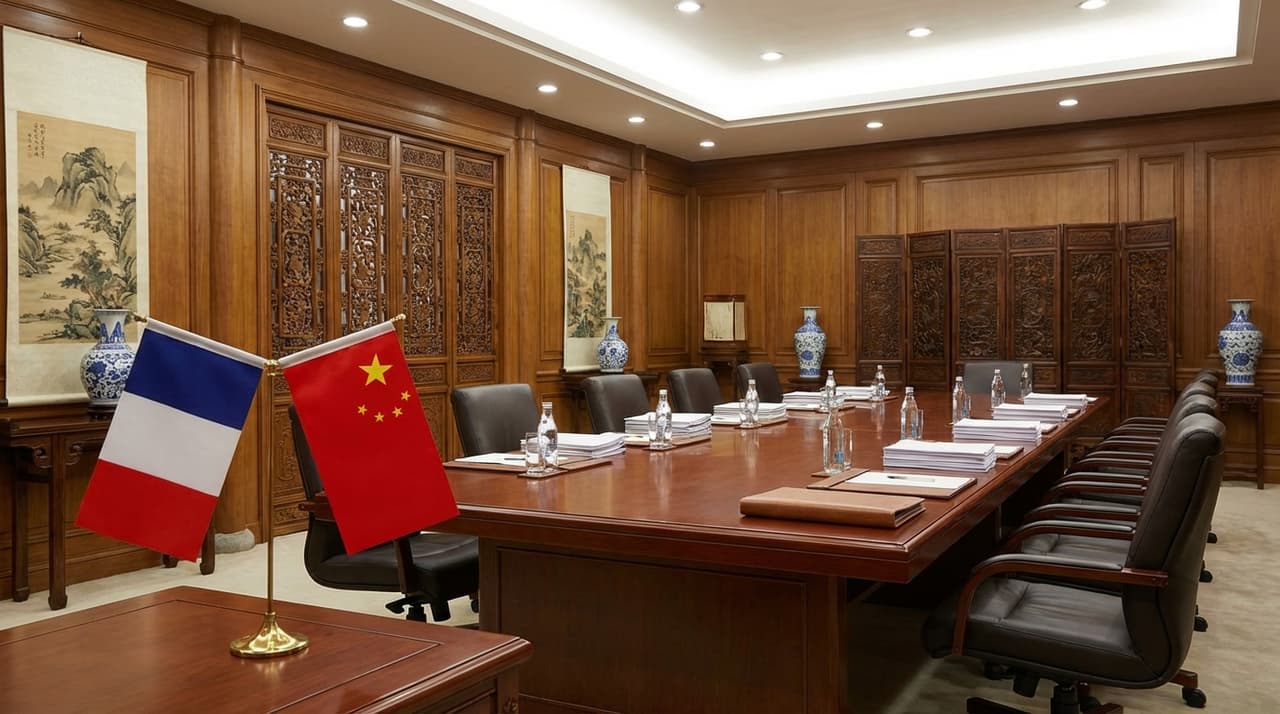
- French President Emmanuel Macron urges increased Chinese investments in Europe during his state visit to China, targeting key sectors like batteries and AI.
- Macron warns of potential EU tariffs if the bloc's €300 billion trade deficit with China persists, highlighting concerns over "predatory" practices.
- The push comes as Europe faces industrial threats from redirected Chinese exports, with Germany's alignment remaining uncertain.
French President Emmanuel Macron has made a dual appeal for more Chinese investments into Europe, particularly France, while cautioning that the European Union may impose tariffs on Chinese goods if trade imbalances are not addressed. Speaking during his December 2025 state visit to China, Macron emphasized the need for "mutually beneficial" investments in critical areas such as batteries, aviation, aerospace, nuclear energy, artificial intelligence, biomedicine, and green technologies. According to people familiar with the matter, this move aims to rebalance a €300 billion trade deficit that has strained EU-China relations.
Efforts to restructure Europe's economic ties with China have hit a snag, as Macron coordinated with European Commission President Ursula von der Leyen on "de-cooperation" measures, including tariffs that could be implemented in the coming months if China does not boost imports and domestic consumption. Without a deal, European industries like automobiles and machine tools risk "life or death" scenarios from import floods, a point Macron framed as China "crashing into the heart" of Europe's model. In a statement, Macron noted, "Italy in this regard has been on a very steady growth trajectory," drawing parallels to investment stability, though he stressed that Europe must enhance its competitiveness through deregulation and border protections.
Agreements signed during the visit cover investment, natural resources, and social welfare, with Chinese President Xi Jinping calling France an "indispensable" partner. However, disruptions from China's rare earth export controls and previous EU tariffs on Chinese electric vehicles—which reached up to 45.3% in 2024—have raised concerns. Chinese countermeasures, such as minimum prices on French cognac, have stakeholders fearing retaliation in sectors like pork and dairy. Macron highlighted insufficient Chinese direct investment in Europe despite calls for re-industrialization, adding that "institutional investors like us are really focused on regulatory stability."
Germany remains unaligned due to its strong China ties, complicating EU consensus on tariffs, according to sources close to the negotiations. Business delegations accompanied Macron to promote opportunities, but experts predict urgency for rebalancing, with Europe's "power strategy" emphasizing innovation and monetary adjustments. Short-term, the EU may impose tariffs absent Chinese action, testing relations in 2026 with intensified scrutiny on Germany. Long-term, Macron targets higher Chinese investment stock in France by 2030, via EU strategies for mines and recycling to cut dependence.
Correction: An earlier version misstated the timeline for potential EU tariffs; they could be implemented in the coming months, not immediately.