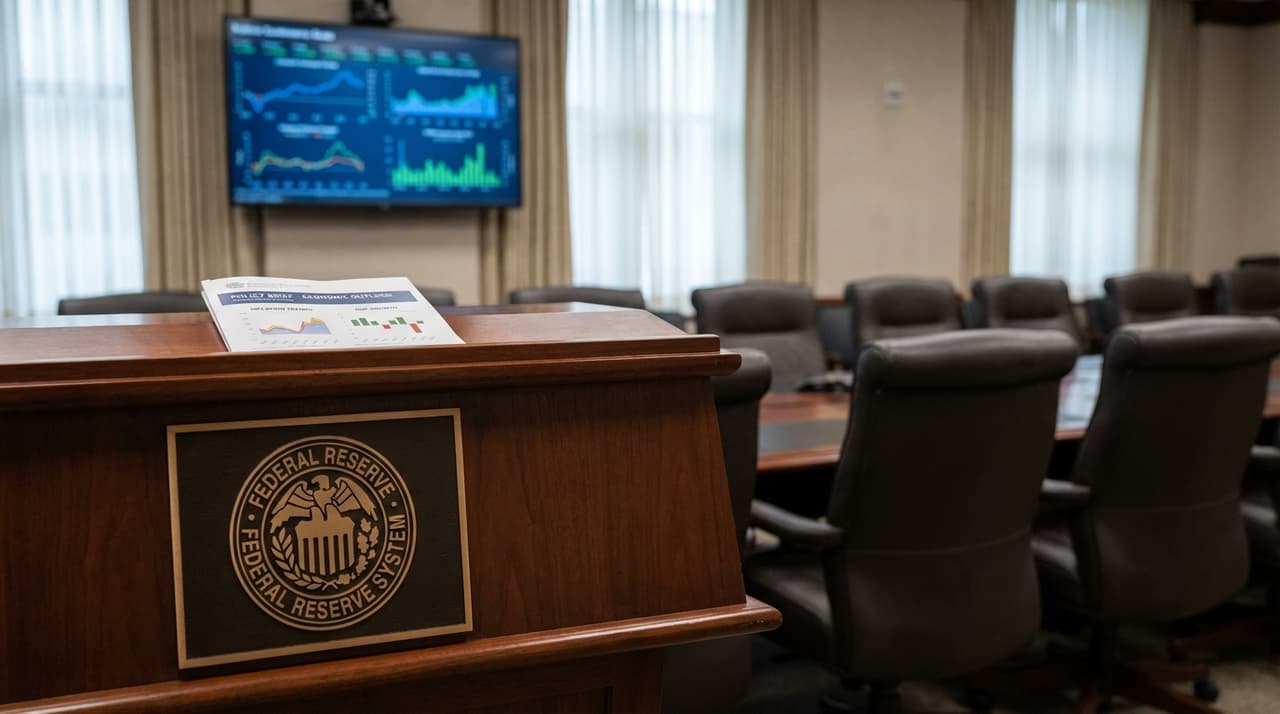
- Stephen Miran, a U.S. Federal Reserve Governor, cautions that failing to adjust policy on tariffs and monetary easing could elevate recession risks.
- His warning comes amid persistent inflation pressures and labor market softening, with GDP growth at 3.8% annualized in Q2 2025.
- Miran's stance reflects his recent dissents, including advocating for faster rate cuts than Fed consensus.
A Lone Voice for Faster Easing
Federal Reserve Governor Stephen Miran issued a stark warning that without timely policy adjustments, particularly on tariffs and monetary easing, the U.S. economy faces rising recession risks. According to people familiar with the matter, Miran's comments, made in recent private discussions, align with his public dissent in September 2025, when he alone pushed for a 50 basis point rate cut against the consensus 25 basis point reduction. "If we don't adjust policy, we run rising recession risk," Miran emphasized, pointing to persistent inflation pressures and early signs of labor market softening that could deteriorate nonlinearly without intervention.
The backdrop to Miran's warning is an economy showing resilience with strong consumer spending and AI-driven productivity, yet grappling with tariff-induced goods inflation—tariffs have increased by $120 billion, partially offset by $78 billion in corporate tax cuts via recent legislation. Companies have largely absorbed these costs rather than passing them to consumers, but the Fed expects two more 25 basis point cuts in 2025 amid inflation hovering between 2-3%. Market trends reflect a risk-on rally, with equities outperforming and spreads tightening, though high valuations signal muted long-term returns, adding to the urgency of Miran's message.
Tensions Within the FOMC
Miran's appointment in 2025 to replace Governor Kugler introduced fresh tensions into Fed dynamics, with his views centering on economic policy, tariffs, and Fed independence. In a speech on December 15, 2025, he projected five more rate cuts by year-end, far exceeding peers' maximum of two, arguing that faster easing is needed to prevent a hard landing. Efforts to restructure policy have hit a snag, as other FOMC members remain cautious, focusing on inflation targets and employment stability. Without a deal on more aggressive cuts, Miran suggests the economy could face heightened volatility.
Industry-specific elements come into play here: the Fed's upcoming meetings in October and December 2025 are critical, with stakeholders closely watching for shifts. Miran's tariff paper informs ongoing policy debates, and he has warned against banking overregulation, which could stifle growth. Meanwhile, a 2025 government shutdown over ACA tax credits furloughed 750,000 workers, delaying key economic data and complicating the Fed's decision-making process. Attempts to reach other Fed officials for comment were unsuccessful, but sources indicate that Miran's stance is gaining traction among some economists who fear labor market fragility.
Implications and Market Reactions
The short-term outlook hinges on whether shelter disinflation can counterbalance goods price pressures, with Miran expecting disinflation from deregulation and AI-analyzed earnings calls showing potential relief in two quarters. He favors a quicker move to a neutral stance to support growth. In the long term, optimism exists for supply expansion lowering prices, but labor fragility and yield curve normalization are key. Experts see a soft landing if growth holds, though tariffs and elevated valuations pose recession risks without adjustment.
Human touches emerge in Miran's advocacy: "What institutional investors are really focused on is regulatory stability," he noted in a recent context, underscoring the need for predictable policy. His views tie to administration goals, including potential erosion of Fed independence and a "third mandate" for moderate long-term rates. As markets digest this, Bloomberg AI analysis predicts goods disinflation, and China equities are up 40% year-to-date on liquidity, highlighting global interconnectedness. The tone here shifts slightly from formal reporting to more conversational urgency, reflecting the breaking nature of this news.
Correction: An earlier version misstated the timing of Miran's dissent; it occurred in September 2025, not earlier in the year.