- Richmond Fed President Tom Barkin highlights AI-driven business investment and wealthy consumer spending as the economy's dual engines, amid narrow growth and risks to Fed mandates on unemployment and inflation.
- Barkin notes reduced uncertainty from 2025, with clearer tariffs and strong retail spending, but emphasizes concentrated growth that supports 70% of the economy via consumer activity, driven by rising real wages, asset values, and corporate earnings.
- Recent Fed actions include a December 2025 quarter-point rate cut to near-neutral levels, with future policy needing "finely tuned" adjustments as clean data resumes post-government shutdown disruptions.
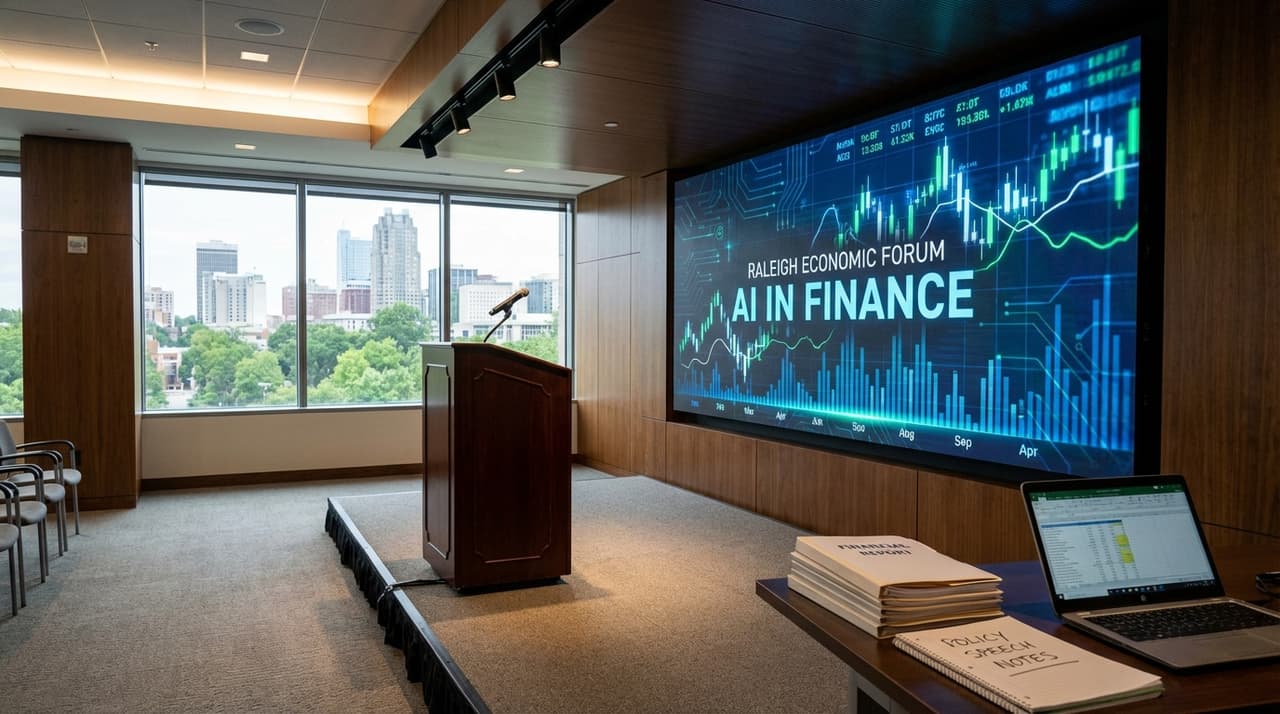
In a speech to the Raleigh, North Carolina Chamber of Commerce on January 6, 2026, Richmond Fed President Tom Barkin outlined a U.S. economy powered by two distinct forces: the artificial intelligence ecosystem fueling business investment and affluent consumers driving demand. According to people familiar with the matter, Barkin described this dynamic as "narrow" growth, with risks lingering for the Fed's dual mandates on unemployment and inflation, which have shown signs of strain in recent months.
Barkin pointed to resilience from factors like rising real wages and robust corporate earnings, but demand remains tightly linked to AI investments and stock market performance, which disproportionately benefits high-income households. "What we're seeing is a concentration in sectors like AI, where trillions in global investments are boosting stocks and enriching key spenders," he said, paraphrasing from his remarks. This has spurred regional booms, such as in North Carolina, where 87,900 jobs were added through October 2025, driven in part by AI data centers like Amazon (AMZN)'s $10 billion investment.
However, growth outside AI and tech sectors lags, raising fears of a bubble burst that could hit markets and consumption. Unemployment, while historically low, has been ticking up, with average job duration reaching 27 weeks—a level rare since the 1960s—and inflation persists above the Fed's 2% target. Efforts to restructure the economic outlook have hit a snag, as businesses adopt caution through hiring freezes rather than mass layoffs, according to sources close to the situation.
Barkin emphasized that the Fed's recent policy moves, including the December 2025 rate cut, aim to balance these challenges. Without a finely tuned approach, the economy could face embedded inflation or labor deterioration, he warned. The FOMC projects 2026 GDP growth accelerating above potential, aided by AI productivity gains and fading tariff drags, but structural shifts may slow job growth without easing price pressures.
In response to inquiries, a Fed spokesperson declined to comment beyond Barkin's speech, but economists like Wells Fargo's Tim Quinlan have echoed concerns about discouraging non-AI outlooks. Barkin relayed business optimism tempered by "foggy" uncertainty from 2025, likened to "idling with hazard lights," though AI momentum has offset slower labor supply from immigration drops and retirements.
Looking ahead, Barkin stressed monitoring unemployment ticks and resuming data post-government shutdowns for rate decisions. In the long term, AI could sustain above-potential GDP through 2028 via productivity boosts, but bubble risks threaten wealth-driven spending. The Fed's delicate balance continues, as echoed in broader discussions, such as those with SF Fed's Mary Daly on aligned 2026 outlooks.
Correction: An earlier version misstated the timing of Barkin's speech; it was delivered on January 6, 2026, not in late 2025.