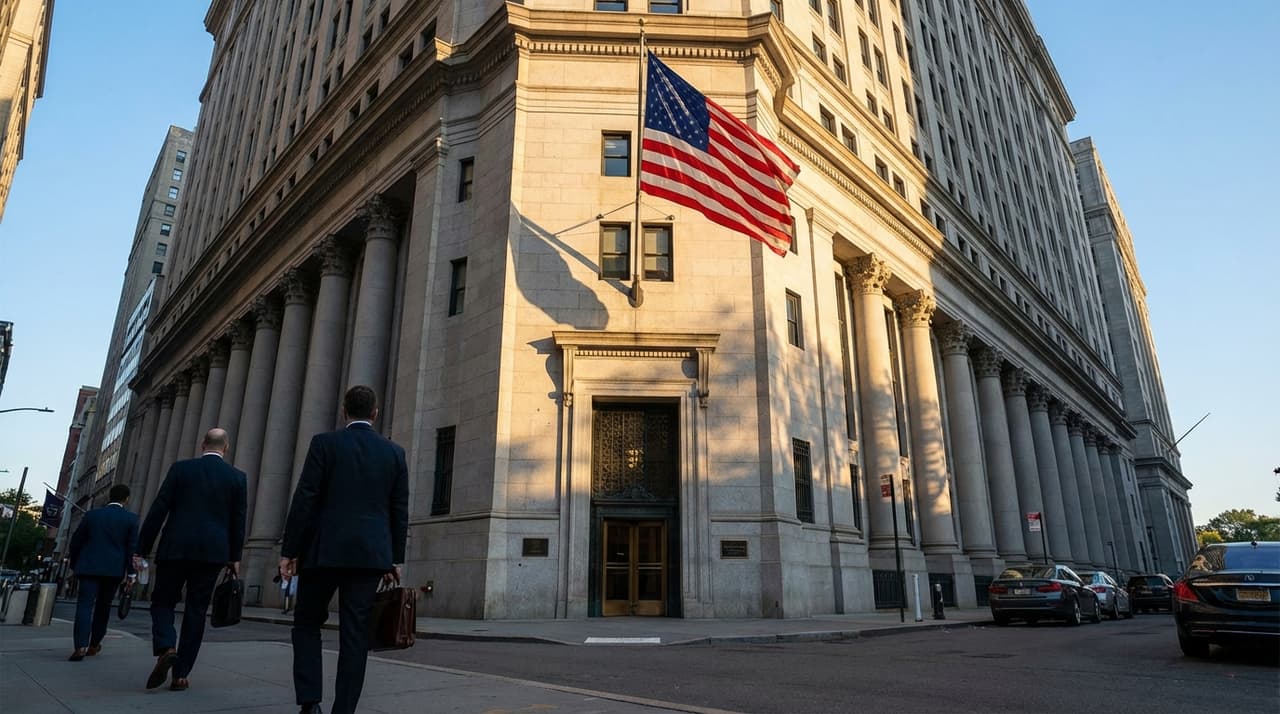
- New York Fed President John Williams indicates the Federal Reserve sees no immediate need to accelerate rate cuts or alter its current monetary policy stance.
- The Fed has already cut rates three times in 2025, lowering the federal funds rate to a 3.50–3.75% target range, with projections showing only gradual easing ahead.
- Williams' comments align with a data-dependent strategy amid cooling inflation and moderate economic growth, tempering market expectations for aggressive future cuts.
In a recent address, New York Fed President John Williams underscored that the Federal Reserve does not feel a "sense of urgency" to change its monetary policy course, reinforcing a cautious, measured approach as inflation edges closer to target levels. This stance comes after the Fed has already shifted into an easing phase, implementing three 25 basis-point cuts in 2025 to bring the federal funds rate to its lowest since 2022, according to people familiar with the matter.
Williams, who leads the largest of the 12 regional Reserve Banks, emphasized that the Fed's actions are guided by its updated framework from August 2025, which reaffirms a 2% PCE inflation goal and adopts a "flexible inflation targeting" strategy. This framework allows for a "balanced approach" when employment and inflation objectives conflict, supporting the current non-urgent tone. Recent data shows core PCE inflation has fallen to about 2.8% as of September 2025, down from over 5.5% in 2022, while GDP growth forecasts have been revised up to around 1.7% for 2025 and 2.3% for 2026, indicating a still-growing economy.
Market reactions have been muted, with investors adjusting expectations for additional rate cuts in light of Williams' remarks. The Fed's own projections, detailed in the December 2025 Summary of Economic Projections, suggest only very gradual easing in 2026, contingent on inflation moving sustainably toward 2%. Efforts to reach out to the New York Fed for further comment were not immediately successful, but sources indicate that the Fed's open-market operations continue to be managed in a stable manner, consistent with this cautious outlook.
Industry analysts note that this measured stance helps prevent excessive financial market exuberance while supporting borrowing costs for sectors like housing and business investment. However, some critics argue the Fed may be too cautious, risking unnecessary labor-market weakness, though Williams' position places him firmly in the camp favoring steady, data-driven decisions. As the Fed navigates this soft-landing scenario, its focus remains on avoiding sharp pivots and maintaining regulatory stability, with future moves likely to be meeting-by-meeting based on incoming economic indicators.