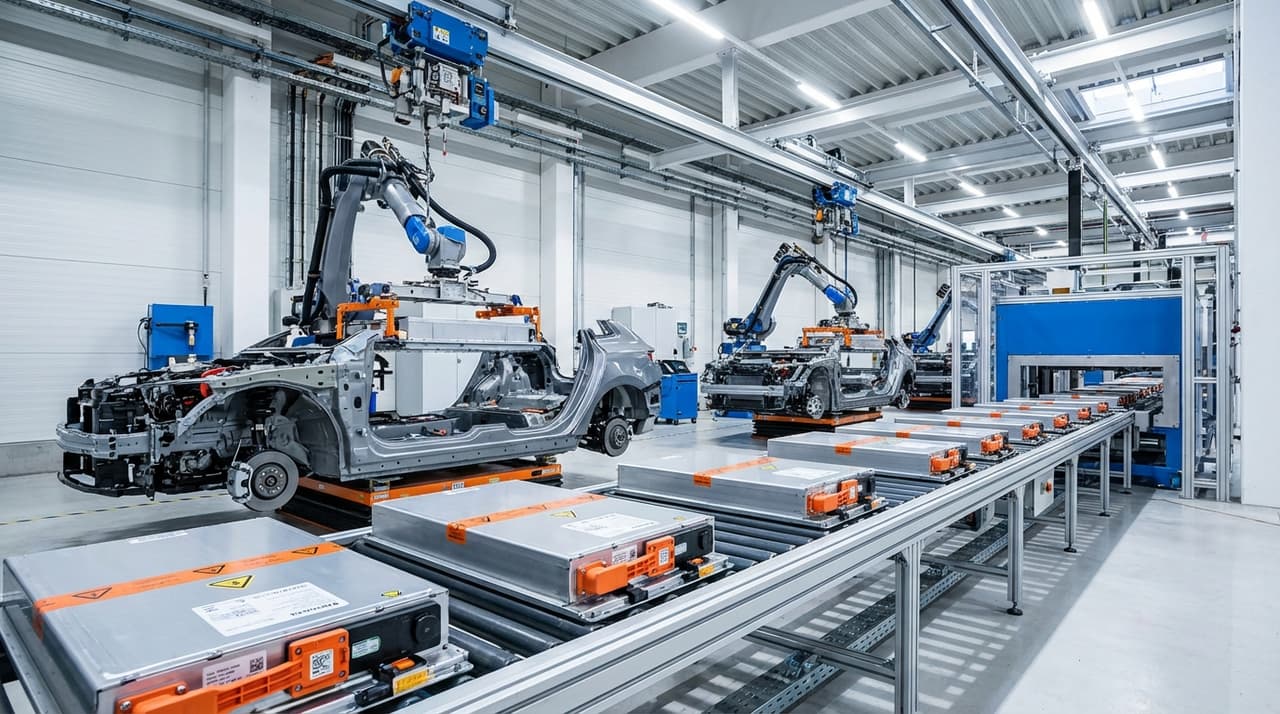
- Ford and BYD (BYDDF) are in discussions to supply hybrid-vehicle batteries for use in Ford factories outside the U.S., according to sources familiar with the matter.
- This move aligns with Ford's strategic pivot toward hybrids and extended-range electric vehicles (EREVs) to counter competition from Chinese EV manufacturers.
- The potential partnership could help Ford produce more affordable hybrids and EREVs, targeting global markets amid rising cost pressures.
Ford Motor Company (F) is exploring a partnership with Chinese battery giant BYD to source hybrid-vehicle batteries for its factories located outside the United States, as reported by sources cited in a recent Wall Street Journal article. These talks, which are still ongoing, come at a critical juncture for Ford as it recalibrates its electric vehicle strategy to better compete with low-cost Chinese rivals like BYD and Geely (GELYY).
According to people with knowledge of the discussions, the batteries would be used in Ford's hybrid and extended-range electric vehicle (EREV) production lines, primarily in regions such as Europe and Asia. This initiative is part of Ford's broader effort to accelerate hybrid development, a shift emphasized by CEO Jim Farley in response to slower-than-expected EV adoption and profitability challenges. In 2025, Ford took a $19.5 billion charge related to its EV strategy adjustments, underscoring the urgency of this pivot.
The potential deal with BYD could enable Ford to produce more cost-effective hybrids and EREVs, potentially priced under $40,000, making them more competitive in global markets. BYD, known for its advanced lithium iron phosphate (LFP) battery technology, has been a key player in the EV space, with its Blade batteries offering advantages in safety and affordability. Ford has previously collaborated with BYD through its joint venture with Jiangling Motors in China, where BYD batteries power models like the Bronco Electric SUV, featuring a 105.4 kWh LFP battery with a 650 km CLTC range.
Industry analysts note that this partnership could help Ford sidestep some of the tariffs on Chinese imports by focusing on non-U.S. factories, though it may still draw scrutiny amid ongoing U.S.-China trade tensions in the EV sector. A spokesperson for Ford declined to comment on the specifics of the talks, but the company has been actively investing in battery technology, including a $2 billion commitment to LFP battery storage aimed at achieving 20 GWh annual capacity by 2027.
In the short term, this collaboration could support Ford's Universal EV Platform, targeting mid-size pickups and EREVs by 2027, with a goal of having hybrids, EREVs, and EVs comprise 50% of its global volume by 2030. Long-term, it positions Ford to tap into growing markets like battery storage and data centers, where U.S. demand is projected to expand at a 21.62% CAGR to 131.75 GW by 2030, fueled by federal incentives such as the Investment Tax Credit.
While some stakeholders have expressed concerns about Ford "joining" Chinese technology rather than competing head-on, others view it as a pragmatic move for survival in a rapidly evolving industry. As one industry insider put it, "Without such partnerships, companies risk being left behind in the face of an onslaught from affordable Chinese models." Ford's efforts to restructure its approach have hit a snag in some areas, but this potential deal with BYD could provide a much-needed boost to its hybrid ambitions.
Correction: An earlier version of this article misstated the timeline for Ford's battery storage capacity target; it is 20 GWh annual capacity by 2027, not 2025.