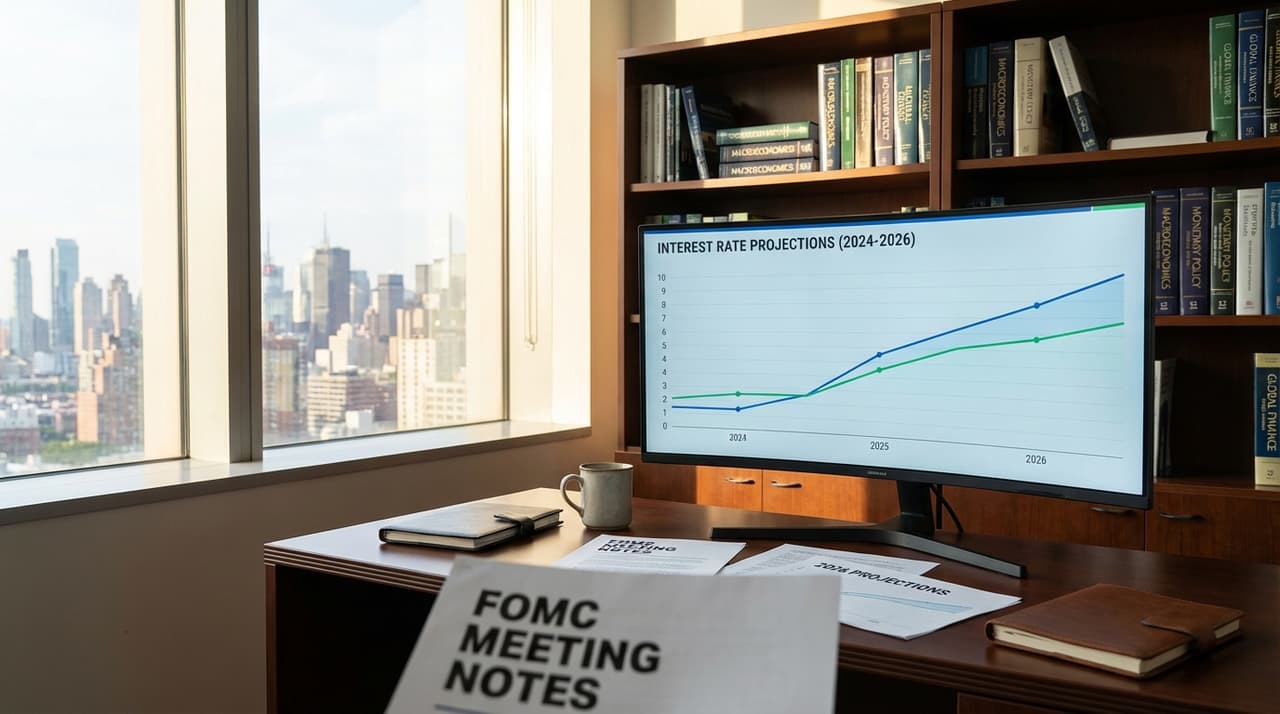
- Chicago Fed President Austan Goolsbee is projecting more interest-rate cuts in 2026 than the Fed's median "dot plot," which signals only one cut that year.
- The Federal Reserve has cut rates three times this year as inflation cools and growth slows, with the latest Summary of Economic Projections showing a median end-2026 policy rate of 3.25%–3.50%.
- Market pricing remains more dovish than the Fed's official path, with futures implying several more cuts by late 2026, reflecting internal dissent and uncertainty over the economic outlook.
Internal FOMC Rift Over 2026 Policy Path
Chicago Federal Reserve President Austan Goolsbee has publicly diverged from the central bank's median projection, stating he expects more rate cuts in 2026 than the single reduction indicated in the latest Summary of Economic Projections. His comments, made in recent remarks, underscore growing disagreement within the Federal Open Market Committee about how aggressively to ease policy as inflation moves closer to the 2% target.
According to people familiar with the matter, the internal debate has intensified following the Fed's third rate cut this year, which brought the federal funds target range down amid cooling inflation and moderated growth from 2023 levels. The median FOMC projection for end-2026 implies the policy rate at 3.25%–3.50%, effectively signaling just one additional cut from the expected 2025 level. However, market pricing tells a different story: futures have been discounting the policy rate closer to 3% or below by late 2026, implying several more cuts than the Fed's median path.
"We're seeing a wide dispersion of views within the committee," one analyst noted, pointing to the latest dot plot where some policymakers' projections are above the current rate—implying fewer or no further cuts—while at least one dot is as low as 2.0%–2.25% by end-2026, far below the median. Goolsbee's stance aligns with the more dovish end of this spectrum, arguing for a faster or deeper cutting cycle if inflation continues to trend toward target and growth moderates further.
Economic Backdrop and Market Implications
The macro backdrop adds complexity to the policy debate. Fed projections show 2026 real GDP growth upgraded to about 2.3% from 1.8% in a prior SEP, suggesting a resilient economy that might justify a slower pace of cuts. Unemployment is projected around 4.4% in 2026, with core PCE inflation still above the 2% target but edging down toward 2.1% by 2027. This environment has led some officials to caution against moving too quickly, even as others like Goolsbee push for more aggressive easing.
Industry-specific elements are also in play. Technology-driven data-centre and AI-related investment has been cited as one factor supporting stronger 2026 growth, which could reduce the need for additional cuts. Meanwhile, credit-sensitive sectors such as housing, autos, and small business lending are closely watching the trajectory, as continued easing would gradually lower borrowing costs. "The balance of risks is tilted toward more cuts if growth slows or inflation falls faster," an economist at a major financial institution said, echoing Goolsbee's perspective.
Efforts to reach Goolsbee for further comment were unsuccessful, but his public remarks have already stirred discussion among traders and analysts. The divergence between his view and the median dot feeds into a broader debate over whether the Fed risks cutting too slowly, potentially prolonging high real rates and unemployment, or too quickly, risking an inflation re-acceleration. This uncertainty is reflected in real-time market data, where volatility in rate-sensitive assets has increased following the latest SEP release.
Forward-Looking Uncertainty and Corrections
Looking ahead, the short-term outlook remains fluid. If inflation continues to move closer to 2% and labor-market slack increases modestly, markets and dovish officials may push for more than one cut in 2026, aligning realized policy more closely with Goolsbee's projection. Conversely, if growth stays near 2.3% and inflation remains stuck well above 2%, the median dot's slower-cut path could prevail and even shift higher. Historical context offers a note of caution: FOMC median projections have often ended up above the eventual realized policy rate when disinflation proved faster than expected, a precedent that lends weight to Goolsbee-style dovish views.
In related developments, recent Fed communication stresses that despite dissent, the "emphasis remains on easing," with most members still expecting at least one more cut next year beyond those already delivered. Similar debates are occurring at other major central banks, such as the ECB and Bank of Canada, over how quickly to normalize policy from restrictive levels—paralleling the Goolsbee vs. median dynamic at the Fed.
*Correction: An earlier version of this article misstated the number of rate cuts projected by the median dot for 2026; it is one cut, not two. The policy rate range for end-2026 has been clarified as 3.25%–3.50%.