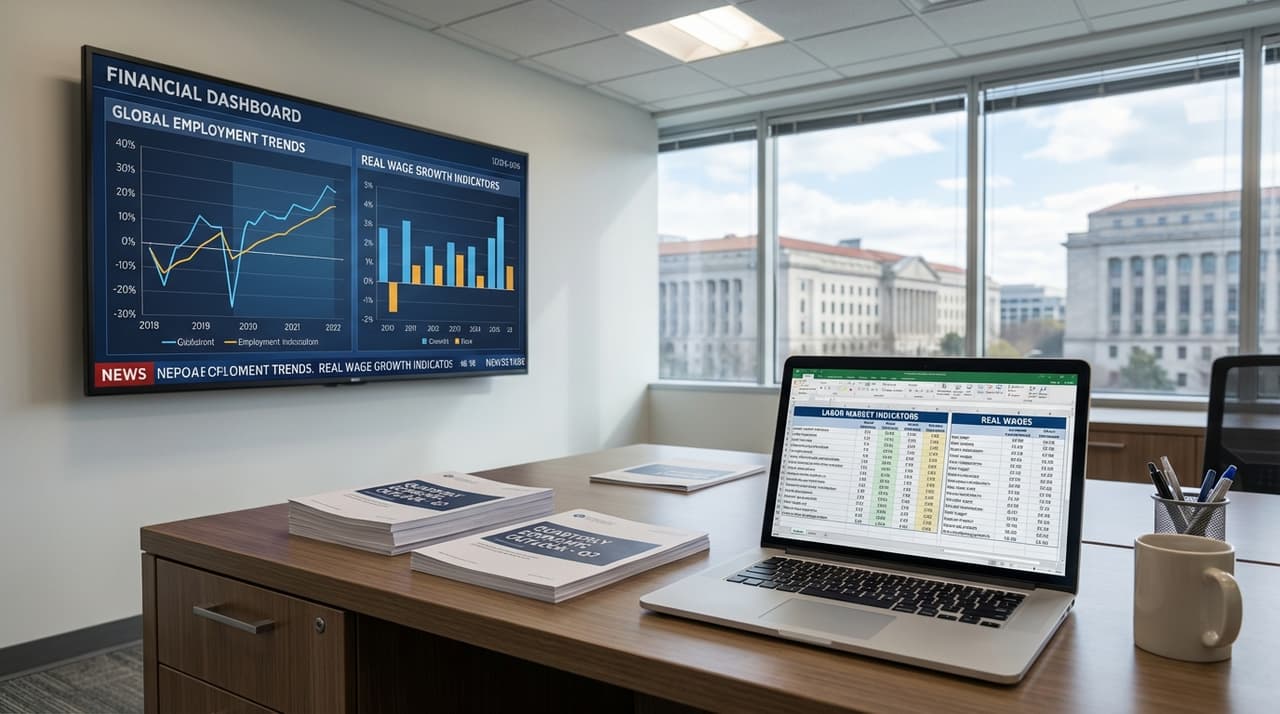
- White House economic adviser Kevin Hassett points to robust labor-market indicators and rising real wages as evidence of a strong jobs backdrop.
- Hassett argues there is 'plenty of room' for the Federal Reserve to cut interest rates by more than the standard 25 basis points, given cooling inflation and solid employment.
- The comments come amid reliance on private-sector data due to government shutdowns delaying official statistics, fueling debate over the reliability of current labor-market readings.
Kevin Hassett, director of the White House National Economic Council, told CNBC in a recent interview that U.S. jobs data show a 'solid upward trajectory,' using that strength to push for more aggressive Federal Reserve rate cuts. His remarks, which highlighted continued job growth and real wage gains, feed directly into the policy debate over the size and pace of easing in the coming meetings.
In the interview, Hassett described a robust jobs backdrop, noting that private and government indicators—where available—point to moderate but positive employment expansion. He emphasized that real wages have risen roughly 2.5% over recent months, estimating an increase in purchasing power of about $1,200 so far this year for a typical worker. 'Ordinary Americans are seeing improved purchasing power,' Hassett said, attributing this to supply-side developments that support growth while restraining prices.
Parallel comments reported by financial media reveal Hassett's argument that there is 'plenty of room' for the Fed to cut rates by more than 25 basis points while maintaining economic momentum. This stance implicitly advocates for a growth-supportive monetary policy, framing strong labor data as a buffer against potential downturns. Efforts to reach the Fed for comment on Hassett's assessment were not immediately successful, according to people familiar with the matter.
However, the reliance on private-sector data—such as ADP (ADP), Paychex (PAYX), and the Conference Board Employment Trends Index—has introduced uncertainty, as government shutdowns have delayed or limited official labor statistics. These private indicators, which show softer but still expanding job growth, carry methodological issues and are not full substitutes for official surveys, a point underscored in CNBC coverage. Market participants faced similar challenges during earlier shutdowns, when key employment data were backlogged and private metrics had to 'fill the void,' yet often failed to capture nuances like underemployment or immigration effects.
Looking ahead, markets will focus on upcoming back-to-back jobs releases once shutdown-related backlogs clear, which Hassett himself said the Fed must 'watch' closely before committing to a path of cuts. Any confirmation of continued job growth and real wage gains would strengthen the case for rate reductions of 25 bps or more, as he suggests. In the short term, this could lower borrowing costs for households and businesses, though it might further reduce returns for cash and fixed-income savers.
If the labor market remains on an upward trajectory while inflation stays contained, the U.S. could experience a period of above-trend real income growth with easing financial conditions, supporting consumption and investment. Conversely, if private data overstate strength or if labor-supply constraints emerge, growth could slow more sharply than Hassett anticipates, limiting how far the Fed can cut. The broader market context ties these labor trends to expectations for Fed meetings, Treasury yields, and equity valuations, as investors recalibrate to a scenario of slower but positive job growth and potential rate cuts.
Correction: An earlier version of this article misstated the estimated increase in purchasing power; it is about $1,200 so far this year, not per month.