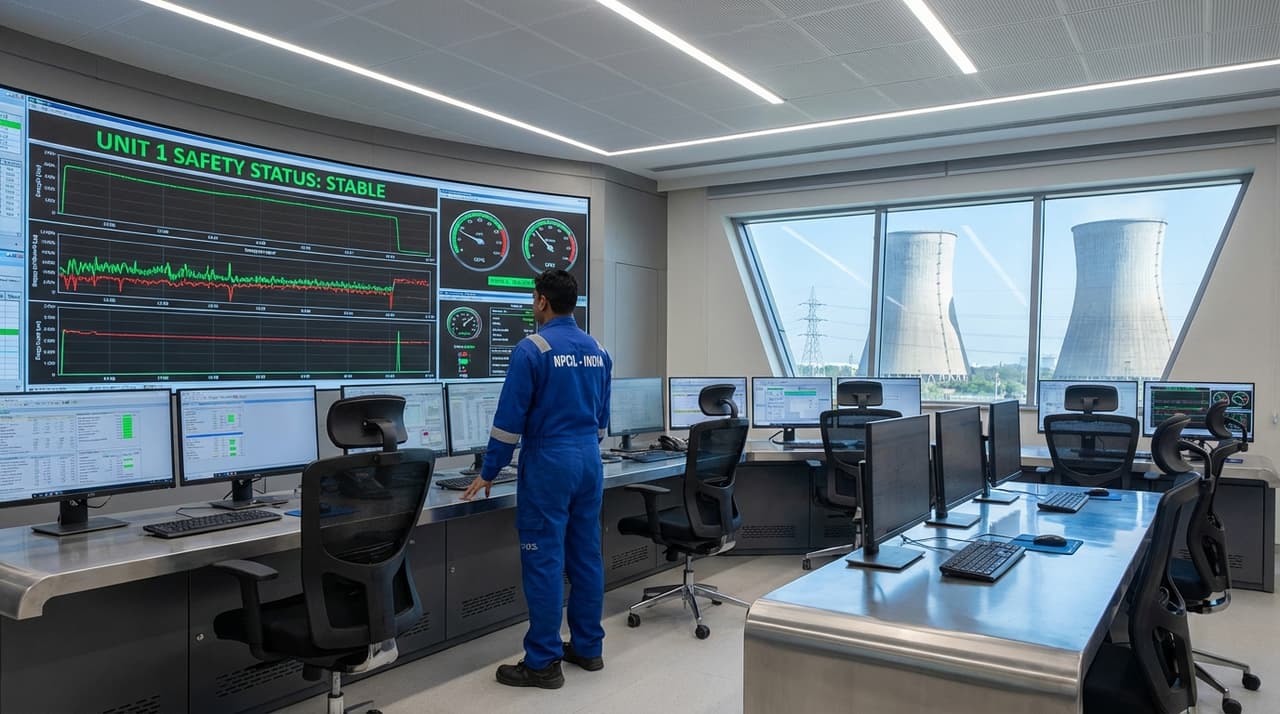
- India's Parliament passes the SHANTI Bill, capping nuclear liability at 300 million SDRs and allowing private companies to build and operate nuclear plants for the first time since 1962.
- The move aims to scale nuclear capacity from 8.7 GW to 22 GW by 2032 and 100 GW by 2047, supporting clean energy goals and energy security.
- Private investment is expected to address capital constraints in high-cost nuclear projects, with recent FDI policy amendments enabling foreign participation.
A New Era for India's Nuclear Sector
India's Parliament introduced the Sustainable Harnessing and Advancement of Nuclear Energy for Transforming India (SHANTI) Bill on December 15, 2025, marking a pivotal shift in the country's nuclear energy landscape. The legislation rewrites long-standing liability rules, capping compensation at 300 million Special Drawing Rights per incident and limiting operator liability, according to people familiar with the matter. This creates a legal pathway for private companies and joint ventures to build, own, and operate nuclear power plants, ending a state monopoly that has persisted since the 1962 Atomic Energy Act.
Efforts to restructure India's nuclear sector have accelerated in recent months, with government officials emphasizing that the bill retains state control over sensitive activities like uranium enrichment for security and non-proliferation reasons. "This is about balancing public oversight with private innovation to meet our energy targets," said one anonymous source close to the legislative process. The Atomic Energy Regulatory Board's independence is strengthened under a new two-tier licensing system, though attempts to reach out to board representatives for comment were unsuccessful as of press time.
Economic and Energy Implications
Without this deal, India would face significant hurdles in scaling nuclear capacity to support its 500 GW non-fossil fuel target by 2030 and net-zero by 2070. The bill addresses capital constraints in nuclear projects, which are notorious for high upfront costs and long timelines, by attracting private investment. Analysts note that tariff design and waste management remain ongoing challenges for investor uptake, but the move complements renewables to meet rising electricity demand. Energy experts like Deloitte's Debasish Mishra have highlighted its role in avoiding over-reliance on intermittent renewables for energy security, positioning nuclear as firm baseload power amid global clean energy shifts.
In parallel developments, the Budget 2025-26 pledged federal funds for five Indian small modular reactors (SMRs) by 2033, and FDI policy amendments explicitly allow foreign investment in nuclear energy. This aligns with global trends, where nations like the US and China are expanding private nuclear roles for decarbonization. Stakeholders include private investors gaining predictable liability, state utilities retaining core roles, and consumers potentially benefiting from stable low-carbon power. Public acceptance, safety, and waste disposal are expected to be debate points as implementation progresses.
Short-term success depends on quick notification of rules and insurance mechanisms, with experts predicting that if safety and public concerns are managed, this could reposition nuclear as a regulated clean energy pillar in India's energy mix.