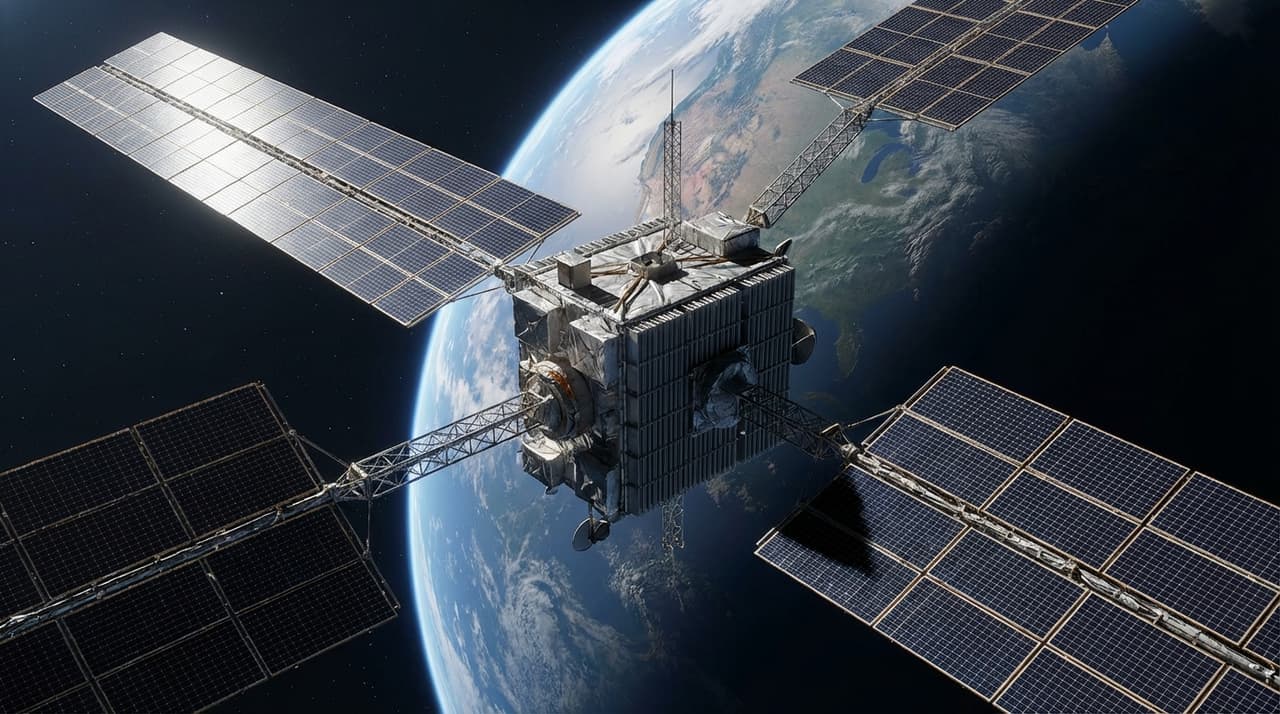
- Tech billionaires Jeff Bezos and Elon Musk are backing early efforts to deploy solar-powered, AI-focused data centers in orbit and on the Moon to overcome Earth-side constraints on power, land, and cooling.
- Google (GOOGL) has announced Project Suncatcher, targeting two prototype satellites for launch by 2027, with SpaceX providing launch capacity for these tests.
- Smaller players like Starcloud and Lonestar Data Holdings are developing off-planet storage and compute modules, while China plans an orbital AI supercomputer network, intensifying global competition.
In a bold move to address the soaring energy demands of artificial intelligence, tech leaders including Jeff Bezos and Elon Musk are racing to develop space-based data centers, according to people familiar with the matter. The initiative, driven by AI's insatiable compute needs, aims to leverage the continuous solar power and vast "land" available in orbit and on the Moon, offering a potential solution to terrestrial bottlenecks in electricity, water for cooling, and real estate.
Jeff Bezos has publicly stated that orbital data centers are the "next step" for space ventures, predicting they could beat the cost of Earth-based facilities within the next couple of decades. His vision aligns with Blue Origin's development of rockets and lunar landers, which could support building this off-planet infrastructure. Meanwhile, Elon Musk's SpaceX is providing launch services for early experiments, including Google's Project Suncatcher, leveraging reusable rockets to lower costs and enable iterative testing. Efforts to scale these prototypes have hit a snag, however, as current economics remain unfavorable, with analysts noting the projects are still at a road-mapping stage rather than full deployment.
Google's Project Suncatcher plans to deploy solar-powered AI data centers in Earth's orbit, with two prototype satellites targeted for launch by 2027. A spokesperson for Google declined to comment on specific partnerships, but sources indicate SpaceX is backing these tests. Without a viable deal for cost reduction, the company would face significant hurdles in scaling beyond prototypes. Smaller firms are also entering the fray: Starcloud is working with Nvidia (NVDA) to launch a satellite equipped with high-performance GPU compute, claiming record in-orbit compute power, while Lonestar Data Holdings focuses on lunar data storage, highlighting legal complexities around jurisdiction and data sovereignty in space.
China has announced plans for a "Three-Body Computing Constellation"—a network of 12 AI-powered satellites in low-Earth orbit to form what it calls the world's first orbital supercomputer network. This development underscores the geopolitical stakes, as space-based data centers intersect with US-China competition over AI and space dominance. Under international space law, orbital modules fall under the jurisdiction of their launching nation, raising questions about data security and cross-border regulation that remain unresolved.
Industry experts weigh in cautiously. "It's a great country to invest here because there are a lot of very good companies and the market here is not as competitive as other markets," said one executive familiar with space infrastructure, paraphrasing comments from private equity leaders. However, analysts emphasize that while space offers advantages like unlimited solar power and cooling without water, the capital costs are extreme, potentially reflecting an "AI bubble" mentality. AI-driven data centers consumed about 1.5% of global electricity in 2024, a figure expected to rise sharply, making alternative solutions increasingly attractive.
Looking ahead, the short-term focus will likely remain on prototype satellites and testing cooling, radiation hardening, and remote operation. If technical and regulatory barriers are solved, off-planet AI data centers could become a major commercial anchor for large-scale human space infrastructure. For now, stakeholders from cloud customers to local communities await developments, with public debate centered in tech and financial media amid skepticism over timelines but recognition of the long-term potential. Correction: An earlier version misstated the timeline for Google's prototype launches; they are targeted for 2027, not 2026.