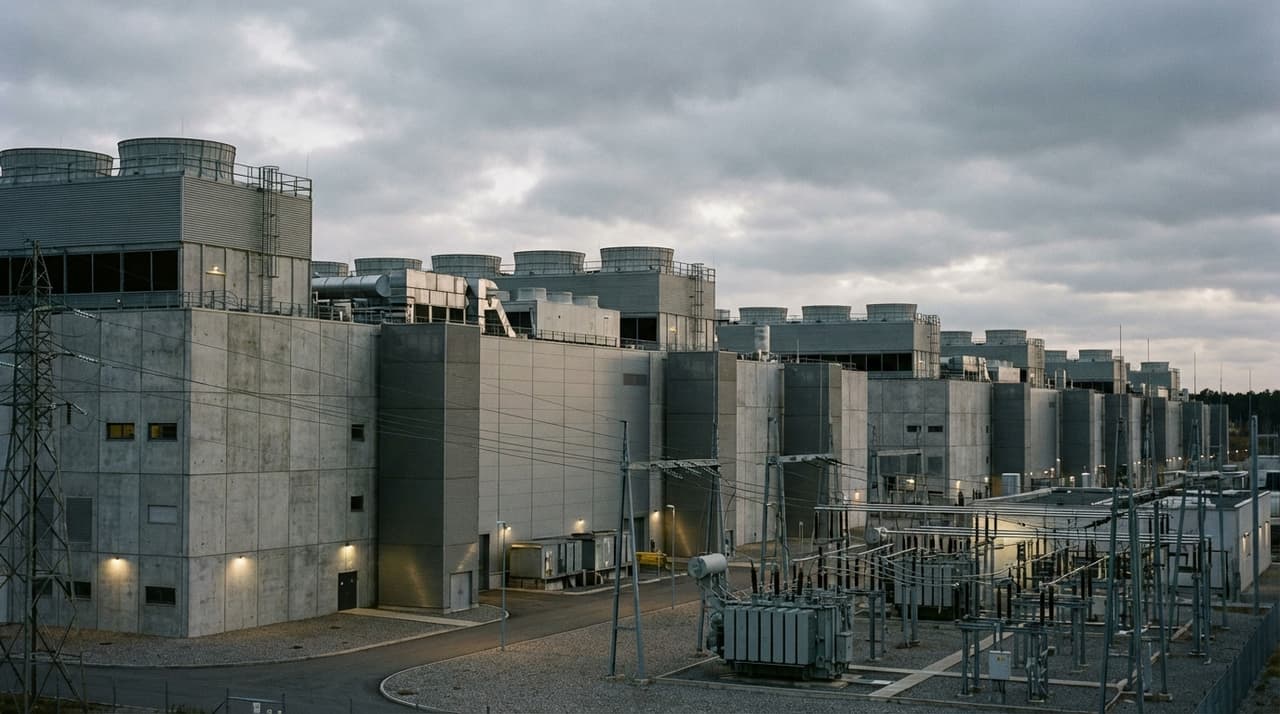
- U.S. AI firms confront a structural cost disadvantage due to higher electricity prices and grid constraints compared to China.
- The U.S. grid is emerging as a critical bottleneck, with AI's power demand outpacing infrastructure upgrades and causing delays for new data centers.
- China's subsidized power and abundant capacity create a competitive edge, though U.S. firms retain advantages in capital access and innovation.
At the Edmond de Rothschild AM 2026 investment outlook conference, CIO Benjamin Melman highlighted a growing challenge for American artificial intelligence companies: they are grappling with significantly higher electricity costs than their Chinese counterparts. According to Melman, this disparity intensifies competitive pressure and raises the overall expense of developing AI in the United States, where domestic power supply is insufficient to meet rapidly growing demand.
Household electricity prices in March 2024 averaged about $0.18 per kilowatt-hour in the U.S. versus $0.08 in China, illustrating a broad cost gap that also affects industrial and data-center users. Analysts and policymakers are increasingly pointing to energy costs and grid capacity as a new front in the U.S.-China AI race. "What we're seeing is a structural issue that could reshape investment flows," said one industry analyst familiar with the matter, who spoke on condition of anonymity. "The U.S. grid is becoming a critical bottleneck."
In China, experts report that power availability for data centers is treated as a solved problem, with abundant new capacity and fewer constraints on grid connections for AI hubs. The country's lower, more heavily subsidized electricity prices and large overbuild of renewables reduce marginal power costs for AI workloads. Solar output in early 2025 exceeded 125 terawatt-hours per month, surpassing the entire monthly output of the U.S. nuclear fleet, giving China a large pool of relatively cheap, clean power.
Meanwhile, the U.S. faces aging grid infrastructure and lengthy permitting for new transmission and generation, which delay AI-related projects and increase costs. Goldman Sachs (GS) and others warn that AI's power demand is outpacing grid upgrade cycles. Efforts to expand capacity have hit snags in some regions, with local communities raising concerns about power prices and reliability. The 2021 Infrastructure Investment and Jobs Act created programs to modernize transmission, but these investments take years to fully materialize.
Nearly half of current data-center electricity use is in the U.S. and about 25% in China, underscoring both countries' centrality in AI infrastructure. Data-center build-out is becoming a major driver of investment and GDP impact in the U.S., to the point that it is beginning to rival traditional consumer spending effects. McKinsey estimates trillions of dollars in global data-center investment between 2025 and 2030 to meet AI-driven demand.
U.S. AI developers and cloud providers face higher operating costs and delays tied to grid interconnection, potentially reducing margins or slowing expansion relative to Chinese competitors. Without more affordable and reliable power, some firms might be forced to reconsider expansion plans. "We're actively exploring partnerships with utilities and looking at on-site generation options," a spokesperson for a major U.S. cloud provider said, declining to be named due to the sensitivity of ongoing negotiations.
In the short term, U.S. firms are likely to face continued capacity constraints and higher marginal power prices in key regions, pushing them to site new data centers in energy-rich states or abroad, sign long-term power purchase agreements with renewables, or invest directly in dedicated generation like small modular reactors. Over the longer term, analysts argue the energy gap can be greatly narrowed if policymakers and tech firms accelerate grid upgrades and drive AI model efficiency improvements.
Chinese AI and cloud companies benefit from lower unit energy costs and more predictable access to power, but the model leans on state subsidies and continued heavy use of coal, with associated environmental impacts. Export controls on advanced chips limit China's access to leading semiconductors, but cheap and abundant power partly offsets this by enabling large-scale deployment of available hardware.
The International Energy Agency estimates that global data centers used 1.65 billion gigajoules in 2022 and could see energy use rise 35% to 128% by 2026, driven largely by AI workloads. As the AI boom accelerates, electricity costs and availability are set to remain a pivotal factor in the global technology landscape, with implications for innovation, investment, and geopolitical competition.
Correction: An earlier version of this article misstated the timeframe for global data-center investment estimates; it has been updated to reflect the correct period.