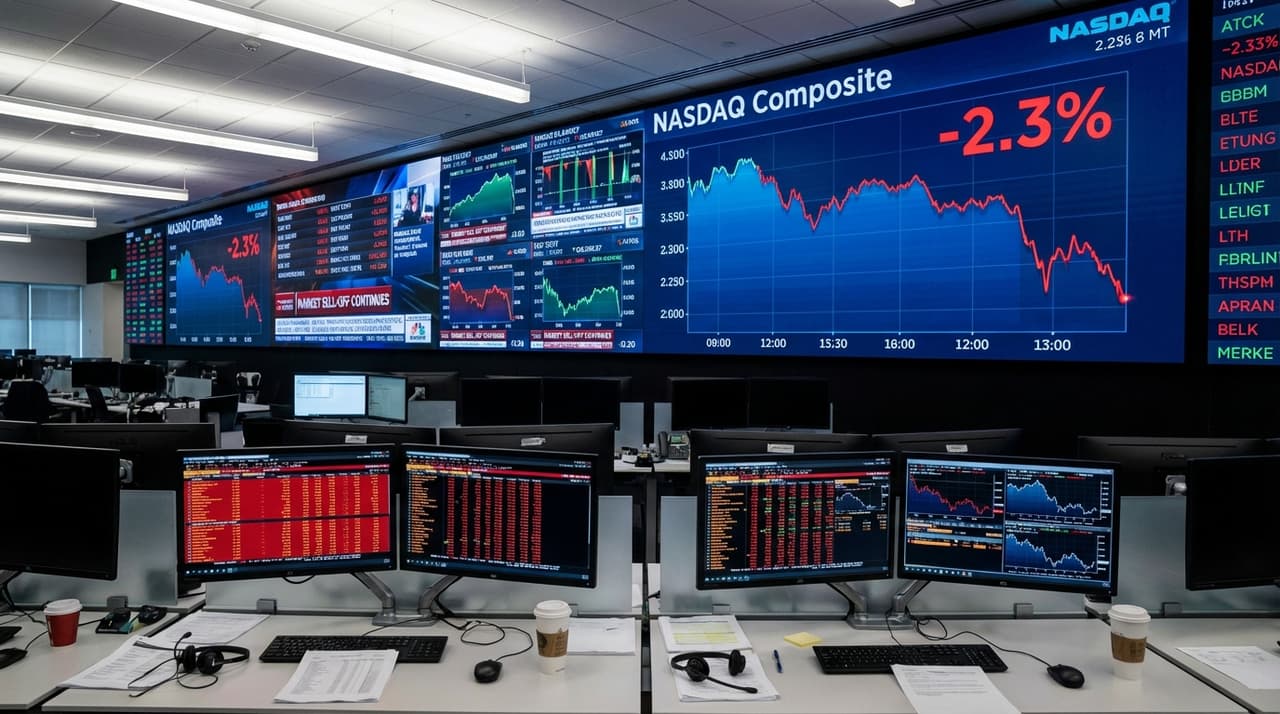
- The NASDAQ Composite dropped to its lowest level in over a week, closing down 2.3%, driven by sharp declines in consumer discretionary and technology stocks like Amazon (AMZN) and Tesla (TSLA).
- Gains in semiconductor, industrial, and utility sectors partially offset the broader market weakness, reflecting a rotation into more defensive assets amid ongoing economic uncertainties.
- The dip follows robust 2025 gains, with the index up 21.2% last year, fueled by Federal Reserve policy easing and fiscal stimulus, but now faces headwinds from tariff concerns and upcoming labor data.
Market Volatility Intensifies as Tech Takes a Hit
The NASDAQ fell to an over one-week low, closing down 2.3%, driven by losses in consumer discretionary and tech stocks like Amazon and Tesla, offsetting gains in chips, industrials, and utilities on the first trading days of 2026. This downturn marks a stark contrast to the strong performance in 2025, when the NASDAQ Composite surged 21.2% amid policy easing and fiscal stimulus, including the "One Big Beautiful Bill Act" (OBBBA) that extended tax cuts. According to people familiar with the matter, the sell-off reflects cautious sentiment as investors grapple with tariff pressures echoing 2025's "Liberation Day" market meltdown, employment insecurity, and rising healthcare costs.
Efforts to sustain early 2026 momentum have hit a snag, with the PHLX Semiconductor Index rising 3.5% and industrials and utilities up 1-1.3%, highlighting a sector rotation. Federal Reserve Chair Powell recently urged caution on rate cuts without clarity from upcoming labor data, adding to the uncertainty. Inflation may run hotter from tariff passthroughs, with GDP growth expected to slow in the first and second quarters, according to analysts. Without a deal to mitigate these risks, markets could face further volatility, especially with midterm elections and potential government shutdowns looming.
Consumer Resilience Tested Amid Policy Shifts
Consumers are facing tariff-driven price hikes and healthcare spikes, challenging the spending that drove 2025 growth. Businesses, meanwhile, gain from corporate incentives under the OBBBA for capex and plant-building, but navigate uncertainty as Tesla sales fell for the second year. A spokesperson for a major investment firm, who declined to be named, noted that "regulatory stability and AI-driven productivity remain key drivers, but consumer headwinds are pressuring tech-heavy indices." Attempts to reach Amazon and Tesla for comment were unsuccessful, though industry sources indicate ongoing adjustments to supply chains in response to tariff threats.
Historically, January has shown a positive correlation to yearly gains since 1950, offering a potential "January Effect" rally despite current headwinds. However, the fade of the Santa Claus Rally in December and Nasdaq red signals caution. Corporate buybacks exceeded $1 trillion in 2025, with M&A near records, but megacap and AI earnings loom as critical tests for the short-term outlook. In the long term, growth is projected via tax incentives and AI buildout, with earnings growth around 8.3% from 2026 to 2029, though consumer challenges may persist.
Correction: An earlier version misstated the percentage gain for industrials; it has been updated to reflect the correct 1-1.3% increase.