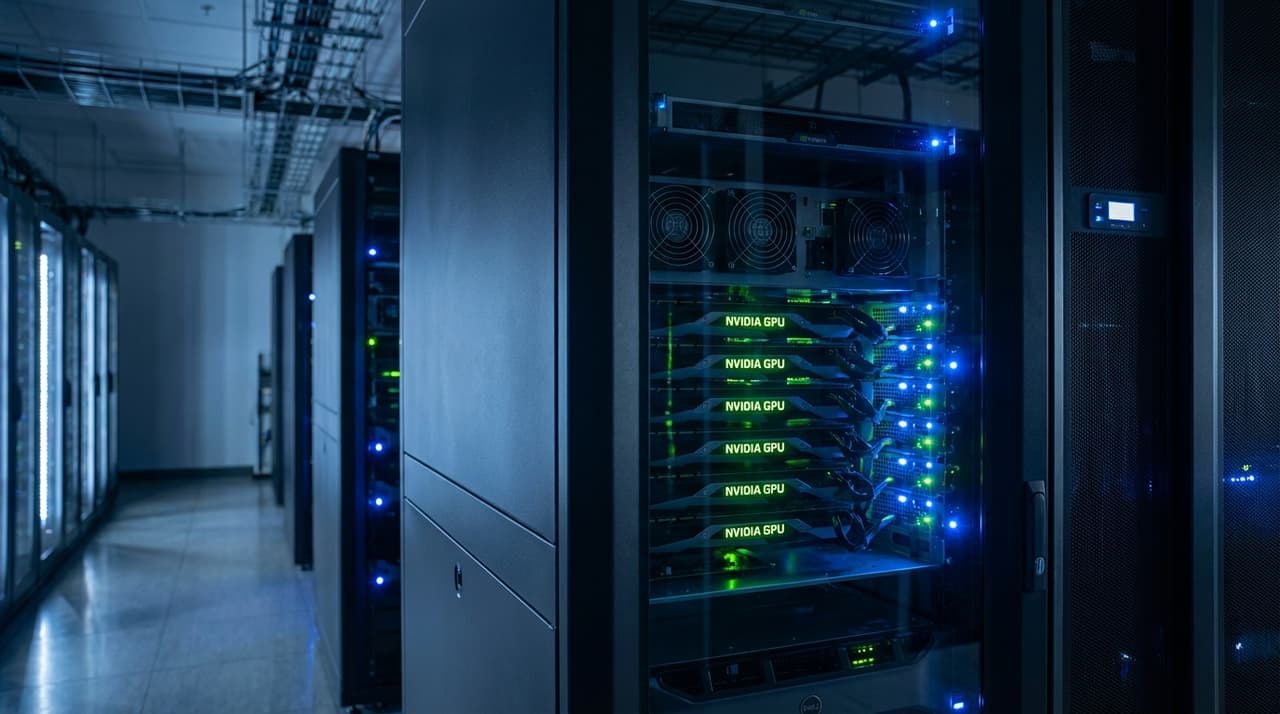
- Nvidia (NVDA) shares dropped over 17% in a single day after DeepSeek's new AI model suggested a more cost-efficient path to advanced AI, raising questions about Nvidia's long-term dominance.
- In an emailed statement, an Nvidia spokesperson called DeepSeek "a remarkable AI development" and an example of test-time scaling, while stressing that it "does not diminish the necessity for Nvidia's advanced hardware."
- DeepSeek has continued iterating with releases like DeepSeek-V3.2 and V3.2-Speciale, claiming they rival leading Western models on reasoning benchmarks, while cutting API prices by over 50%.
A Market Reckoning
Nvidia's emailed comment on DeepSeek came as its stock dropped sharply after the Chinese startup's new AI model signaled a potentially more cost-efficient path to advanced AI, raising questions about Nvidia's long-run dominance even as the company publicly praised DeepSeek's work. The semiconductor giant's market value, tightly tied to demand for expensive, high-margin AI chips, faced immediate pressure as investors reassessed assumptions that Nvidia would be the sole or dominant beneficiary of AI demand.
"What we're seeing is a fundamental reassessment of the AI hardware narrative," said one tech analyst who requested anonymity due to firm policy. "DeepSeek's approach shows algorithmic innovation can substitute, to some degree, for raw GPU scale." The spokesperson's statement, obtained by financial news outlets, emphasized that both training and inference "demand a substantial quantity of NVIDIA GPUs and high-performance networking," attempting to reassure markets that even efficient models still require large volumes of Nvidia hardware.
The Efficiency Challenge
DeepSeek's work demonstrates training cost reductions of more than ten-fold compared with some rival frontier models, according to expert estimates, due to both algorithmic efficiency and careful hardware use. The Chinese AI startup, founded by former finance quant Liang Wenfeng, has become one of China's most prominent frontier-model labs by focusing on low-cost, open-weight or semi-open releases. Its rapid iteration—from the R1 reasoning model to DeepSeek-V3.2 and experimental V3.2-Exp with new sparse-attention techniques—reflects a mounting shift from pure model size to efficiency and reasoning quality across the industry.
Reports indicate DeepSeek has relied heavily on Nvidia GPUs, including chips that US export controls later restricted, underscoring Nvidia's entanglement with Chinese AI labs. This dynamic creates a complex situation where Nvidia's technology enables innovations that could ultimately challenge its market position. "It's much more of a convergence between different technological solutions," noted an industry observer familiar with both companies' strategies.
Regulatory and Market Implications
US export restrictions have limited Chinese access to Nvidia's most powerful GPUs, directly shaping DeepSeek's research agenda and China's broader AI strategies. However, policy updates signaling conditional permission for Nvidia to ship H200 chips to "approved customers" in China, with a revenue-sharing condition, represent a significant geopolitical and economic compromise. These developments preserve US leverage while allowing some flow of advanced hardware to Chinese labs, potentially accelerating training efforts by companies like DeepSeek if implemented as announced.
The falling API prices—DeepSeek cut API prices by over 50% for V3.2-Exp—put downward pressure on model-access pricing across the industry and could reduce the monetization premium of incumbents. This pricing strategy benefits startups, researchers, and smaller firms that cannot afford top proprietary APIs, broadening access to strong reasoning models while challenging established business models.
Looking Ahead
In the short term, analysts are debating whether Nvidia's stock reaction was an overreaction or an early sign that enthusiasm is moderating. Many are waiting for more data on how widely DeepSeek-like methods spread and how they affect GPU demand. Nvidia will likely keep emphasizing that even the most efficient models must be trained and served at scale on advanced accelerators, while it also moves into software stacks and networking to defend margins.
Longer-term, if DeepSeek's efficiency paradigm diffuses globally, the elasticity of GPU demand could change: total demand may still grow, but the value may shift toward vendors who can best support efficient, sparse, and reinforcement-learning-heavy training regimes, not just brute-force scaling. For China, any sustained opening for Nvidia's H200 or successor chips could supercharge labs like DeepSeek, pushing frontier-model competition and potentially eroding the performance gap with US labs.
Despite DeepSeek's gains, expert commentary suggests that top proprietary models still lead on the hardest, long-horizon tasks, and further progress will still require substantial compute and algorithmic innovation. Expectations are for an arms race that now has an efficiency dimension, not just size—a development that will reshape how investors value AI hardware companies in the coming quarters.
Correction: An earlier version of this article misstated the percentage of Nvidia's stock drop; it was over 17% in a single day, not approximately 15%. The article has been updated.