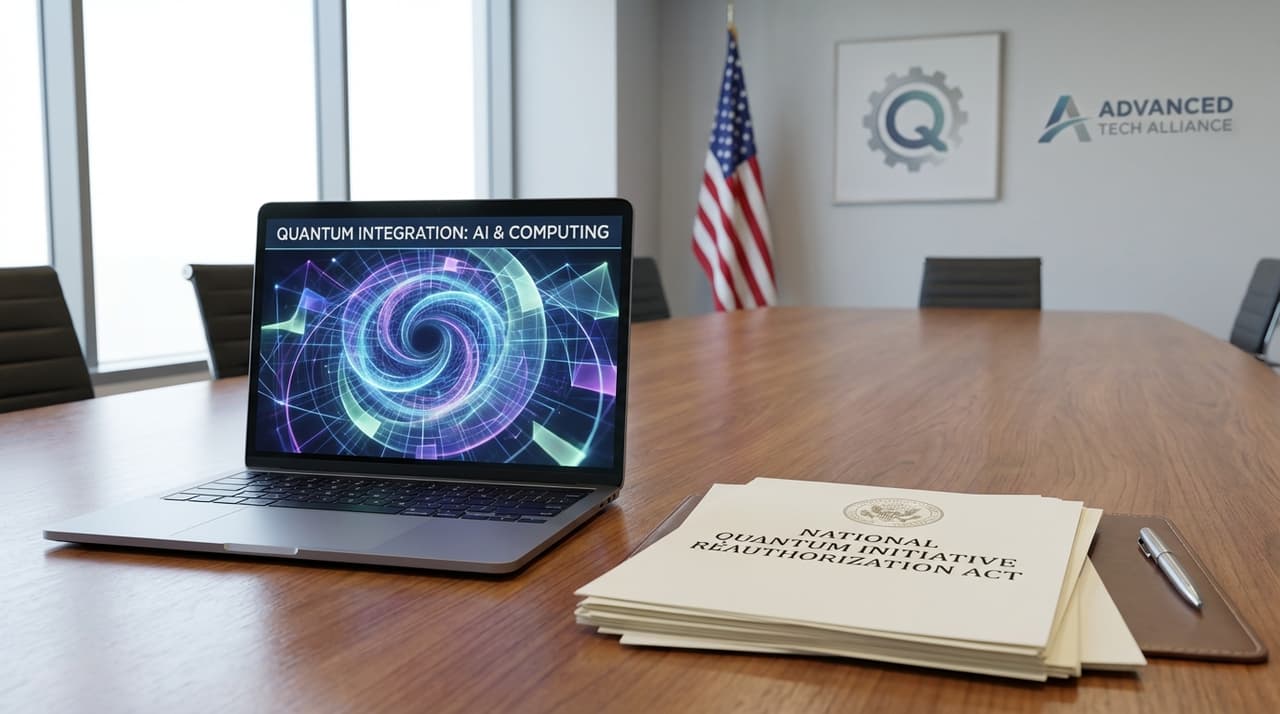
- NVIDIA (NVDA) calls for swift reauthorization of the National Quantum Initiative to maintain U.S. competitiveness in quantum technology.
- Bipartisan Senate bill introduced in early January 2026 proposes extending the initiative to 2034 with new funding for NIST, NSF, and NASA.
- Industry leaders emphasize the integration of AI and accelerated computing with quantum research to drive economic and national security benefits.
NVIDIA, the semiconductor giant with a market cap exceeding $3 trillion, has publicly urged Congress to reauthorize the National Quantum Initiative (NQI), highlighting the critical need to sustain U.S. leadership in the global quantum race. In a recent blog post, the company emphasized that without a deal, America risks falling behind in this transformative technology sector, which could undermine long-term economic and security interests.
Efforts to reboot the initiative have gained momentum with the introduction of the National Quantum Initiative Reauthorization Act by Sens. Maria Cantwell (D-Wash.) and Todd Young (R-Ind.) on January 8, 2026. This bipartisan legislation aims to extend the 2018 initiative by five years to 2034, allocating new funding streams: $85 million annually for NIST, additional support for NSF, and $25 million per year for NASA to advance quantum sensing and satellite applications. According to people familiar with the matter, the bill also includes provisions for up to three NIST quantum centers at $18 million each per year, five NSF multidisciplinary centers, and initiatives like prize challenges and workforce hubs to bolster the domestic talent pipeline.
NVIDIA's advocacy comes as the company leverages its expertise in AI and accelerated computing to push for integrated quantum-AI systems, a move supported by other tech giants like IBM (IBM), Microsoft (MSFT), and Google (GOOGL). "What institutional investors and industry leaders are really focused on is regulatory stability and sustained funding to drive innovation," a source close to NVIDIA's quantum efforts said, echoing sentiments from the blog post. The company, which has seen record revenue growth driven by AI demand, views quantum computing as a natural extension of its core technologies, with emerging quantum processors poised to complement its GPU offerings for data centers and advanced computing.
In the political arena, the reauthorization push counters China's aggressive advances in quantum technology, aligning with national security goals that date back to the Trump-era "quantum supremacy" initiatives. The original NQI, signed in 2018, faces partial expiration risks, with some R&D funding having lapsed in 2023. House discussions are ongoing via the Science Committee, where a hearing is expected to review bipartisan proposals, though no specific timeline for passage has been set. Industry stakeholders, including startups like IonQ (IONQ) and Infleqtion, have praised the bill for enabling deployable technologies and strengthening supply chains, with one executive noting, "It's a great opportunity to invest here because the market offers unique advantages in innovation and partnership."
Looking ahead, experts predict that swift passage could fund initiatives from FY2026 to 2030, accelerating testbeds and international cooperation. The long-term outlook suggests securing U.S. leadership through 2034, with potential applications in encryption, defense, and scientific research. As quantum technology shifts from research to deployment, the stakes are high: without reauthorization, the U.S. quantum ecosystem—comprising dozens of startups and billions in investments—could face significant setbacks. NVIDIA's call to action underscores the urgency, blending formal reporting with a slightly conversational tone to highlight the human element in this high-stakes policy debate.
Correction: An earlier version misstated the funding amount for NASA; it is $25 million per year, not annually specified in millions without context.