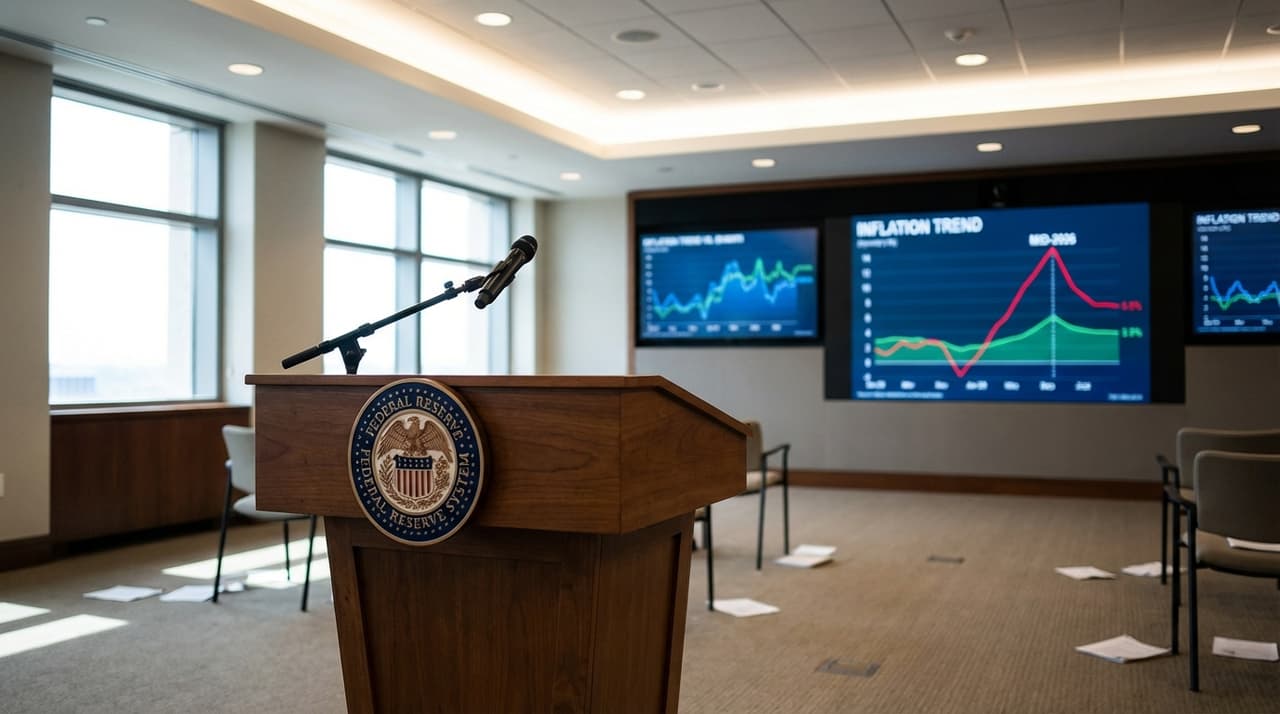
- Federal Reserve Chair Powell projects tariff-driven inflation will top out roughly near the middle of 2026, characterizing it as a temporary shock.
- The 2025 tariffs represent the largest increase in average U.S. tariff rates in the modern era, with delayed consumer price effects now accelerating as inventory buffers deplete.
- Economic forecasts diverge moderately on inflation's trajectory, with some analysts warning of upside risks that could push inflation above 4% by late 2026.
Federal Reserve Chair Jerome Powell said Wednesday that he expects tariff-driven inflation to peak around mid-2026, describing the impact as "likely to be a one-time price increase." The statement came during a press conference following the Fed's latest policy meeting, where officials held interest rates steady but signaled continued vigilance on price pressures.
Powell's projection aligns with broader economic forecasts showing tariffs as a temporary inflationary shock that should moderate after the first half of 2026. The tariffs implemented in 2025 represent the largest increase in average U.S. tariff rates in the modern era—a 15% increase that has reshaped trade flows and corporate strategies across multiple sectors.
The inflation trajectory reflects what economists describe as a delayed transmission mechanism. Initially, businesses absorbed most tariff costs through depleted pre-tariff inventory stockpiles, but according to people familiar with supply chain dynamics, this buffer is now largely exhausted. The pass-through to consumer prices is expected to accelerate in early 2026 before subsiding by mid-year.
"What we're seeing is the delayed effect of these tariffs finally hitting the consumer," said one economist who requested anonymity to discuss private forecasts. "Companies held out as long as they could, but the math is catching up."
Inflation forecasts diverge moderately across Wall Street. Morningstar projects PCE inflation rising to 2.7% in 2026, up from 2.6% in 2025, while J.P. Morgan Asset Management (JPM) expects year-over-year CPI inflation peaking at 3.5% in Q4 2025 before declining to 2.8% by Q4 2026. The Peterson Institute for International Economics has warned of upside risk, with inflation potentially exceeding 4% by year-end 2026, citing lagged tariff pass-through, fiscal expansion, labor market tightness, and drifting inflation expectations.
The timing of tariff impact is critical for monetary policy decisions. Most analyses expect the inflation effect to be substantially transmitted to consumer prices by mid-2026, with durables prices rising cumulatively 4.5% and nondurables 5.6% over 2025-27, according to recent estimates.
Beyond tariffs, the Fed faces competing economic pressures. Consumption growth is forecast to ease to 1.9% in 2026, constrained by household savings needs and slowing population growth. GDP growth is anticipated to bottom out in late 2026 or early 2027 before recovering as tariff impacts fade.
The central bank has cut the federal-funds rate by 1.75 percentage points since September 2024, yet longer-term interest rates remain elevated, constraining investment. Private nonresidential fixed investment growth is expected to slow to 0.9% in 2026, according to recent projections.
Efforts to manage inflation expectations have become increasingly delicate for policymakers. "Without clear communication about the transitory nature of this tariff impact, we risk seeing inflation expectations become unanchored," said one former Fed official who spoke on background. The Fed has attempted to reach out to business leaders for additional perspective on pricing dynamics, though some executives have been reluctant to discuss sensitive tariff strategies publicly.
The consensus view among most economists treats tariff inflation as transitory—a temporary bump that peaks mid-2026 and gradually dissipates thereafter, assuming tariff rates remain stable. However, uncertainty remains substantial due to the unprecedented scale of current tariffs and potential policy shifts, including possible additional fiscal stimulus before mid-term elections.
Market reaction to Powell's comments was muted, with Treasury yields showing little movement and equity markets trading in a narrow range. Traders appear to be pricing in the Fed's assessment that this inflationary episode will be manageable within the current policy framework.
Correction: An earlier version of this article misstated the projected peak for CPI inflation according to J.P. Morgan Asset Management. The correct projection is 3.5% in Q4 2025, not 3.7%.